
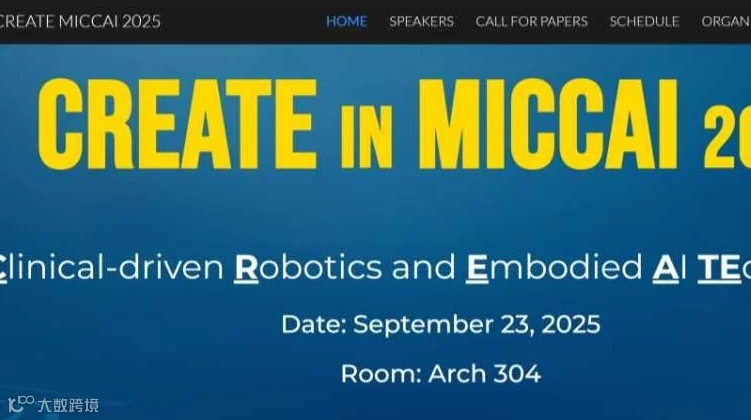
具身人工智能与机器人医疗研讨会
 导航
导航152****0293

作为国际顶级的人工智能医疗科技领域会议,MICCAI 一直致力于将人工智能和机器人的最新技术应用于医疗健康领域。中国科学院香港创新研究院人工智能与机器人创新中心(CAIR)联合科技与医疗等领域多位专家共同组织2025年9月23日的「具身人工智能与机器人医疗研讨会」,欢迎投稿!
The CREATE workshop (Clinical-driven Robotics and Embodied AI TEchnology) aims to bridge the gap between clinical needs and technological innovations by fostering collaboration among researchers, clinicians, and engineers. By focusing on the synergy between embodied AI, including breakthroughs in Large Language Models (LLMs) and robotics, the workshop seeks to drive innovations that deliver tangible benefits to healthcare, such as enhanced precision, adaptability, and standardization in surgical procedures, ultimately leading to better patient outcomes.
CREATE workshop
https://sites.google.com/view/create-miccai-2025
Paper Submission Link:
https://openreview.net/group?id=MICCAI.org/2025/Workshop/CREATE
Call for Papers
TheCREATEworkshop is proposed as a multidisciplinary forum, where leading researchers will present their latest work in embodied AI and robotics.
We invite topics related to medical imaging and efficient medical modeling which include but are not limited to:
-
Clinical-Driven Challenges in Surgery:Identifying and addressing real-world clinical problems that can benefit from embodied AI and robotics. By involving clinicians, the workshop aims to ensure that technological developments are aligned with pressing needs in patient care, surgical workflows, and healthcare delivery.
-
Clinical-Driven Embodied AI:Exploration and development of AI systems designed to meet specific clinical demands. This includes creating AI solutions that integrate seamlessly into healthcare environments, adapt to the complexities of medical workflows, and provide meaningful support to surgeons and clinicians.
-
AI-Driven Robotics for Surgical Applications:Development of robotic systems that leverage AI to enable autonomous or semi-autonomous functioning, support clinical decision-making, and facilitate procedural learning in surgical settings.
-
Intelligent Surgical Assistants:Design and refinement of robotic systems capable of perceiving, interpreting, and interacting with their environment to provide real-time assistance during surgery. These systems aim to enhance surgeons’ capabilities, improve workflow efficiency, and contribute to safer and more effective procedures.
-
Human-Robot Collaboration in Surgery:Innovations in natural language processing, machine learning, and embodied AI to enable intuitive communication and effective collaboration between surgeons and AI-powered robotic systems. This includes fostering trust and usability in surgical environments.
-
Foundation Models for Surgical Applications:Development and application of large-scale multimodal foundation models in surgery. These models leverage diverse data modalities, such as surgical videos, medical imaging (e.g., ultrasound, CT, MRI), and electronic health records, to support surgical workflow analysis, personalized planning, real-time guidance, and post-operative assessment.
-
AI-Augmented Operating Rooms:Exploring how AI can be integrated into operating rooms to enhance workflow efficiency, improve patient safety, and optimize surgical outcomes. This includes real-time data processing, predictive analytics, and AI-driven decision-making tools to support surgical teams.
Scientific Speakers
Jiebo Luo
ACM/AAAI/IEEE/NAI/AIMBE/
IAPR/SPIE Fellow

Nassir Navab
Full Professor, Technical University of Munich
Director of the Laboratory for Computer Aided Medical Procedures, Technical University of Munich and Johns Hopkins University.
IEEE/MICCAI/AIMBE/AAIA Fellow
S. Kevin Zhou
Hongbin Liu
Director, CAIR-HKISI-CAS
Professor and Director of the group for intelligent technology for minimally invasive surgery at Institute of Automation, Chinese Academy of Sciences (CASIA)
Hongliang Ren
Professor, The Chinese University of Hong Kong (CUHK)
Health Longevity Catalyst Award by the National Academy of Medicine (US)
NUS Engineering Young Researcher Award
Nicolas Padoy
Professor of Computer Science,
the University of Strasbourg
Director of Computer Science and AI Research at IHU Strasbourg, MICCAI Fellow
Qi Dou
Assistant Professor, The Chinese University of Hong Kong (CUHK)
NSFC Excellent Young Scientists Fund (Hong Kong & Macau)
MICCAI Young Scientist Publication Award, 2022.
Clinical Speakers
Danny Tat Ming CHAN
Consultant, The Prince of Wales Hospital of Hong Kong
Head of Division of Neurosurgery, Prince of Wales Hospital
Associate Director, CUHK Otto Wong Brain Tumour Centre

Shiro Horisawa
Do Hyun Nam
Organizers
Hongbin Liu, Director of CAIR, HKISI, CAS
Gaofeng Meng, Deputy Director of CAIR, HKISI, CAS
Zhen Lei, Professor of CAIR, HKISI, CAS
Jinlin Wu, Research Assistant Professor of CAIR, HKISI, CAS
Mingyang Zhao, Research Assistant Professor of CAIR, HKISI, CAS
Links and Contact
CREATE workshop
MICCAI2025
声明:本页面所有信息均由商家提供,大数跨境仅提供技术支持