




某在先商标阻碍了我方客户的商标申请,因此我们针对该在先商标本身提起了抗辩。
关联理由驳回,并不必然意味着在后申请人只能选择放弃。
有时候更值得思考的问题是: 该在先商标,对于造成驳回障碍的商品类别而言,是否仍然具备可执行力?
我们近期在瑞典处理过一起此类案件。
我方客户的商标申请,因一件已注册在先商标被予以驳回。
我们并未局限于协商共存、缩小商品范围或者就商标近似度展开辩论,而是对该在先商标的实际使用情况开展了分析。
分析得出了关键性结论: 该在先注册商标虽已注册满五年以上,但经我们核查,商标权人并未针对阻碍客户申请的那部分商品进行真实商业使用。
据此,我们以连续不使用为由提起商标撤销程序。
商标权人对该注册进行抗辩,并提交了商标使用证据。 但提交的证据印证了我们的预判: 该商标仅在部分商品上存在使用行为,并未在与我方客户申请相冲突的商品上实际使用。
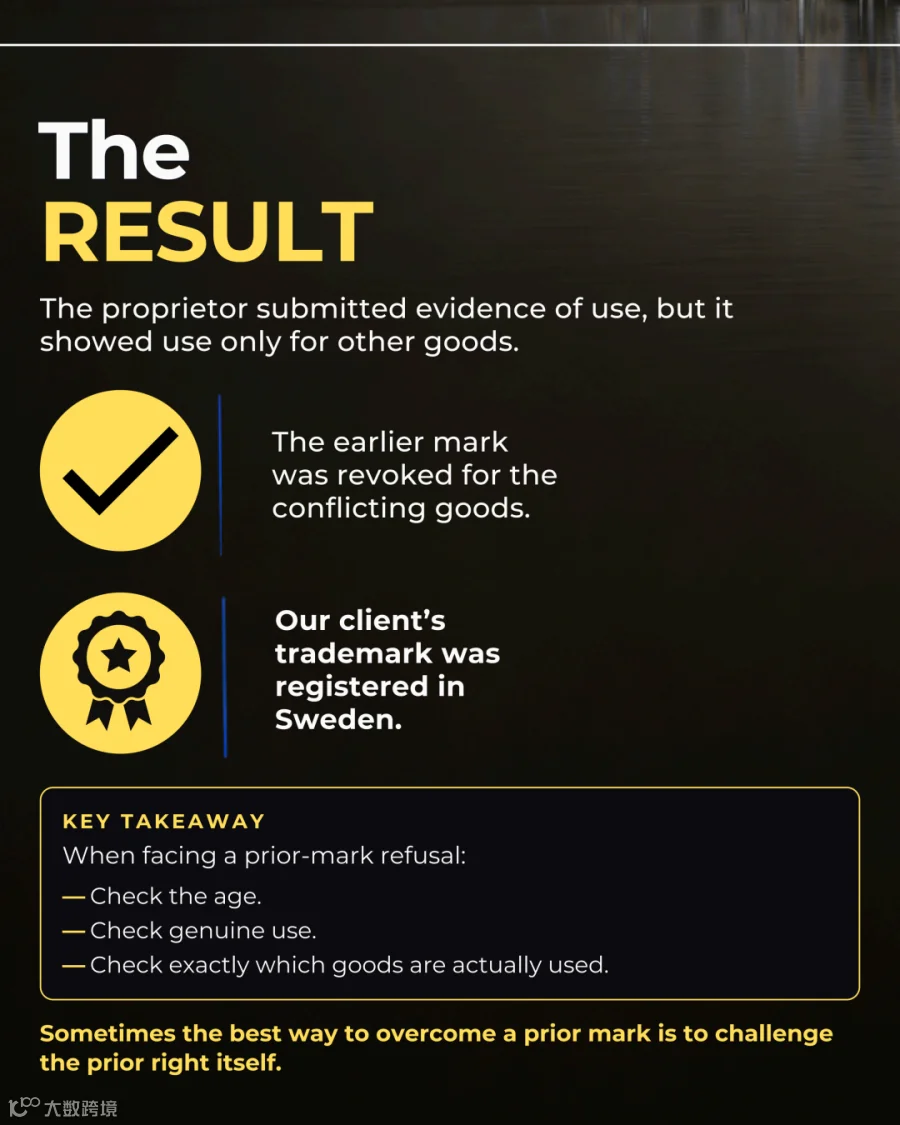
最终,该在先商标就该部分冲突商品被予以撤销。
带来的实际结果是什么? 阻碍申请的障碍就此消除,我方客户的商标顺利在瑞典完成注册。
该案带来重要实务启示:当商标申请被援引在先商标予以驳回时,分析工作不能仅停留在判断 “两件商标是否构成近似”。
还应当同步核查以下要点:
→ 该在先商标注册时长多久?
→ 是否存在因不使用被撤销的风险?
→ 有证据证明商标真实使用的具体是哪些商品?
→ 前述使用商品,是否正是阻碍新商标申请的那部分商品?

面对在先商标驳回,最高效的应对方式,有时并非去争辩商标近似的判定结论,而是直接消除产生权利冲突的在先商标权利本身。
(以下为英文版)
A prior trademark blocked our client’s application. So we challenged the prior mark itself.
A relative grounds refusal does not always mean that the later applicant has to give up.
Sometimes, the better question is:
Is the earlier mark actually still enforceable for the goods that are causing the problem?
We recently handled such a case in Sweden.
Our client’s trademark application faced a refusal based on an earlier registered mark.
Instead of looking only at coexistence, limitation or argumentation on similarity, we analysed the actual use of the earlier mark.
The result was important.
The earlier registration had already been on the register f or more than five years, but our analysis indicated that the proprietor was not genuinely using the mark for the goods that were blocking our client’s application.
We therefore initiated revocation proceedings for non-use.
The proprietor defended the registration and submitted evidence of use.
But the evidence confirmed what we had expected:
the mark was being used for certain goods, but not for the conflicting goods relevant to our client’s application.
As a result, the earlier registration was revoked in relation to those goods.
And the practical consequence?
The obstacle disappeared and our client’s trademark proceeded to registration in Sweden.
This is a useful reminder that when a prior mark is cited against an application, the analysis should not stop at:
“Are the marks similar?”
It should also include:
→ How old is the earlier registration?
→ Is it vulnerable to non-use?
→ For which goods is genuine use actually shown?
→ Are those the same goods that are blocking the new application?
Sometimes the most effective response to a prior mark refusal is not to fight the similarity assessment itself.
It is to remove the right that creates the conflict.

素材来源:单个国家或联盟知产局/官方媒体/网络新闻
