
加拿大安大略省注册会计师协会近日宣布,德勤加拿大公司(Deloitte LLP)将因违反《安大略注册会计师职业行为准则》(第501和502规定)而支付159万加拿大元(115万美元,折合人民币841万元)的罚款和费用。第501条规定涉及事务所在遵守专业标准方面的政策和程序维护,第502条涉及事务所在事务所成员的能力和行为方面的政策和程序维护。
新闻稿中称:
2016年11月至2018年5月期间,安大略省的多名德勤审计师更改了计算机上时钟的日期和时间设置,手动规避了德勤审计软件中的控制措施,并追溯了审计工作底稿的签章。在此期间,至少有39项审计业务的930多份审计工作底稿被追溯。
加拿大安大略省注册会计师协会网站公布的和解协议提供了更多信息:
某些德勤审计从业人员发现有机会规避2016年11月7日审计业务管理系统(EMS)更新所施加的新限制,并开始调整其计算机上的时钟,以追溯审计工作底稿的签核日期。
审计业务中的一些实习生、员工、经理、业务合伙人和业务质量控制审查合伙人在为私营和公共实体执行鉴证业务的过程中将其计算机时钟更改为追溯签核。这种行为一直持续到2018年3月。
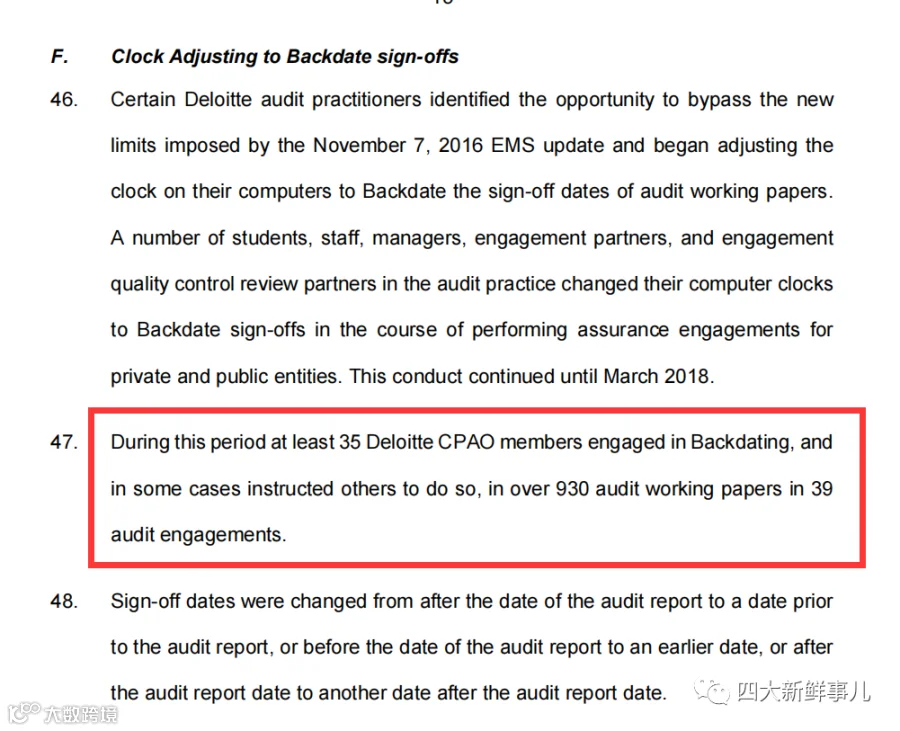
在此期间,至少有35名德勤安大略省注册会计师成员在39项审计业务中的930多份审计工作底稿中进行了倒签。在某些情况下,他们还指示他人进行倒签。
他们将签核日期从审计报告日期之后改为审计报告日期之前,或从审计报告日期之前改为更早的日期,或从审计报告日期之后改为审计报告日期之后的另一个日期。

根据和解协议,是该公司自己向安大略注册会计师报告,其一些合伙人和专业人员在许多审计工作文件中更改了签字日期。调查始于2019年9月,最终于9月达成和解。2016年之前,Deloitte Canada的审计业务管理系统允许用户手动选择审计工作文件的签字日期。

和解协议为我们介绍了这一变化的背景:
针对上市公司会计监督委员会发现的一起存档审计文件在加拿大境外被不当篡改的事件,德勤(Deloitte Touche Tohmatsu Limited,简称“DTTL”)要求其全球成员,包括德勤加拿大,在2016年10月底之前与所有审计合伙人召开一次以审计质量和完整性为主题的强制性电话会议。
新程序将默认签署日期设置为用户电脑上的日期,在启用新程序之前,德勤全国办事处与合作伙伴进行了电话沟通,告知他们这一变化。
德勤国家办事处首先介绍了电话沟通的监管背景,并提到:
(a)PCAOB对诚信的重视,以及PCAOB最近的公开声明,即诚信“与审计质量问题一样重要,甚至比审计质量问题更重要”;
(b)迄今为止,PCAOB发布的许多涉及不合作的纪律命令都包括不当更改文件;
(c)PCAOB检查员在PCAOB检查前不久或检查期间发现了创建文件的证据,这些文件被追溯日期并在没有披露创建时间的情况下提供,从而导致公司因在检查过程中不当删除、添加或更改文件而受到处罚。
随后,德勤国家办事处表达了德勤对PCAOB发现的此类行为的零容忍政策,重点介绍了最近推出的DTTL归档和取证质量流程,并告知电话会议参与者:
“今后,我们将加强EMS,以便在提供档案供检查之前,作为流程的一部分,识别对先前存档的业务档案进行的无记录篡改。从即日起,不允许对工作文件进行'追溯日期'。德勤的每家成员公司都必须停止这项功能,不可再用。”
国家办公室的脚本没有明确规定不允许追溯所有签字日期,仅提到在监管检查期间可能受到审查的日期不允许追溯,这是违反专业标准和《准则》的行为。这一遗漏至少导致了混淆,一些电话参与者理解,被禁止的“回溯”专门指的是存档的工作文件,而没有意识到即将进行的审计业务管理系统(EMS)变更,也将禁用工作文件签署日期的选择。
2016年10月26日,德勤向所有审计人员发布了审计实务警示,其中指出将取消在EMS中选择签核日期的功能。
EMS更新于2016年11月7日发布,禁用了用户使用软件选择签字日期和代表他人签字的功能。
2016年11月7日,德勤发布了第二封审计警示电子邮件,表明EMS更改将在当天推送到用户的笔记本电脑上,以禁用“编辑签字日期”和“代表签字”功能。
公司国家办公室的某些人员意识到,个人手动更改用户计算机时钟上的日期和/或时间可能会规避新的软件限制。他们采取了措施,以确定是否有可能检测或防止任何规避新EMS功能的行为,但他们得出的结论是,没有可用的解决方案。
在发现用户可以通过更改计算机时钟绕过新的EMS限制后,国家办事处考虑了是否在其沟通中明确说明这一问题,并明确指出禁止这样做。但是,全国办事处决定不传达这一信息,因为如果让人知道仍有可能通过调整时钟来倒签日期,那么这种传达反而会使不适当的行为“普遍化”。
2016年11月至2018年2月期间,德勤国家办公室没有传达任何信息来传达:审计师通过更改计算机时钟来规避审计软件的功能是不合适的;强调为什么EMS签核日期编辑功能被禁用;或者回溯是不可接受的,违反了《准则》。
德勤错误地认为,2016年10月26日和11月7日发出的关于EMS变更的两份实务警示已充分告知审计执业人员,并且不需要就2016年11月ADG的变更进行额外沟通。
2017年初,德勤安大略省的两名审计合作伙伴获悉审计从业人员存在“倒签”情况。两位合伙人都向各自审计小组的成员表示,这种做法是不可接受的。双方均未采取措施与其他合伙人或公司领导层解决该问题。此外,一些审计合伙人自己也参与了这一违规行为。
最终,由于上述违规行为,德勤将向安大略注册会计师事务所支付90万加拿大元的罚款和69.5万加拿大元的费用。

原英文报道如下:
This is not the kind of behavior we expect from our friends in the north!
CPA Ontario announced yesterday Deloitte will be paying $1.59 million ($1.15 million USD) in fines and costs for breaches of the CPA Ontario Code of Professional Conduct (Rule 501 and 502). 501 covers a firm’s maintenance of policies and procedures for compliance with professional standards and 502 a firm’s maintenance of policies and procedures: competence and conduct of firm members.
The press release says:
A number of Deloitte auditors in Ontario changed the date and time settings on their computer clocks to manually override controls in Deloitte’s audit software and backdate audit working paper signoffs between November 2016 and May 2018. During this period over 930 audit working papers were backdated in at least 39 audit engagements.
The settlement agreement [PDF] gives a bit more info:
Certain Deloitte audit practitioners identified the opportunity to bypass the new limits imposed by the November 7, 2016 EMS update and began adjusting the clock on their computers to Backdate the sign-off dates of audit working papers.
A number of students, staff, managers, engagement partners, and engagement quality control review partners in the audit practice changed their computer clocks to Backdate sign-offs in the course of performing assurance engagements for private and public entities. This conduct continued until March 2018.
During this period at least 35 Deloitte CPA Ontario members engaged in Backdating, and in some cases instructed others to do so, in over 930 audit working papers in 39 audit engagements.
Sign-off dates were changed from after the date of the audit report to a date prior to the audit report, or before the date of the audit report to an earlier date, or after the audit report date to another date after the audit report date.
According to the settlement agreement, it was the firm themselves that tipped off CPA Ontario that a number of its partners and professional staff had changed the sign-off dates in numerous audit working papers. The investigation began in September 2019 and concluded with the settlement reached in September. Prior to 2016, Deloitte Canada’s engagement management system allowed users to manually select a sign-off date for an audit working paper.
The settlement gives us the backstory on the change, explained below.
In response to findings by the Public Company Accounting Oversight Board of an incident where archived audit documentation had been improperly altered outside of Canada, DTTL required all its global members, including Deloitte, to conduct a mandatory conference call focused on audit quality and integrity with all audit partners before the end of October 2016.
Prior to debuting the new procedure that would default sign-offs to the date on a user’s computer, Deloitte National Office held a call with partners informing them off the change.
Leading with the script National Office was given by DTTL, the National Office first set out the regulatory context of the call, referencing:
(a) the emphasis placed by the PCAOB on integrity, and PCAOB’s recent public statements about how integrity was “as important, if not more
important, than audit quality issues;”
(b) many discipline orders issued by PCAOB to date involving a failure to cooperate included the improper alteration of documents;
(c) that PCAOB inspectors uncovered evidence of the creation of documents shortly before or during a PCAOB inspection which were then backdated and provided without disclosing when they were created, resulting in firm sanctions for improperly deleting, adding, or altering documentation in connection with an inspection.
The National Office then expressed Deloitte’s zero tolerance policy for the type of behavior found by PCAOB, focused on recently introduced DTTL quality processes for archiving and forensics, and informed call participants that:
“Going forward we are enhancing EMS such that the undocumented alteration of a previously archived engagement file will be identified as part of a process prior to the provision of a file for inspection.
Effective immediately, ‘back-dating’ of working papers is not allowed. DTTL is mandating that this function be discontinued at each DTTL member firm, so that it will no longer be available.”
The National Office script did not make it clear that backdating of all sign-off dates, and not just those that might be under scrutiny during a regulatory inspection, was not permitted and was conduct which violated professional standards and the Code. This omission led, at a minimum, to confusion, with some call participants understanding that the prohibited “back-dating” referred specifically to archived working papers, rather than the broader focus of the pending Engagement Management System change to disable the selection of working paper sign-off dates.
On October 26, 2016, Deloitte issued an audit practice alert to all audit staff, indicating, among other things, that the ability to choose a sign-off date in EMS was being removed.
The EMS update was released on November 7, 2016, disabling a user’s ability to use the software to both choose the date of their sign-off and the ability to sign-off on someone else’s behalf.
On November 7, 2016, a second audit alert email was issued indicating that the EMS changes would be pushed to users’ laptops that day to disable the “edit signoff date” and “sign-off on behalf” features.
Certain personnel in the Firm’s National Office were aware of a risk that the new software restrictions could potentially be bypassed by individuals manually changing the date and/or time on a user’s computer clock . They took steps to determine if it was possible to detect or prevent any effort to avoid the new EMS functionality, and they concluded that there was no solution available. LOL.
Having identified that the new EMS restrictions could potentially be bypassed by a user changing their computer clock, the National Office considered whether to expressly address this issue in its communications, and to be explicit that doing so was prohibited. Instead, the National Office decided not to communicate this message on the basis that such communication could instead “socialize” inappropriate conduct if it were made known that Clock Adjusting in order to Backdate sign-off dates remained possible.
No messages were conveyed by the National Office between November 2016 to February 2018 to communicate that: it was inappropriate for auditors to bypass the function of the audit software by changing the computer clock; highlighting why the EMS sign-off date edit function had been disabled; or that Backdating was unacceptable and contrary to the Code.
Deloitte incorrectly assumed that the two practice alerts sent October 26 and November 7, 2016, about the changes to EMS were sufficient communication to the audit practice, and that no additional communication was required about the changes to the ADG in November 2016.
In early 2017, two Ontario audit partners learned that audit practitioners were engaging in the practice of Backdating. Both partners communicated to members of their respective audit teams that the practice was not acceptable. Neither partner took steps to address the issue with other partners or with Firm leadership. Moreover, a number of audit partners took part in the practice themselves. LOL again.
So here we are. Per the settlement, Deloitte will pay a fine of $900,000 ($649k USD) and costs of $695,000 to CPA Ontario for its troubles.
推荐您看看《企业合理节税避税经典案例讲解(2022年版)》,本书分为14章,分别介绍了企业投资决策、企业经营决策、企业融资决策等200多个税收筹划经典案例以及500多个税收筹划法律文件,可谓纳税人进行税收筹划的“宝典”。