


原文链接:
http://www.sciencedirect.com/science/article/pii/S0921344917300265


文章导读
生活垃圾引发的问题尚未彻底解决,新一轮的建筑垃圾又汹汹来袭。近年来随着经济的腾飞,我国在城市建设方面取得了瞩目的成就。然而一旦这些建筑物达到设计寿命,或由于城市规划等原因不得不进行拆除时,巨量的建筑垃圾又会变成城市的累累重负。据《中国建筑垃圾资源化产业发展报告(2014年度)》显示,目前我国每年产生15.5~24亿吨建筑垃圾,约占城市垃圾总量的40%,并呈现持续增长趋势。迄今,我国建筑垃圾尚无成熟的回收途径,其回收率仅为5%左右,也没有足以容纳的填埋场,随意堆放处置的情况屡屡发生,严重影响城市环境与土地利用。
然而,建筑垃圾管理政策、法规和管理办法的制定,资源化利用设施的建设,再生产品市场的培育,再生行业系统规范地运行等均需要足够的预备时间。因此,提前把握、正确估算未来建筑垃圾产生量,配合设计建筑垃圾的消纳途径,有望解决这一城市难题,并有助于“十三五”智慧城市建设。
本文探究了日本和美国建筑材料存量和建筑垃圾产生量。主要回答了以下三个问题:(1)特定寿命分布函数是如何影响建筑材料存量核算的?(2)寿命分布函数又是如何影响建筑垃圾产量预测的?(3)可精确拟合实际房屋寿命的概率分布函数,到底能否找到呢?



文章亮点
选择合适的寿命分布函数对物质存量核算至关重要;
不同的寿命分布函数对存量累积核算影响很小;
不同的寿命分布函数对建筑垃圾的产量预测影响巨大;
短寿命建筑拆除模式呈对数正态分布;
长寿命建筑拆除模式取决于地点、时代和建筑类型。


摘 要
在过去几年,精确评估人类社会建筑材料的存量在产业生态学领域越来越受到关注。然而,许多用于估算建筑材料流入、存量累积、末端废物的模型仅仅依靠简单假定,来进行建筑设施的寿命预测。虽然已有一些概率分布函数(如正态分布、韦布尔分布、对数正态分布等)被用来解决相应问题,但哪个模型最适用于模拟城市或国家层面的建筑材料存量累积,尚没有定论。
本文借助工程数学领域的相关概念,介绍了一种建筑失效率(即年拆除率)的分析方法,讨论了在五种分布函数模拟下的建筑物寿命,并测试了这五种分布函数对实际数据的拟合度(数据分别来自日本名古屋和和歌山、英国索尔福德)。结果显示,更新速率较高的城市整体上最符合右偏态分布,但不同时期的建筑拆除率因时代特色而最终表现出不同的分布曲线。此外作者还探究了不同分布函数下的自上而下存量累积模型的灵敏度,和输入参数的不确定性。
结果表明,在国家层面上使用不同寿命分布函数模拟得到的物质累积总存量非常接近,但对拆除废物流的估算结果差异很大。在城市层面上的预测结果有更显著的差异,同时特定的分布函数将会大大影响平均寿命的估算。该研究表明自上而下的全国物质存量核算模型可靠性高,不同分布函数的模拟结果差异很小。考虑到不同城市建筑密度和特征各异,最好的选择是基于其建筑特征选取合适的分布函数。今后,存量累积研究将利用自下而上模型对建筑寿命的模拟,以验证其自上而下评估过程。
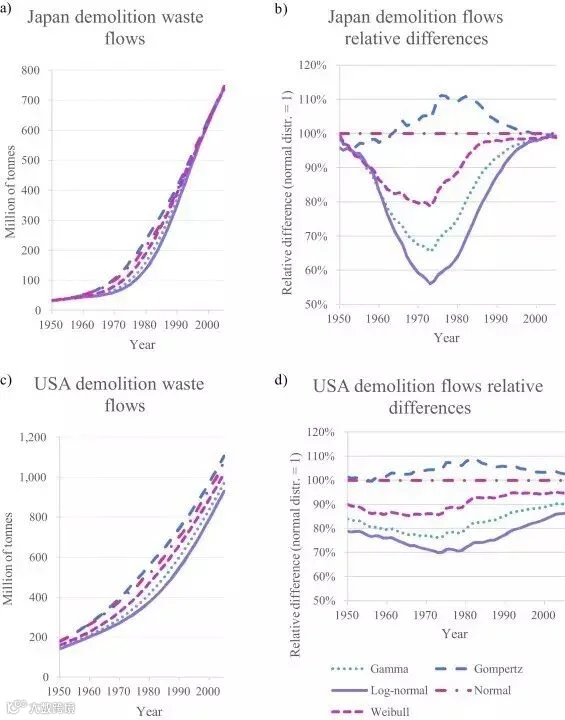
Fig. 4. a) 日本建筑废物流(1950–2005); b) 日本建筑废物流的相对偏差(不同分布函数),基线=正态分布; c) 美国建筑废物流(1950–2005);d) 美国建筑废物流的相对偏差,基线=正态分布。所有模拟分布函数 中位数=30年,标准差=15年。 注:图a和图c纵轴的尺度不同。


原文信息
Title:How important are realistic building lifespan assumptions for material stock and demolition waste accounts?
Authors:Alessio Miattoa, Heinz Schandla,b, Hiroki Tanikawaa
Affiliation:
aNagoya University, Graduate School of Environmental Studies, D2-1(510) Furo-cho, Chikusa-ku, Nagoya 464-8601, Japan
bCommonwealth Scientific and Industrial Research Organisation (CSIRO), Black Mountain Laboratories, Clunies Ross Street, Acton, 2601 ACT, Australia
Abstract
Accurate assessments of construction materials stocked in the built environment have received increased attention in the Industrial Ecology literature over the past few years. Many recent models that estimate building material inflows, stock accumulation and end-of-life waste, however, rely on simplistic assumptions about the lifespan of built infrastructure. While several probability distributions have been proposed (normal, Weibull, log-normal, and so on) there is no agreement on which model is best suited for modelling the accumulation of building material stock at urban and national levels.
In this study we introduce an analysis of the hazard rate of buildings and discuss alternative distribution functions to model lifespan, testing the fit of five commonly used distributions to real data from the cities of Nagoya (Japan), Wakayama (Japan), and Salford (UK). The results highlight how cities with fast replacement rates are overall best modelled by right-skewed distributions, but single cohort levels express independent behaviours based on their characteristics. We investigate the sensitivity of a top-down stock accumulation model to the choice of different distributions and input parameters uncertainties.
The results show that different lifespan distribution functions result in very similar overall stock accumulation at the national level, but have large impacts on calculated demolition waste flows. Differences are more pronounced for cities and the choice of a certain distribution will significantly affect the calculation of the average lifetime. Our results suggest that top-down national material stock accounts have high reliability, and are only weakly affected by the choice of one distribution over another. For cities, it is beneficial to use a distribution based on the characteristics of the buildings analysed, with regard to density and building characteristics. Stock accumulation research would profit from future bottom-up research into building lifespans to validate top-down estimation procedures.

本期编辑
高小峰,东京大学都市資源管理(森口)研究室。研究方向:城市建筑物质流分析和建筑废物管理
(E-mail:xiaofeng@env.t.u-tokyo.ac.jp)


欢迎关注“RCR期刊”微信公众号,《Resources, Conservation & Recycling》致力于发表资源和环境可持续管理领域的最前沿学术论文。
诚邀怀揣学术热情的志愿者,将RCR学术成果编辑为微信小文,献与读者。虽不能飨以薪资,但必奉之真诚,许之自由。简历请发至rcr-office@umich.edu,RCR欢迎你的加入!
RCR期刊


请拉至底部留言
