



编者按
这项研究通过引入方向性距离函数(DDF),计算出中国27个行政区的能源节约总量和能源节约率,并且讨论了影响行业节能的因素。结果表明,有色金属行业整体可以节约近 20%的能源消费,且27个省级行政区节能率均未同比下降。因此,有色金属行业应该把提高能源效率放在首位。
一方面,相关政府应该把资源投入到技术创新,结构调整,产业升级,并淘汰落后生产能力。另一方面,企业要提高节能系统和监测系统,以及将节能工作纳入绩效考核。有色金属回收是增加资源供应和降低能源消耗非常重要的方法。中国有大约5000–6000企业参与回收业务,员工在1500万到1800万之间,有关政府应鼓励利用税收和土地政策帮助回收可再生资源的企业兼并重组,加快废有色金属贸易和加工标准化,对有着高能源节约率的地区应该给予更多的关注,将有色金属产业转化为一个科技化,集约化,清洁化,循环化的产业。
注:方向性距离函数(Directional Distance Function,DDF),在给定的投入水平下,以最小的非期望产出(如污染)来尽可能多地生产期望产出的一种计算模型

原文链接:http://www.sciencedirect.com/science/article/pii/S0921344915300926
文章亮点:
1.利用DDF模型计算出中国27个行政区的能源节约总量和能源节约率;
2.提出了有色金属行业节约能源应主要通过提高能效;
3.发现了地区不同,节能潜力也有不同的现象。

文章摘要
中国是全球精炼铜、原铝、铅,精炼锌、精炼镍、锑、原镁、锰铁矿、锡矿、钨和钼的主要生产国之一。有色金属生产工业属于能源密集型产业,其能源消费量从2000年的3150万吨油当量增长至2012年的1亿2000万吨油当量,而这几乎相当于2012年澳大利亚的能源消费总量(1亿3300万吨油当量)。因此,降低有色金属工业的能源消耗势在必行。本研究采用方向性距离函数建立有色金属工业生产系统模型,分析了中国的有色金属工业的节能潜力。另外,对中国2003-2009年的27个省级行政区的能源节约总量和能源节约比例也做了探讨。结果表明,有色金属行业总体上可以节省超过20%的能源消耗,27个省级行政区节能率均未同比下降。此外,研究还发现,有色金属产量高的地区能源节约率较低。本研究另外一个主要发现是根据区域的不同,节能潜力也会有显著的不同,在中国中西部的能源节约的比例会更大。最后,本研究提供了几个提高有色金属节能率的建议。

图 1 各区域(省,自治区,直辖市)平均资源节约量与产量(左:资源节约量;右:10种有色金属产量)
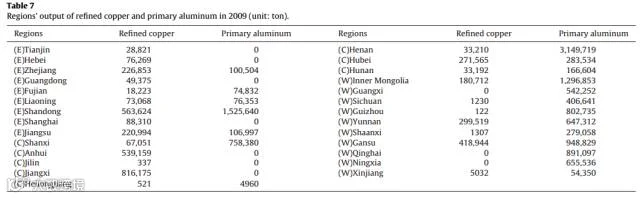
表 1 2009年各区域精炼铜和原铝矿的产量

原文信息
Title:Analysis of energy savings potential of China’s nonferrous metals industry
Authors:Yanmin Shao a b
Affiliation:
a Academy of Mathematics and Systems Science, Chinese Academy of Sciences, Beijing 100190, China
b Center for Forecasting Science, Chinese Academy of Sciences, Beijing 100190, China
ABSTRACT:
China is one of the world’s leading producers of refined copper, primary aluminum, lead, refined zinc, refined nickel, antimony, primary magnesium, manganese ore, tin ore, tungsten, and molybdenum. The production of the nonferrous metals industry is also energy-intensive, its energy consumption increased from 31.5 million tons of oil equivalent in 2000 to 112 million tons of oil equivalent in 2012, which is almost the same as Australia’s total energy consumption (133 million tons of oil equivalent) in 2012. Thus, it is imperative for the industry to reduce its energy consumption. This study tries to analyze the energy savings potential of China’s nonferrous metals industry by employing the directional distance function approach to model the nonferrous metals industry’s production system. Further, the energy savings ratios and energy savings amounts of the 27 administrative regions of China during 2003–2009 are also discussed. The results show that the nonferrous metals industry, overall, can save more than 20% in energy consumption, and that none of the 27 regions show a year-on-year decrease in their energy savings ratios. In addition, the study finds that the regions with a high proportion of output of secondary nonferrous metals have low energy savings ratio. Another key finding of this study is that the energy savings potential significantly differed according to regional characteristics, and the energy savings opportunities are great in the central and western regions of China. Finally, this study provides several recommendations to improve the energy efficiency of the nonferrous metals industry.
本期编辑:任米阳
中国石油大学(北京) 能源经济专业本科生
研究兴趣包括碳交易,能源经济管理,资源环境政策

欢迎关注“RCR期刊”微信公众号,《Resources, Conservation & Recycling》致力于发表资源和环境可持续管理领域的最前沿学术论文。
诚邀怀揣学术热情的志愿者,将RCR学术成果编辑为微信小文,献与读者。虽不能飨以薪资,但必奉之真诚,许之自由。简历请发至rcr-office@umich.edu,RCR欢迎你的加入!
RCR期刊

对今天的推送内容,您有哪些看法呢? 欢迎大家一起来讨论。

请拉到底部为我们留言


点击阅读原文查看更多