


原文链接:
https://doi.org/10.1016/j.resconrec.2016.07.001

文章导读
一般所说的飞灰包括垃圾焚烧飞灰、锅炉飞灰、洗涤残渣、过滤飞灰等,通常含有二恶英、呋喃等有毒物质,以及锌和铅等重金属,是一种危险废物。近年来,很多学者开始对飞灰和炉渣的性质及其处理方法进行研究。目前对飞灰处理的常用方法有稳定/固化后进填埋场、作为水泥的部分原材料再利用、作为砖块中的填料等。在台湾,由于成本效益,稳定/固化后进行填埋,是对MSWI飞灰最常用处理方法,也是最符合当地法规要求的。也有人提出新的解决方案,例如,回收EAF飞灰中的氧化锌,利用MSWI飞灰作为Waelz工艺中的碱替代剂等。本文通过成本效益对以上几种方法进行了对比分析。
目前很少有研究对飞灰利用的整个生命周期进行评价,包括对环境的影响、能源消耗、资源枯竭和污染物排放等,未来的研究可以结合健康、生态风险等方面进行全面评估。
文章亮点

本文对飞灰再利用的环境影响及成本效益进行了评价分析。
飞灰的最佳再利用方法是在电弧炉中以Waelz工艺作为碱回收。
飞灰作为碱再利用可以减少30.6kg CO2(当量)/t飞灰的碳排放。
飞灰作为水泥再利用可最高引起563kg CO2(当量)/t飞灰的排放量。
固化/填埋对环境影响最大,成本最高。


中文摘要


城市生活垃圾焚烧(MSWI)飞灰是一种难以回收的常见危险废物,它包括来自半干洗涤器和袋式过滤器的残渣。我们评估了一项新颖的MSWI飞灰回收方案,由于环境效益和经济效益,在Waelz工艺中,电弧炉(EAF)飞灰可以用来作为强碱替代剂。通过生命周期评价和成本效益分析与其他方案进行了比较,例如,稳定/固化后进行垃圾填埋处理,作为水泥窑部分原材料进行再利用,作为砖块部分集料进行再利用。我们采集台湾的一家EAF飞灰回收厂的现场实验数据进行评估。研究结果表明,这种回收方案对环境的影响最小,因为EAF飞灰氧化锌的循环利用可以减少锌矿开采,具有环境友好性。从经济方面来看,由于其较高的销售价格,作为水泥产品可以获得最大的利润。综合考虑环境效益和经济效益,这种应用方案仍然优于其他三种方案。尽管对MSWI飞灰进行稳定/固化后再做后续处理的方案是最常用的方法,但垃圾填埋场容量和数量的有限性导致其牵涉到垃圾焚烧运行的风险性。因此,寻找多种回收MSWI飞灰的方法是有必要的。本研究为MSWI飞灰的回收利用提供了一个潜在的选择,并在MSWI飞灰处理方面提现了其环境效益和经济效益。

图1 不同情景下的MSWI飞灰的LCA评价
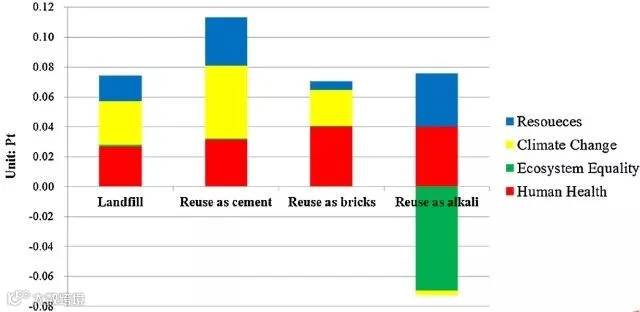
图2 不同情景的环境影响比较分析

图3 不同情景的温室气体排放

图4 不同情景的环境影响分布
原文信息

标题
Life-cycle environmental and cost impacts of reusing fly ash
作者
T.Y. Huang, P.T. Chiueh∗, S.L. Lo
作者单位
Graduate Institute of Environmental Engineering, National Taiwan University, 71, Chou-Shan Rd., Taipei 106,Taiwan, ROC
摘要
Municipal solid waste incinerator (MSWI) fly ash, which includes residues collected from semidry scrubbers and bag filters, is a common hazardous waste that is difficult to recycle. We evaluate a novel application of the reuse of MSWI fly ash as a substitute alkali reagent in the Waelz process at an electric arc furnace (EAF) ash recycling plant because of its economical and environmental benefits. Life-cycle assessment and cost-benefit analysis were used to compare the application with other alternatives, namely, disposal in landfill after stabilization/solidification, reuse as part of raw material in a cement kiln, and reuse as part of aggregates in brick. Data from field experiments which were performed at a commercial EAF ash recycling plant in Taiwan were used for the evaluation. Our results show that the proposed application has the lowest environmental impact because the ZnO recycling of EAF ash is environmental friendly for reducing the excavation of zinc ore. In terms of economy, the higher sale price of the resulting cement product offers the best benefit among different applications in this research. After integration of environmental and economic effects, the application was still superior to the three alternatives. Although stabilization/solidification and subsequent disposal of MSWI fly ash is common practice, the scarcity of landfill sites and its volume leads to risks associated with operation of incinerators. Thus, finding multiple approaches to recycling of MSWI fly ash is necessary. This study provides a potential option for the recycling of MSWI fly ash and presents its environmental and economic benefits in management of fly ash from MSWIs.
本期编辑:刘岳贞,硕士研究生,研究方向生物质废弃物资源化利用,水泥窑协同处置固危废,土壤修复等


icRS2018会议 大幕将启
长按二维码 抢先参会
www.icrsconf.com
2018.6.27--2018.6.29 北京
更多优秀论文
尽在RCR
Resources 丨 Conversation 丨 Recycling
欢迎加入公众号编辑团队,简历请投至邮箱:
rcr-office@umich.edu
谈笑有鸿儒:请留言!
都说点赞会变美!不信你试试

对今天的推送内容,您有哪些看法呢? 欢迎大家一起来讨论。

请拉至底部留言

