


原文链接:
http://www.sciencedirect.com/science/article/pii/S0921344916303871

图片来源于网络
文章导读:
中国现有6亿多农民,由于农村有限的资源、高的人口增长率、脆弱的农业环境和显著的社会不平等,使得农民的可持续生计尚未完全实现,而且区域特征对其也有重要影响。本文利用可持续生计安全(sustainable livelihood security)指数和模糊综合评价法,确定了我国农民可持续生计和可持续发展的必要条件,对区域特征明显的东、中、西部省份提出了改善农民可持续生计的具体建议。
文章亮点
• 提出可持续生计安全(SLS)指数。
• 采用模糊综合评价方法对各省农民的SLS水平进行评价。
• 认为中国各省农民SLS分布存在空间差异。
• 提出了针对提高SLS的具体政策。
摘要
农村地区的可持续生产和消费仍然是农村可持续发展中一个很少被研究而又重要的问题。特别是生活在农业污染严重、生态质量差的地区的农民,他们的可持续生计尚未得到过充分的调查。同时,农民还遭受生产力和生活水平低下、社会不平等问题。可持续生计安全(SLS)指数为确定可持续生计和可持续发展所需的条件提供了有效手段。本文采用模糊综合评价法,旨在评估中国各省农民的可持续生计安全水平及其生态安全、经济效益和社会公平三要素。本文建立了可持续生计安全(SLS)指数体系,利用熵权法来确定指标权重,并分析可持续生计安全及其三要素的空间分布。结果表明,各省间可持续生计安全指数及其组成因素不同,西部省份可持续生计、经济效益和社会公平是最不安全的(或相对不安全)的,而东部和中部省份的经济效益是最为安全(或相对安全)的,而东部省份的社会公平最为安全。结语提出了根据当地区域状况制定改善农民可持续生计安全的政策建议。
表1 利用SLS指数评估中国农民的可持续生计安全

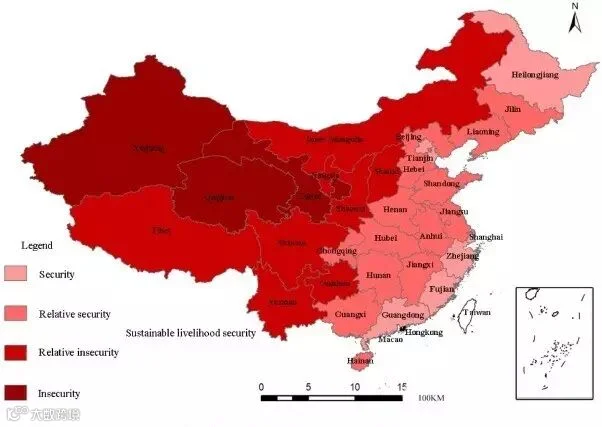
a.可持续生计安全的空间分布

b.生态安全的空间分布

c.经济效益的空间分布

d.社会公平的空间分布
原文信息
Title:
Sustainable livelihoods and rural sustainability in China: Ecologically secure, economically efficient or socially equitable?
Authors:
Heyuan You(a), Xiaoling Zhang(b)
(a) School of public administration, Zhejiang University of Finance and Economics, Hangzhou, China
(b) Department of Public Policy, City University of Hong Kong, Hong Kong, China; City University of Hong Kong, Shenzhen Research Institute, Shenzhen, PRC
abstract:
Sustainable production and consumption in the rural regions remains a barely tried yet important issue for contributing to rural sustainability these days. In particular, the sustainable livelihood of rural farmers has not been fully investigated for those in rural areas with high agricultural pollution emissions and a poor ecological quality of agricultural production in China. Also affected are farmers with a low living standard and output, or suffer from social inequity. The sustainable livelihood security (SLS) index therefore provides a useful means of identifying the existence of the conditions necessary for sustainable livelihood or sustainable development. Using the fuzzy comprehensive method, this paper aims to assess the level of sustainable livelihood security of China’s provincial farmers and its three components of ecological security, economic efficiency and social equity. A SLS index is established and the entropy weight method used to determine the weight of the indices and analyze spatial distribution. The results indicate that the sustainable livelihood security index and its components vary between provincial regions, with the western provinces being most adversely affected, sustainable livelihood, economic efficiency and social equity being the least secure (or relatively insecure) in the western provinces while economic efficiency is most secure (or relatively secure) in the eastern and middle provinces, and social equity most secure in the eastern provinces. Concluding remarks suggest policies designed to improve the sustainable livelihood security of farmers according to local regional circumstances.
本期编辑:张继美,北京工业大学经济与管理学院,应用经济专业

欢迎关注“RCR期刊”微信公众号,《Resources, Conservation & Recycling》致力于发表资源和环境可持续管理领域的最前沿学术论文。
诚邀怀揣学术热情的志愿者,将RCR学术成果编辑为微信小文,献与读者。虽不能飨以薪资,但必奉之真诚,许之自由。简历请发至rcr-office@umich.edu,RCR欢迎你的加入!
RCR期刊

对今天的推送内容,您有哪些看法呢? 欢迎大家一起来讨论。

请拉至底部留言
