


原文链接:
https://www.sciencedirect.com/science/article/pii/S0921344918301964

图片来源于网络(侵删)
文章导读
混凝土,通常由水泥,骨料和水制成,是世界上使用最多的人造材料。在欧盟地区,2015年生产了2.15亿立方米的预拌混凝土。除了原材料的巨大需求之外,建筑行业也是欧洲最大的废物产生行业之一,每年约有1亿吨建筑和拆迁废弃物(CDW),这也造成重大的环境影响(EI)。混凝土是温室气体排放的最大贡献者之一,但改善其环境表现也有很多尝试。例如通过在混凝土混合料中使用再生骨料(RA)来减少原生NA的量。回收材料可以来自CDW,可以是混凝土,砖块或瓷砖。出于简单的经济原因,回收CDW的工厂通常靠近人口稠密的地区。对于距离回收厂更远的地区,需要详细评估运输和来自生产的相应影响,以确定使用RA是否具有环境可行性。根据原材料生产,混凝土生产和施工现场的位置,本文结合了现有的广泛运用的两种方法,生命周期评价(LCA)和GIS,回答了交通运输对混凝土生产的环境影响重要性的问题。
文章亮点
1、与混凝土混合料运输相关的环境影响进行了分析。
2、与运输有关的影响与生产进行了比较。
3、提出了一种结合LCA和地理空间分析的新方法。
4、对于传统的混凝土运输相关的影响并不重要。
5、运输在选择替代混凝土混合物时很重要。
摘要
世界城市正在快速扩张和致密化。这就需要大量的新建筑材料以及产生大量的建筑和拆迁废物。就绝对数量而言,混凝土不仅是最重要的建筑材料,而且还涉及到大量的体现温室气体排放。通过引入辅助胶结材料(例如飞灰)和CDW(例如再循环的聚集体)已经开发了替代混凝土混合物。到目前为止,环境评估主要关注混凝土混合料的生产,而不考虑与运输相关的影响。本文评估了原材料在混凝土生产中与运输有关的影响的重要性,提出了一种结合生命周期评估和材料道路运输地理空间分析相结合的新方法。对具体位置混泥土工厂的不同混合物进行了环境影响评估。比较了传统混凝土和选择的特定场地的低影响的替代混凝土混合料。为此,两个葡萄牙城市被视为案例研究。新方法解释了混凝土生产的供应和需求的位置和其是否重要。结果表明,对于传统混凝土和掺入低FA比率和/或RA的混合物,运输无关紧要。然而,选择已经大幅度改进的混合料时很重要:从原材料供应商到混凝土厂的距离可能会降低总环境影响的比例。事实上,FA和回收厂的距离影响着最环保的混凝土混合料的选择。该方法可以应用于其他案例和材料研究。

图1 运输步骤概述

图2 混凝土混合料的原材料生产和运输的环境影响比较分析

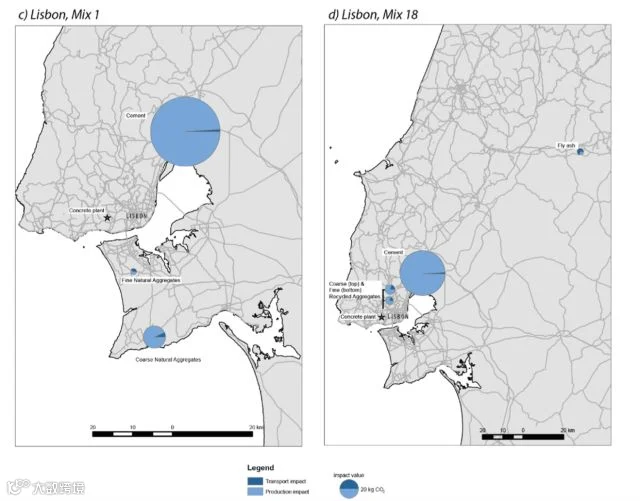
图3 波尔图(a和b)和里斯本(c和d)的案例研究

原文信息

标题:
Transportation matters – Does it? GIS-based comparative environmentalassessment of concrete mixes with cement, fly ash, natural and recycledaggregates
作者:
VerenaGöswein(a,*),AlexandreB.Gonçalves(a), José Dinis Silvestre (a,b), Fausto Freire
(b),Guillaume Habert(c),Rawaz Kurda(a)
单位:
a CERIS, Department of Civil Engineering, Architecture and Georesources, Instituto Superior Técnico, Universidade de Lisboa, Av. Rovisco Pais 1, 1049-001, Lisbon,Portugal
b ADAI/LAETA, Department of Mechanical Engineering, University of Coimbra, Polo II Campus, R. Luís Reis Santos, 3030-788, Coimbra, Portugal
c Chair of Sustainable Construction, IBI, ETH Zürich, Stefano-Franscini-Platz 5, 8093 Zurich, Switzerland
英文摘要:
The urban world is expanding and densifying fast. This requires and produces huge amounts of new constructionmaterials and construction and demolition waste (CDW) every year. Concrete is not only the most importantconstruction material in terms of sheer amount but also regarding embodied greenhouse gas emissions.Alternative concrete mixes have been developed by introducing supplementary cementitious materials (e.g. flyash (FA)) and CDW (e.g. recycled aggregates (RA)). So far, environmental assessments focus mostly on theproduction of concrete mixes without considering the transportation-related impacts. This paper appraises theimportance of transportation-related impacts of raw materials for concrete production and proposes a newmethod combining Life Cycle Assessment and geospatial analysis of road transportation of materials.Environmental impacts (EI) of different mixes are assessed for the specific locations of concrete plants.Traditional and alternative concrete mixes are compared to choose site-specifically the mix with lower impacts.For that purpose, two Portuguese cities were considered as case studies. The new method uncovers if and howlocation of supply and demand for concrete production is important. The results show that for traditionalconcrete and for mixes incorporating low FA ratio and/or RA, transportation does not matter. However, itmatters when choosing between already drastically improved mixes: then, distances from raw materials sup-pliers to concrete plants can tip the scales of total EI. In fact, the distances to FA and recycling plants influencethe selection of the most environmental friendly concrete mix. The method can be applied to other case studiesand materials.
本期编辑
张浩然,北京大学城市与环境学院博士研究生,研究方向:资源环境政策和管理。

icRS2018会议 大幕将启
长按二维码 抢先参会
www.icrsconf.com
2018.6.27--2018.6.29 北京
更多优秀论文
尽在RCR
Resources 丨 Conservation 丨 Recycling
欢迎加入公众号编辑团队,简历请投至邮箱:
rcr-office@umich.edu
谈笑有鸿儒:请留言!
都说点赞会变美!不信你试试
