


原文链接:https://www.sciencedirect.com/science/article/pii/S0921344918300557

图片来源于网络(侵删)
文章导读
钢铁生产是现代社会发展的关键推动工业,其二氧化碳排放量占总工业排放量四分之一以上。国际能源署(IEA)2050年的2度情景表明,工业(不包括发电)减排量中有三分之一以上来自钢铁行业,为工业减排的最大单一贡献者。有效节能(EE)和节材(ME)策略预计将在短期内实现显著的减排,特别是在脱碳技术(如冶炼减排和碳捕获和储存)仍在发展中的情况下。实际上,IEA有效节材情景显示“节材战略相比于节能战略可以在能源密集型行业实现更高的节能量”,尤其是在钢铁行业。本文基于可用能指标度量了钢铁行业能源和材料使用的效率情况。通过将能源和材料整合为一项指标,可以研究一系列节能节材措施,如降低能源燃料投入,通过提高材料产出减少原材料投入,回收能源副产品,回收材料副产品等。本文基于此回答了以下三个问题:(1)全球钢铁行业的资源效率如何?(2)钢铁生产的工序和工艺流程之间的资源效率不均性是怎样的?(3)将钢铁生产平均水平提高至最佳可得水平需要些什么?
文章亮点
1、关于全球钢铁工业资源利用的最新综合数据。
2、提高能源和材料的利用效率可以分别节约4EJ/年和1EJ/年。
3、2010年全球钢铁行业的资源效率为32.9%。
4、将原生钢生产平均水平提高至最佳可得水平最多可以节约6.4EJ/年。
5、再生钢的资源效率(65.7%)是原生钢(29.1%)的两倍。
摘要
提高资源效率是钢铁行业减排的有效手段,但现有研究未能对该行业的能源和材料使用情况进行全球分析。尽管炼钢过程中能源和材料之间存在相互作用,但最近的研究仅对这些资源进行了单独研究,并且对资源效率提供了部分洞见。本研究分析了全球钢铁行业最新、最全面的资源数据,并通过节能和节材措施量化节约情况。本研究调查了2010年的三种钢铁生产流程,即高炉-转炉流程(原生流程);直接还原-电弧炉流程;废钢-电弧炉流程(再生流程)。该部门的资源效率(包括能源和材料)使用可用能表示,并在工艺流程和工序两个层面进行测量。结果显示,该部门的资源效率为32.9%,再生钢资源效率(65.7%)是原生钢(29.1%)的两倍。节能手段(如废气回收)每年可节省大约4EJ(以下均指可用能)。节材手段(如提高产量)每年可额外提供1EJ节约量。将全球原生钢生产平均水平提高至最佳可得水平每年最多可以节约6.4EJ;相当于全球炼钢能值投入减少26%。受限于废钢回收量,若至2050年一半的钢铁产量为再生钢,则每年可节约8EJ。基于可用能测量的资源效率为利益相关者提供了一种平等对待节能和节材措施的工具。

图1 2010年钢铁部门资源流动(以可用能为测量单位)

图2 六种工序中资源效率分布
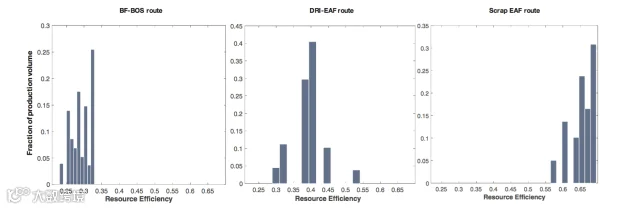
图3 三种生产工艺中资源效率分布

原文信息

标题:
How resource-efficient is the global steel industry?
作者:
Ana Gonzalez Hernandez(*), Leonardo Paoli
, Jonathan M. Cullen
单位:
Department of Engineering, University of Cambridge, Cambridge, United Kingdom
英文摘要:
Resource efficiency is an instrumental mitigation option in the steel industry but, existing studies have failed toprovide a global analysis of the sector's energy and material use. Despite the interactions between energy andmaterials in steelmaking, recent studies investigate each of these resources in isolation, providing only partialinsight into resource efficiency. This study analyses the latest, most comprehensive resource data on the globalsteel industry and quantifies the savings associated with reducing this through energy- and material-savingmeasures. Three production routes are investigated for 2010, namely the blast furnace/basic oxygen furnace(ore-based); direct reduction/electric arc furnace; scrap-based electric arc furnace routes (secondary). Thesector's resource efficiency – accounting for energy and materials – is expressed in exergy and measured at twolevels, that of production routes and plants. The results show that the sector is 32.9% resource-efficient and thatsecondary steelmaking is twice as efficient (65.7%) as ore-based production (29.1%). Energy-saving options,such as the recovery of off-gases, can save about 4 EJ/year (exergy). Materialsaving options, such as yieldimprovements, can deliver just under 1 EJ/year extra. A global shift from average ore-based production to bestavailable operation can save up to 6.4 EJ/year; a 26% reduction in global exergy input to steelmaking. Shiftingto secondary steelmaking can save 8 EJ/year, limited only by the need to still produce half of steel from ore in2050. Resource efficiency, measured in exergy, provides stakeholders with an instrument that treats energy andmaterial efficiency measures on an equal footing.
本期编辑
张浩然,北京大学城市与环境学院博士研究生,研究方向:资源环境政策和管理。
王键,东北大学国家环境保护生态工业重点实验室,博士研究生

icRS2018会议 大幕将启
长按二维码 抢先参会
www.icrsconf.com
2018.6.27--2018.6.29 北京
更多优秀论文
尽在RCR
Resources 丨 Conservation 丨 Recycling
欢迎加入公众号编辑团队,简历请投至邮箱:
rcr-office@umich.edu
谈笑有鸿儒:请留言!
都说点赞会变美!不信你试试
