


原文链接: https://www.sciencedirect.com/science/article/pii/S0921344918302398

图片来源于网络(侵删)
文章导读
城市化是一个不断增长的全球趋势,因为世界上超过54%的人口居住在城市化地区。城市化程度最高的地区包括北美、拉丁美洲和加勒比以及欧洲。过去几十年的数据显示,人类的增长、经济发展、自然资源的消耗和自然生态系统的退化是相互联系的。这种城市发展在许多层面上构成了一种脱钩的挑战,包括促使生产过程和人类生活方式发生变化的政策。过去的研究表明,为了能够成功地缓解人类面临的重大环境挑战,有必要考虑行为复杂性、行为分组和生活方式类型。 同样重要的是要了解消费的哪些组成部分最能影响环境,以及各个组成部分造成的影响类型和大小。本文中通过在终点水平应用PM-LCA模型,阐述并讨论不同的城市消费成分如何影响终端水平的环境影响。此外,对中点水平和终点水平的消费成分贡献进行了比较,对比和随后的解释。本文还确定了消费驱动因素和减少城市消费对环境影响的重点。最后,研究了人口因素和生活方式对城市消费模式对环境影响的影响。
文章亮点
1、评估了丹麦城市消费造成的环境负担。
2、对终点进行了贡献分析和聚类分析。
3、食物消费和公路运输主导影响。
4、人口和生活方式对环境影响产生了强烈影响。
摘要
本文的研究目的是分析城市生活方式如何影响环境,为与丹麦消费模式相关的有效环境政策提供理论和灵感。通过聚类分析支持的个人代谢(PM)耦合生命周期评估(LCA)的方法的应用,促进了基于中心人口统计和生活方式参数(例如收入,饮食,运输和年龄)的消费相关聚类的识别。评估的消费模式的环境表现从整个生命周期的角度进行计算,并通过应用ReCiPe 2008生命周期影响评估(LCIA)方法涵盖中点和终点水平的所有相关环境影响。贡献分析的结果表明:气候变化、颗粒物质、人体毒性、化石消耗和电离辐射对ReCiPe 2008所涵盖的三个终点贡献最大。聚类分析结果表明,受访者的收入水平和年龄等人口统计参数对环境影响有很大影响。本文还研究了生活方式的影响,如饮食选择、私家车使用和家庭规模。发现这三个参数显著影响了丹麦城市居民对消费的相关环境影响。总体而言,我们的研究确定了消费的驱动因素和重点,并提供了丹麦城市消费相关环境影响的当代图景。

图1 建模方法:根据个人代谢法(PM)和生命周期评估(LCA)估算城市居民的环境足迹

图2 1281名受访者的终点和单一分数变化

图3 ReCipe 2008中的18个中点影响类别中消费成分的平均贡献

图4 中点对终点和单个分数的贡献
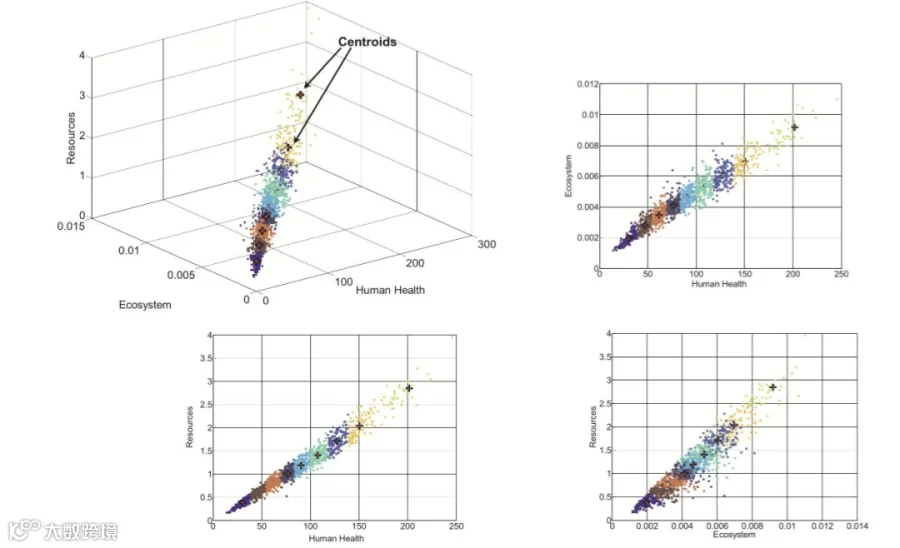
图5 1281名受访者数据集的聚类分析结果

原文信息

标题:
Environmental impact of urban consumption patterns: Drivers and focuspoints
作者:
Pradip P. Kalbar(a,b,*), Morten Birkved (c),
Michael Hauschild (c), Simon Kabins (d),
Simon Elsborg Nygaard (d),
单位:
a Centre for Urban Science and Engineering (CUSE), Indian Institute of Technology Bomba, Powai, Mumbai 400 076, India
b Interdisciplinary Programme (IDP) in Climate Studies, Indian Institute of Technology Bomba, Powai, Mumbai 400 076, Indiac Quantitative Sustainability Assessment Division, DTU Management Engineering, Technical University of Denmark, Denmark
d Department of Psychology and Behavioral Sciences, BSS, Aarhus University, Denmark
英文摘要:
The purpose of our study is to analyse how urban lifestyles impact on the environment to offer knowledge based inspiration for effective environmental policies relating to contemporary Danish consumption patterns. The application of a Personal Metabolism (PM) coupled Life Cycle Assessment (LCA) approach supported by cluster analysis facilitated the identification of consumption-related clusters based on central demographic and life style parameters such as income, diet, transport, and age. The environmental performance of the assessed consumption patterns were calculated in a full life cycle perspective and covering all relevant environmental impacts both on midpoint and endpoint levels by applying the ReCiPe 2008 Life Cycle Impact Assessment (LCIA) methodology. The results of the contribution analysis revealed that climate change, particulate matter, human toxicity, fossil depletion and ionizing radiation contribute most to the three endpoints covered by ReCiPe 2008. Results of cluster analysis indicated that demographic parameters such as income level and age of the respondents has a strong influence on the environmental impacts. The influence of lifestyle aspects such as choice of diet, use of private car and household size was also investigated. These three parameters were found to significantly influence the consumption related environmental impacts of urban Danish residents. Overall our study identify drivers and focus points of consumption and provides a contemporary picture of Danish urban consumption-related environmental impacts.
本期编辑
张浩然,北京大学城市与环境学院博士研究生,研究方向:资源环境政策和管理。
更多优秀论文
尽在RCR
Resources 丨 Conservation 丨 Recycling
欢迎加入公众号编辑团队,简历请投至邮箱:
rcr-office@umich.edu
谈笑有鸿儒:请留言!
都说点赞会变美!不信你试试
