原文链接:https://www.sciencedirect.com/science/article/pii/S0921344918302672

图片源于网络,侵删
文章导读
文章亮点
1.对废物投入产出模型(WIO)进行了综述。
2.通过一个MFA模型(MaTrace-alloy)对WIO模型进行了动态拓展。
3.原料、合金和废弃物是广泛定义的,适用于大部分的背景。
4.引入了涉及技术和需求模式的“深度参数”。
5.根据深度参数解释回收机制。
文章摘要
自上世纪末以来,废物投入产出(WIO)模型的应用已拓展到产业生态学的广泛领域。包括物质流分析(MFA),生命周期成本核算(LCC),区域分析和基于线性规划(LP)的技术选择。据我们所知,动态的废物产生和再循环是一个可能的概念延伸领域,对此领域还没有足够的探索。我们最近进行了动态MFA研究。在这项研究中,我们开发了一个动态WIO(dWIO)模型,该模型充分考虑了循环利用中的质量问题,包括混合,耗散和污染。

表1.WIO模型示意图

表2.dWIO模型中的WIO物质流描述
注:X指商品流,W代表废物流。y:最终需求,q:耐用最终产品,p:部件和成分,a:合金,m:金属,o:其他,r:提炼,d:反汇编,l:垃圾填埋,e:EoL产品,s:废料,z:残渣。
原文信息
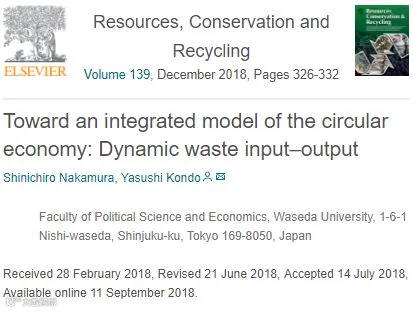
Abstract
Since its development at the end of the previous century, the waste input–output (WIO) model has been extended to wide areas of industrial ecology including material flow analysis (MFA), life-cycle costing (LCC), regional analysis, and linear programming (LP)-based technology selection. To our knowledge, the dynamics of waste generation and recycling is an area of possible conceptual extension that remains least explored. Building upon our recent work on dynamic MFA, in this work, we develop a dynamic WIO (dWIO) model that fully considers the issue of quality in recycling that involves mixing, dissipation, and contamination.

本期编辑
关雨琦,北京工业大学循环经济研究院,资源环境与循环经济交叉专业。

更多优秀论文
尽在RCR
Resources 丨 Conservation 丨 Recycling
欢迎加入公众号编辑团队,简历请投至邮箱:
rcr-office@umich.edu
谈笑有鸿儒:请留言!
都说点赞会变美!不信你试试