


原文链接:
https://www.sciencedirect.com/science/article/pii/S0921344918304750

图片来源于网络(侵删)
文章导读
为了评估生物经济的发展和生物能源对温室气体排放的影响程度,本文使用修正后的EKC模型进行了分析。实证结果表明,可再生能源(特别是生物质能源)的使用促进了欧盟经济活动与温室气体排放的脱钩。
文章摘要
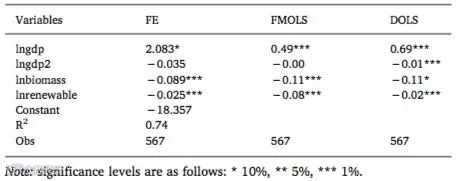
生物经济是欧盟(EU)政治议程的重要组成部分。促进生物能源的使用是生物经济战略的主要方面之一。本文的目的是展示生物能源的发展如何对气候变化做出贡献。具体而言,我们研究了在环境库兹涅茨曲线(EKC)框架内可能减少的温室气体排放量。通过在EKC模型中加入生物质等可再生能源变量,对经典的EKC模型进行了修正,建立了适用于欧盟国家的面板模型。结果表明,当模型中包含可再生能源时,与GDP相关的系数会降低。更具体地说,模型中包含的可再生能源种类越多,与线性项相关的系数值越低。此外,与其他可再生资源相比,生物质对温室气体减排的影响更大。在其他因素不变的情况下,生物质利用率增加1%,温室气体排放量将减少0.089%,而其他可再生能源对温室气体的减排效果仅为0.025%。因此,生物能源的推广是推行生物经济战略的一大重要方面。

图1 欧盟27国GDP、温室气体、生物质等可再生能源的变化情况

图2 EKC模型
表1 模型1估计结果
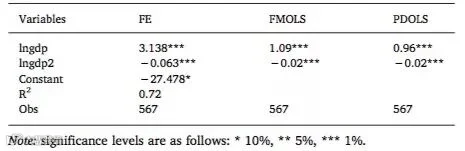
表2 模型2估计结果

表3 模型3估计结果
原文信息

ABSTRACT
Bioeconomy is an important element of European Union (EU) political agenda. Promotion of bioenergy is one of the main aspects of bioeconomy strategy. The aim of this paper is to show how the development of bioenergy can contribute to climate change (and the associated policy). Specifically, we look into the possible reduction of GHG emissions within the framework of Environmental Kuznets Curve (EKC). The panel models are estimated for the EU countries by modifying the classical EKC by including in the EKC model biomass and other renewables. The results showed that the coefficient associated with GDP decreases when renewables are included in the model. More specifically, the more types of renewables are included, the lower values of the coefficient associated with the linear term are observed. Furthermore, the effect of biomass on the reduction of GHG emission is higher if opposed to that caused by the other renewable resources. If we hold other factors fixed, increase in biomass use of 1% would reduce GHG emission by 0.089%, whereas the effect of the other renewable energy sources is 0.025%. Therefore, the development of bioeconomy and the promotion of bioenergy are one of the main tools for climate change mitigation.
本期编辑
李阳,中国人民大学,博士研究生
研究方向:环境经济学
