


原文链接:
https://www.sciencedirect.com/science/article/pii/S0921344917303038

图片来源于网络(侵删)

文章导读
近年来,海洋“塑料微粒”一度成为环境问题的焦点话题。据报道,全球每年至少有900万吨塑料垃圾流入海洋,这些塑料垃圾在海洋上经海浪拍打、风化等作用形成极其细微的颗粒存在于海洋中,易被海洋生物摄入,进而侵入整个海洋生态系统和包括人类在内的整个生物圈,对人和动物的健康带来极大危害。2018 年 6 月国家地理《National Geographic》杂志以“Planet or plastic?”为主题的一个照片作为杂志封面,呼吁社会关注塑料危机,指出这个时代人类面对的一个最大的环境问题:塑料污染,提出拒绝塑料星球,减少废塑料排放量。
目前,全球对塑料垃圾的处理方法有填埋、焚烧、再生造粒和热解等方法。相较于传统塑料垃圾处理技术,优势突出的热解技术近年来正在受到越来越多的政策支持与行业肯定。此项技术真正实现塑料垃圾的无害化、资源化处理,安全环保、高效节能优势突出。
热解是指利用固体废物中有机物的热不稳定性,将其置于热解反应器内受热分解的过程。此项技术可以将塑料垃圾转化为燃料油、天然气、固态燃料等高附加值能源产品,是高分子废弃物最重要的终极处理手段。

文章亮点
1. 塑料包装废弃物在半连续式反应器中低温慢速热解。
2. 热解产物主要是塑料衍生油(PDO)。
3. 1H-NMR分析表明,PDO主要成分是链烷烃和烯烃。
4. PDO的燃料特性类似于石油中间馏分。

文章摘要
低密度和高密度聚乙烯(LDPE、HDPE)以及聚丙烯(PP)是三种最常见的聚烯烃,广泛用作包装材料,在塑料垃圾中也大量存在。从生活垃圾中收集这些塑料包装废弃物作为样本,在半连续式反应器中进行低温(300 ~ 400 ℃)慢速热解,将其转化为塑料衍生油(PDO),PDO样品的成分组成和燃料特性随热解温度变化而变化。聚丙烯热解得到的PDO辛烷值较高(∼92)且粘度低。值得注意的是,低温热解得到的PDO样品粘度低、辛烷值高、发热量高。1H-NMR分析表明,油样主要由石蜡和烯烃组成。PDO的模拟蒸馏(SimDist)结果表明,该液体产品与石油中间馏分的特征相似,具有非常低的倾点和闪点。慢速热解温度也影响了气体产物的组成和产率,气体产物主要由微量的H2、CO和CO2以及多种介于C1-C5之间的烃类小分子组成。塑料包装废弃物降解的机理为端链断裂形成单体单元,而随机断链产生烃类产物,随后的自由基重组、分子间或分子内氢转移等反应形成了烯烃组分。


图1 半连续热解装置示意图

图2 10℃/min条件下的非等温TGA和DTG曲线: (a) LDPE, (b) HDPE, (c) PP, (d) RMIX

图3 不同热解温度下获得的PDO中石蜡、烯烃和芳烃的体积分数: (a) LDPE, (b) HDPE, (c) PP, (d) RMIX
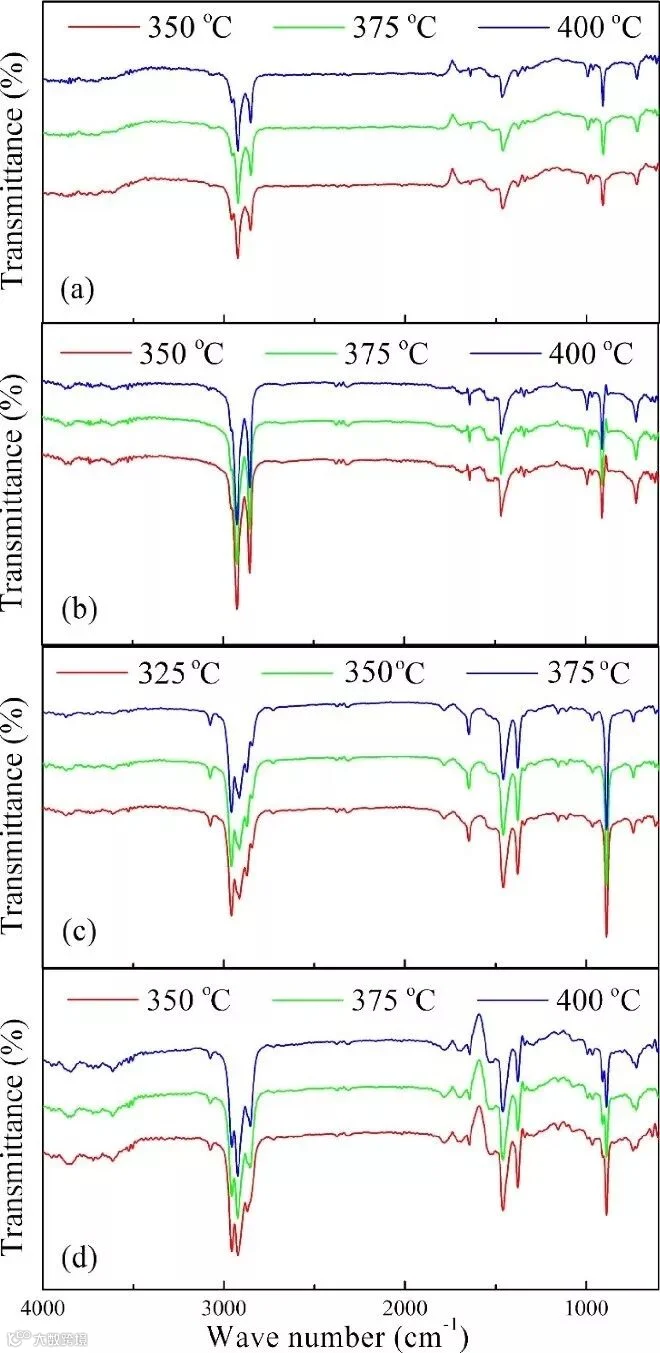
图4 三种热解温度下获得的PDO的FTIR-ATR光谱: (a) LDPE, (b) HDPE, (c) PP, (d) RMIX

图5 RMIX样品在三种温度下获得的PDO中各烃类组分的累计产率(wt.%)以及正构烷烃的碳数分布
原文信息
标题
Valorization of packaging plastic waste by slow pyrolysis
作者
Pallab Das, Pankaj Tiwari
单位
Department of Chemical Engineering, Indian Institute of Technology Guwahati, Guwahati, Assam 781039, India
摘要
Low and high-density polyethylene (LDPE and HDPE) and polypropylene (PP) are three most common polyolefins profusely used as packaging materials and abundantly found in the plastic waste stream. These plastic waste samples were collected from household waste and converted into plastic derived oil (PDO) by low temperature (300 °C to 400 °C) slow pyrolysis (long isothermal holding time) in a semi-batch reactor. The PDO samples obtained had shown variation in their compositions and fuel properties based on the pyrolysis temperature. PDO from the pyrolysis of PP has high octane number (∼92) and low viscosity. Noticeably, the PDO samples obtained at low temperature pyrolysis are lighter with low viscosity, high octane number and having high calorific values. 1H-NMR analysis revealed that the oil samples mostly consist of paraffinic and olefinic hydrocarbons. Simulated distillation (SimDist) of PDO indicated that the liquid products resemble the characteristic closer to middle distillate of petroleum fraction having very low pour point and flash point. The temperature with long pyrolysis time also influenced the evolved gas composition and yield. Trace amount of hydrogen, carbon monoxide and carbon dioxide were present in the gaseous product along with various hydrocarbon gases ranging from C1–C5. The degradation mechanism follows end chain scission which produces monomer units whereas random scission results most of the hydrocarbon products. Subsequent reactions like radical recombination and inter or intra molecular hydrogen transfer results in the formation of most of the olefinic components.

本期编辑
王志强,石油化工科学研究院,博士后
研究方向:超临界水氧化技术处理有机固废
更多优秀论文
尽在RCR
Resources 丨 Conservation 丨 Recycling
欢迎加入公众号编辑团队,简历请投至邮箱:
rcr-office@umich.edu
谈笑有鸿儒:请留言!
都说点赞会变美!不信你试试
