


原文链接:
https://www.sciencedirect.com/science/article/pii/S0921344919304434

(图片来源于网络侵删)

文章导读
耗散损失是物质流入一个接收介质中,并且这些物质的回收无论在技术上还是经济上都不可行。金属既不能通过开采也不能通过使用被破坏,因为它无论形成什么化学键,原子都存在,所以金属的耗散损失是其实际消耗的一部分。然而,目前用于定量评估多种金属耗散损失的数据和指标都缺乏。因此在本文中,我们确定了全球范围内金属耗散损耗的定量指标,包括所有的生命周期阶段,并应用在18种金属中。
文章亮点
1.耗散损失是在接收介质中不可回收的物质流;
2.耗散率将年度耗散与开采和最终生产进行比较;
3.预期寿命量化了耗散的速度;
4.在18种金属中,铝、铁、镍的耗散率较小;
5.技术金属和副产品的耗散率较高、寿命较短。
原文摘要
金属的耗散损失是其实际消耗过程中无法回收的物质流。耗散损失会发生在金属全生命周期中的任何一个过程中,并且有不同的接收介质。避免耗散损失可以减少初级材料的需求和金属潜在的负面环境影响。但是,目前尚无定量指标可用于评估使用阶段前后所有过程金属的全球耗散损失。在这篇文章里,我们提出了三个指标:耗散开采比,耗散与最终产量比以及预期寿命。这些指标被应用到18种金属中。结果表明,整个元素周期表中金属元素的耗散损失相差很大。铁,铝和镍等大宗金属的耗散率最低,而镓,锗和碲等技术金属的耗散率最高。对于高耗散率的金属,预期寿命在短短几个月之间,而对于铝和铁,预期寿命则长达一个世纪。评估结果显示,在材料效率和回收方面需要采取重要措施,以减少各种金属的耗散损失。针对每种金属,可以根据我们的结果确定最有效的行动方案。

图1 物质流动、库存和过程的概念模型

图2 动态物质流模型传递系数的概念模型
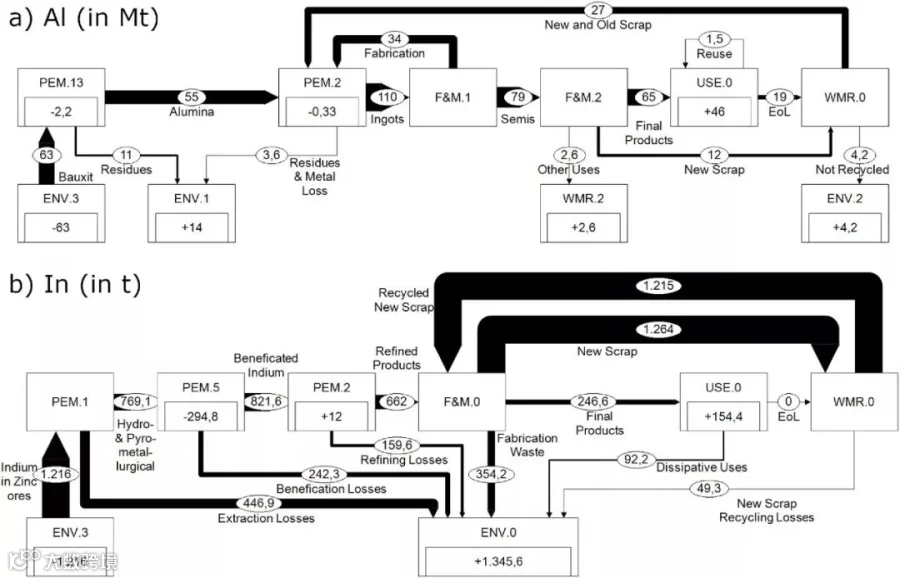
图3 全球铝(a)和铟(b)的物质流

图4 铝(a)和铟(b)的使用存量及耗散损失

图5 金属的耗散开采比、耗散最终产量比和预期寿命的散点图
原文信息

Abstract
Dissipative losses of metals are unrecoverable material flows representing the real consumption of metals. They occur during any process in the global metal cycle from primary production to waste management and have different receiving mediums. Avoiding dissipative losses can reduce both primary material requirements and potential negative environmental impacts of metals. However, there are currently no quantitative indicators available for the assessment of global dissipative losses of metals covering all processes before and after the use-phase. Here we present three indicators, the Dissipation-to-Extraction Ratio, the Dissipation-to-Final-Production Ratio, and the Expected Lifetime in the Anthroposphere. These indicators are further applied to 18 metals. The results show that the severity of dissipative losses throughout the periodic table differs a lot. Dissipation ratios are lowest for mass metals like iron, aluminum, and nickel, and highest for technology metals like gallium, germanium, and tellurium. Expected lifetimes vary between just months for metals with high dissipation ratios and up to a century for aluminum and iron. The assessment shows that there are important measures in material efficiency and recycling efforts to be taken to decrease dissipative losses for a wide range of metals. For each metal, the most effective options for action can be identified based on our results.

本期编辑:
刘盈,北京林业大学环境科学与工程学院,硕士研究生,研究方向:产业生态学


更多优秀论文
尽在RCR
Resources 丨 Conservation 丨 Recycling
欢迎加入公众号编辑团队,简历请投至邮箱:
rcr-office@umich.edu
谈笑有鸿儒:请留言!
都说点赞会变美!不信你试试
