


原文链接:
https://www.sciencedirect.com/science/article/pii/S0921344919304902

图片来源于网络(侵删)
1-文章导读
凭借廉价、轻便和耐用的特点,塑料已经成为世界上最常用的材料之一。自1950年代以来,塑料开始大量生产,并且呈指数级增长的趋势。
聚氯乙烯(PVC)作为最常用的塑料材料之一,凭借耐用和耐腐蚀的特性,广泛应用于建筑、运输、包装、医疗保健应用等领域。与其他塑料材料(例如PET和PP)不同,PVC通常在消费后直接被丢弃,不易回收,并且PVC废弃物的不当处理会导致环境污染。
在这项研究中,采用了动态物质流分析方法,建立综合全面的模型估算中国的PVC存量和流量。综合自上而下和自下而上的方法来获取数据,分析覆盖七个消费部门和五个最终用途类别的PVC循环过程。系统分析了中国1980年至2015年期间的PVC的生产、消费和废弃过程,预测了2016年至2050年PVC使用和废弃量。研究可以为制定与促进PVC材料可持续利用相关的政策提供科学依据。
2-文章亮点
(1)使用动态物质流分析模型估算国家PVC的存量和流量;
(2)中国PVC循环的综合特征;
(3)基于7个PVC消费部门和5个最终使用类别,解析PVC循环过程;
(4)PVC使用量和废弃量在近35年剧增;
(5)截至2050年PVC的使用和废弃物的产生轨迹。
3-摘要
聚氯乙烯(Polyvinyl chloride, PVC)是一种广泛使用、可能导致环境污染的塑料材料。由于快速的城市化和飞速的经济增长,中国成为世界上最大的PVC材料生产和消费国。此项研究中,我们使用了一种包括物料投入、制造和消费分配及废物管理过程的动态物质流分析方法,估算中国的PVC存量和流量。我们研究了1980年至2015年中国PVC的物质流。基于PVC物料历史消费数据和情景分析,预测2016年至2050年的PVC存量和流量。所有类型产品的PVC消费总量从1980年的0.4 Mt(人均0.4kg/人)剧增至2015年的14.5 Mt(人均10.7kg/人),累计达到173.7Mt。中国PVC消费量的快速增长加速了PVC材料的废弃量积累,已达到66.3 Mt,在1980年至2015年期间的PVC使用量占总量的38.2%。建筑行业的PVC使用量最大,然而消费部门产生最大的PVC废弃量。近十五年来,通过物理回收、化学回收、焚化和垃圾填埋处理的PVC废弃物比率分别为25.5%、0.8%、9.3%和36.0%。 PVC的预测结果表明,在有限增长的情景下,到2050年底,中国的PVC累积废弃量将为508.6 Mt;正常情况下则为562.0Mt。根据物质流分析(MFA)的结果,此项工作分析了PVC回收系统的改进政策。
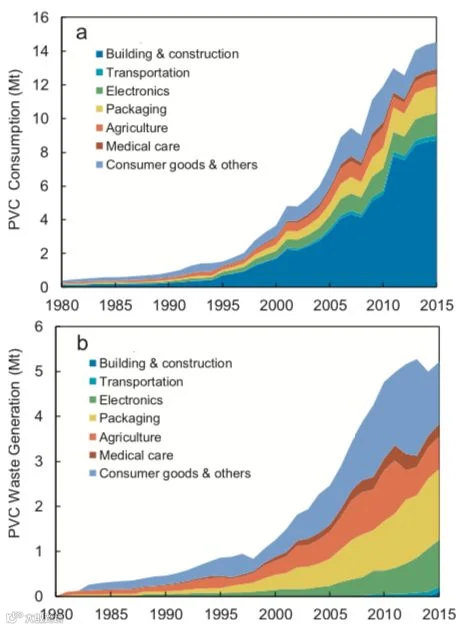
图1 中国1980-2015年不同部门的PVC年消费总量和PVC废弃物年产生量

图2 中国1980-2015年人均PVC消费量和PVC废弃物产生量

图3 中国PVC物质流动分析

图4 中国PVC累计废弃量
(a)正常消费情景;(b)废弃物处理量有限情景
4-原文信息
Abstract: Polyvinyl chloride (PVC) is a widely consumed plastic material and may lead various environmental pollutions. China produces and consumes the largest amount of PVC material in the world, owing to its rapid urbanization and economic growth. Herein, we establish a dynamic material flow analysis methodology for quantifying PVC stocks and flows in China, including material input, manufacturing and consumption distribution, and waste management stage. We examine the material flow of PVC in China from 1980 to 2015. The PVC trajectory analysis from 2016 to 2050 is based on the historical PVC material consumption data and scenario analysis. Total amount of PVC consumption in all types of products dramatically increased from 0.4 Mt (0.4 kg/capita) in 1980 to 14.5 Mt (10.7 kg/capita) in 2015, with a cumulative amount of 173.7 Mt. The rapid increase of PVC con- sumption in China significantly accelerated the PVC waste accumulation, reaching 66.3 Mt, accounting for 38.2% of total PVC use from 1980 to 2015. Building & construction sector has the largest PVC in-use stock, while consumer goods sector generated the largest PVC waste. In recent fifteen years, mechanical recycling, chemical recycling, incineration, and landfill of PVC waste ratios are 25.5%, 0.8%, 9.3%, and 36.0%, respectively. The PVC trajectory analysis shows that by the end of 2050, the accumulative PVC waste in China will be 508.6 Mt in the limited growth scenario and 562.0 Mt in the business as usual scenario. Based on the MFA results, policies for improving PVC recycling system were analyzed in this work.
本期小编:
陈楚珂,中国科学院城市环境研究所,博士研究生。
更多优秀论文
尽在RCR
Resources 丨 Conservation 丨 Recycling
欢迎加入公众号编辑团队,简历请投至邮箱:
rcr-office@umich.edu
谈笑有鸿儒:请留言!
都说点赞会变美!不信你试试
