


原文链接:
https://www.sciencedirect.com/science/article/pii/S0921344919304999

图片来源:https://m.sohu.com/a/235664253_100075065(侵删)
文章导读
电动汽车利用来源多样化的电能取代传统化石能源,不但可以显著提高能源转化效率,而且有助于减少温室气体排放、改善空气质量、降低噪声污染。此外,车辆的电动化还能提高国家的能源安全性,实现可持续发展。因此,电动汽车行业受到各国政府的重视而取得了飞速发展。
然而,目前媒体和公众主要关注电动汽车电池组的生产和使用阶段,对电池组的报废回收过程却知之甚少。作为电动汽车的核心部件,动力电池组含有较高含量的锂、钴等关键金属,报废后有极大的回收潜力。本研究通过分析电池组的可回收程度和比较不同回收方式的优缺点,为电池回收产业的发展做出了贡献。
文章亮点
1. 电池组可能成为锂、钴、镍和铜的有吸引力的来源。
2. 电池组中铜和镍的浓度通常比经济矿石高一个量级。
3. 与机械回收相比,热回收方式所需的可变成本更低。
4. 机械回收需要比热回收消耗更多的时间,但热回收会消耗更多的能量。
5. 考虑到锂的回收,机械回收方式的最大可回收金属值更高。
原文摘要
尽管预计在未来十年内将有数百万辆电动汽车(Electric Vehicles, EV)上路,但当前的锂离子电池(Lithium-ion battery, LiB)回收基础设施仅限于针对锂和钴等战略金属。考虑到锂和钴在新兴的绿色技术中的重要性,各国政府将其作为战略金属,同时由于这些金属供应区域集中、可替代性低和报废回收率低而具有较高的供应中断的风险,因此也被作为关键金属。本文旨在帮助利益相关者形成“电动汽车电池组可作为战略金属的一种来源”的概念,同时也旨在帮助提高锂和钴的报废回收率。尤其是,本文论证了电动汽车电池组相比于自然资源其作为金属来源的价值,并概述了热回收和机械回收过程在能耗、可变成本和最大可回收金属价值三个方面的优缺点。研究结果表明,电动汽车电池组中锂、钴、镍和铜的含量通常高出各自的经济矿石一个数量级。由于钴、锂和镍是正极活性材料的一部分,当将EV电池组拆解成单个的电池时,它们的浓度就会增加。在热回收和机械回收的过程中,关键是对处理时间和回收锂的能力这两者进行权衡。热回收比机械回收需要的处理时间更少,从而降低了每个电池组的可变成本,但是机械回收产生的最大可回收金属价值更高,因为锂可以与钴、铜和镍一起回收。

图1 经济采收率边界和经济矿物中金属稀(释)度
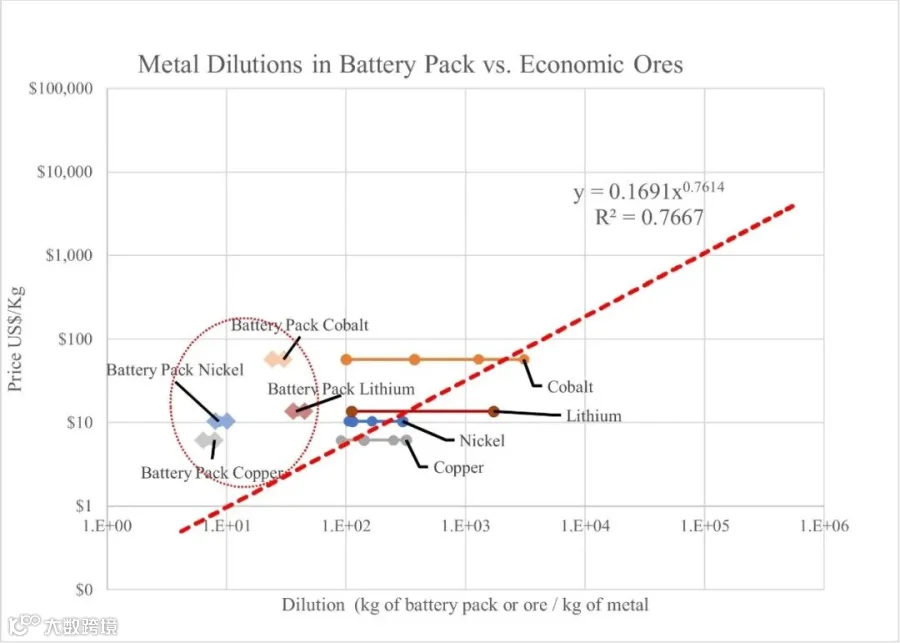
图2 电池组与经济矿物金属稀(释)度对比图

图3 预处理产品熵比较

图4 电池拆解过程的熵变情况及预处理的耗能情况

图5 电池拆解过程的熵变情况及预处理的可变成本
原文信息

Abstract
Current lithium-ion battery (LiB) recycling infrastructure is limited for strategic metals such as lithium and cobalt, despite projections that millions of electric vehicles (EVs) will hit the road in the next decade. Governments have labeled lithium and cobalt as “strategic” due to their importance in emerging green technologies as well as “critical” due to the increased risk of supply disruption resulting from geographic supply concentration, low substitutability, and low end-of-life recycling rates (EOL-RR’s). This paper aims to assist stakeholders conceptualize EV battery packs as a source of strategic metals and to help improve EOL-RR’s for lithium and cobalt. Specifically, this paper demonstrates the value of EV battery packs as a source of metals compared to natural resources and outlines advantages and disadvantages of thermal and mechanical recycling processes in terms of energy consumption, variable costs and maximum recoverable metal value. Findings suggest that EV battery packs contain favorable concentrations – often 1 magnitude higher – of lithium, cobalt, nickel and copper compared to respective economic ores. Disassembling the EV battery pack to the cell level increases cobalt, lithium and nickel concentrations since they are part of the cathode active material. Between thermal and mechanical recycling processes, the key tradeoff is between process time and ability to recover lithium. Thermal recycling requires less processing time than mechanical recycling, resulting in lower variable costs per battery pack, but mechanical recycling yields a higher maximum recoverable metal value since lithium can be recovered along with cobalt, copper and nickel.
本期编辑
段临林,中国科学院城市环境研究所,博士研究生,研究方向:资源代谢及其环境效应
更多优秀论文
尽在RCR
Resources 丨 Conservation 丨 Recycling
欢迎加入公众号编辑团队,简历请投至邮箱:
rcr-office@umich.edu
谈笑有鸿儒:请留言!
都说点赞会变美!不信你试试
