


原文链接:
https://www.sciencedirect.com/science/article/abs/pii/S0921344920301105?via%3Dihub

(图片来源于网络,侵删)
文章导读:
水、能源和食品是我们日常生活和经济发展必不可少的基础资源。这三类资源彼此相互依赖、互相影响,其构成的复杂网络即为Water-Energy-Food (WEF) nexus。可用资源数量是资源安全评估考虑的主要因素,量化资源消耗可以揭示系统内所需的额外资源。全生命周期评价是可评估整个生产周期内总资源消耗和潜在环境影响的方法。本研究不仅量化了台湾地区水和能源的流动,还区分了产品生产过程中的资源直接消耗以及产品准备过程中的间接消耗。此外还确定了每个过程所造成的环境影响以及如何改进间接操作减轻环境影响。总之,该研究有助于制定节约水资源和能源的相关政策,避免低估资源消耗,加强资源安全。
文章亮点:
1. 全面了解WEF耦合的资源消耗情况;
2. 有效避免对资源消耗和环境影响的低估;
3. 有利于实现WEF资源安全过渡。
文章摘要:
本研究旨在利用全生命周期的方法研究直接和间接资源消耗所带来的环境影响,从而弥补我们对于水-能源-食品(WEF)耦合认知的不足。在台湾,食品系统是水资源和能源密集型的,几乎99%的水和能源都直接用来生产食品。水资源系统直接消耗87.18%能源用于生产水,间接消耗12.82%的能源用于为生产和供应水做准备。而能源系统在产能预备阶段可间接消耗91%的能源以及83%的水资源。因此,在食品系统中直接的资源消耗以及能源系统中间接的资源消耗会造成比其他因素更严重的环境影响。结果强调对环境的影响不仅仅来自直接资源消耗还来自资源的准备和生产过程,即间接消耗。大约28%的环境影响都来自WEF耦合系统中间接的资源消耗。不考虑间接资源消耗会造成对总资源消耗量以及环境影响的低估。本研究有助于节约水资源和能源制定政策并加强资源安全。
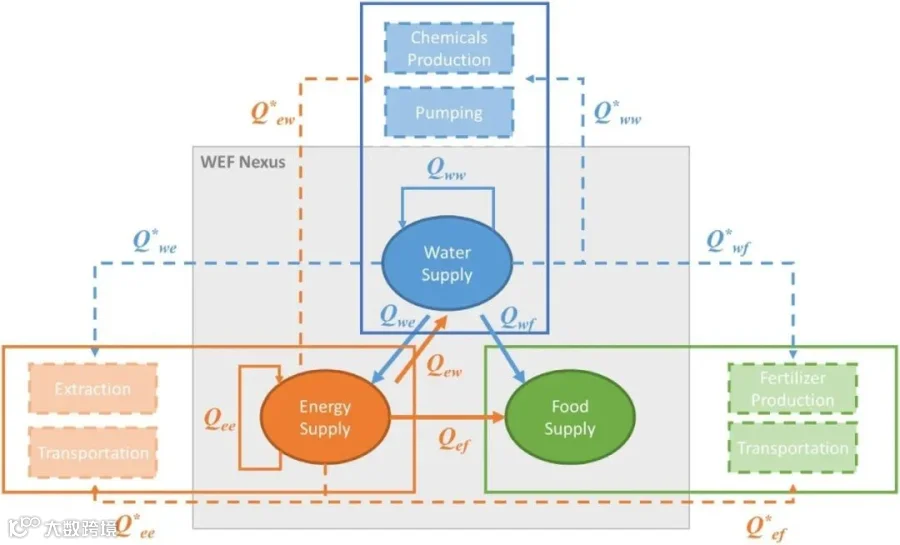
图1. WEF耦合的系统边界

图2. 台湾水的供应和消费

图3. 台湾能源的供应和消费

图4. WEF耦合中各子系统能源和水的直接和间接消耗

图5. WEF耦合中直接和间接消费资源的环境影响
原文信息:

ABSTRACT
This study is an attempt to fill a knowledge gap in our understanding of WEF nexus, focusing on the effects of direct and indirect resource consumption with a life-cycle approach. In Taiwan, the food subsystem is water- intensive and energy-intensive, consuming 99% of water and energy resources directly to produce food. The water subsystem directly consumes 87.18% of its energy for water production, but indirectly consumes 12.82% for operations to prepare for water production and supply. However, the energy subsystem indirectly consumes 91% of the energy and 83% of the water from operations to prepare for energy generation. Consequently, direct resource consumption in the food subsystem and indirect operations in the energy subsystem cause more environmental impacts than those caused by others. The results highlight that environmental impacts derive from not only direct resource consumption but also preparation and production for resource generation (indirect consumption). There are approximately 28% of environmental impacts derived from indirect resource consumption in WEF nexus. Without considering the indirect resource consumption, we will underestimate the total resource depletion and environmental impacts. This study can help in developing policies for saving water and energy and in enforcing resource security.
本期小编:
崔蕴晗,大连理工大学,硕士研究生
研究方向:物质流分析
更多优秀论文
尽在RCR
Resources 丨 Conservation 丨 Recycling
欢迎加入公众号编辑团队,简历请投至邮箱:
rcr-office@umich.edu
谈笑有鸿儒:请留言!
都说点赞会变美!不信你试试
