


原文链接:
https://www.sciencedirect.com/science/article/pii/S0921344919305233

图片源于网络(侵删)
文章导读
原材料关键性的研究是针对特定时间段内的特定利益相关者群体,评估原材料的经济和技术依赖性以及供应中断的可能性。关键性评估对于行业和决策者都起着重要作用,例如材料选择、产品和流程设计、投资决策、贸易协议、合作策略。
关键性评估可以针对特定产品、技术、企业、国家或地区甚至全球,并且可以在不同时间尺度上开展,例如短期(几年)或者长期(几十年)。此外,评估方法通常使用多种指标来反映影响因素,包括地质、技术、地缘政治、社会和环境因素。进行此类研究的立足点和目的有所区别,因此关键原材料的识别过程及结果存在很大差异,目前尚没有通用的标准方法来进行关键性评估。
本文旨在阐明研究人员使用不同评估方法的原因,特别关注关键性评估的框架(目标、范围),其次是评估方法本身(指标、汇总、表述)。
文章亮点
(1)原材料关键性研究目标和范围不同会导致结果差异。
(2)指标和结果的因果机制研究不足。
(3)数据质量限制了关键性评估的开展。
(4)为支持决策,关键性研究方法需要公开。
文章摘要
原材料关键性评估可以预判供应链中断的可能性以及对系统(例如国家的经济,技术或公司)的整体影响。为解析原材料关键性评估方法选择上的核心因素以提升评估流程的准确性,本文整理归纳了研究文献以及国际专家间圆桌讨论内容,阐明了当前关键性研究中预期风险、研究目的和方法选择上的差异,发现这些差异会影响评估指标选择、数据聚合级别、汇总方法选择以及阈值的确定。然而,由于缺乏指标和结果间因果关系的系统研究,这种联系不易被发现。数据可用性是限制关键性评估的关键因素。另外,结果分析和讨论中,大多没有涉及数据不确定性、数据代表性等数据质量的相关讨论。在制定关键性研究的目标和范围,选择适当的指标和汇总方法以及对结果进行解释方面,亟需建立一套明确的指导方案,以提高原材料关键性评估的质量。

图1 研究目标和范围影响着材料关键性

图2 材料关键性指示因子

图3 研究数据来源
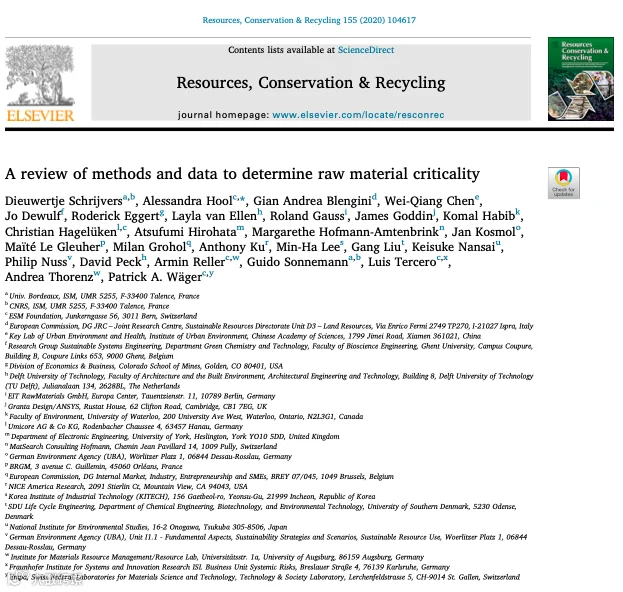
原文信息
Abstract
The assessment of the criticality of raw materials allows the identification of the likelihood of a supplydisruption of a material and the vulnerability of a system (e.g. a national economy, technology, or company)to this disruption. Inconclusive outcomes of various studies suggest that criticality assessments wouldbenefit from the identification of best practices. To prepare the field for such guidance, this paper aims toclarify the mechanisms that affect methodological choices which influence the results of a study. This isachieved via literature review and round table discussions among international experts. The paper de-monstrates that criticality studies are divergent in the system under study, the anticipated risk, the purposeof the study, and material selection. These differences in goal and scope naturally result in different choicesregarding indicator selection, the required level of aggregation as well as the subsequent choice of ag-gregation method, and the need for a threshold value. However, this link is often weak, which suggests a lackof understanding of cause-and-effect mechanisms of indicators and outcomes. Data availability is a keyfactor that limits the evaluation of criticality. Furthermore, data quality, including both data uncertaintyand data representativeness, is rarely addressed in the interpretation and communication of results. Clearguidance in the formulation of goals and scopes of criticality studies, the selection of adequate indicatorsand aggregation methods, and the interpretation of the outcomes, are important initial steps in improvingthe quality of criticality assessments.
本期小编:
陈楚珂,中国科学院城市环境研究所博士研究生。
更多优秀论文
尽在RCR
Resources 丨 Conservation 丨 Recycling
欢迎加入公众号编辑团队,简历请投至邮箱:
rcr-office@umich.edu
谈笑有鸿儒:请留言!
都说点赞会变美!不信你试试
