


原文链接:
https://www.sciencedirect.com/science/article/pii/S0921344920302251

图片来源于网络,侵删
文章导读

塑料的回收利用是向循环经济过渡的关键环节,欧洲国家计划到2030年将包装废弃物的回收率提高到70%,其中塑料材料的回收率要达到55%。消费剩余聚合物通常掺杂有添加剂、粘合剂等非聚合成分,回收处理过程复杂,而且这些物质的分解会形成复杂的挥发混合物,造成回收塑料异味,使得目前大量塑料废料仅适用于向下循环。为解决这一问题,人们开始关注更为先进的废料洗涤程序。然而,对洗涤效率进行量化,需要先明确哪种分析方法最适合塑料废物上这些复杂的潜在气味源头混合物。现有研究虽然很好地概述了来自原始物质以及某些来源的废弃塑料中各种潜在的有味物质,但是仍需要一种能够在洗涤过程中测量各种有味成分去除效率的技术。最为重要的是,这种技术必须快速可靠,因为每种塑料废物流的成分都存在很大差异。本研究旨在开发一种结合GC-MS分析的采样方法,以测定复杂塑料废料流中可能产生气味的污染物。本研究探索了三重采样技术,以探讨其量化污染物去除效率的潜力。这些技术还被应用于案例研究中,以监控整个回收链中潜在的异味成分。

原文摘要

欧洲国家坚定致力于塑料,尤其是包装的回收。在闭环回收利用过程的开发中,回收物品必须具有包括异味少在内的适当特性。本研究的主要目的是开发一种技术,定性和半定量地分析这些复杂塑料废料基质在洗涤程序前后产生的挥发性污染物。我们一共探索了三种采样方法:固相微萃取技术(SPME),和同属吹扫捕集法的活性炭溶剂解吸法和Tenax-TA热解吸法,然后使用气相色谱-质谱进行分析。由于废料样品的异质性和方法的静态特性,固相微萃取技术不能做重复实验。二硫化碳的溶剂解吸(RSD 14.5%)和热解吸(RSD 13.4%)能够以半定量方式测量污染物的去除效率,可以检测到化学差异宽泛但大部分为非极性的挥发物。另外,很显然,对挥发性较低的组分的分析也是必不可少的,因为这些组分牢固地粘附于疏水性聚合物基质上。在洗涤和造粒工序前后,对消费剩余的液膜废物流进行分析,用热解吸法和溶剂解吸法分别测定了所筛选组分的总降解率分别为97%和44%。然而,经过再处理,潜在的可产生气味的化合物会再次生成或释放,体现了塑料回收过程中去除异味的复杂性。

图解摘要


图1 图片摘要

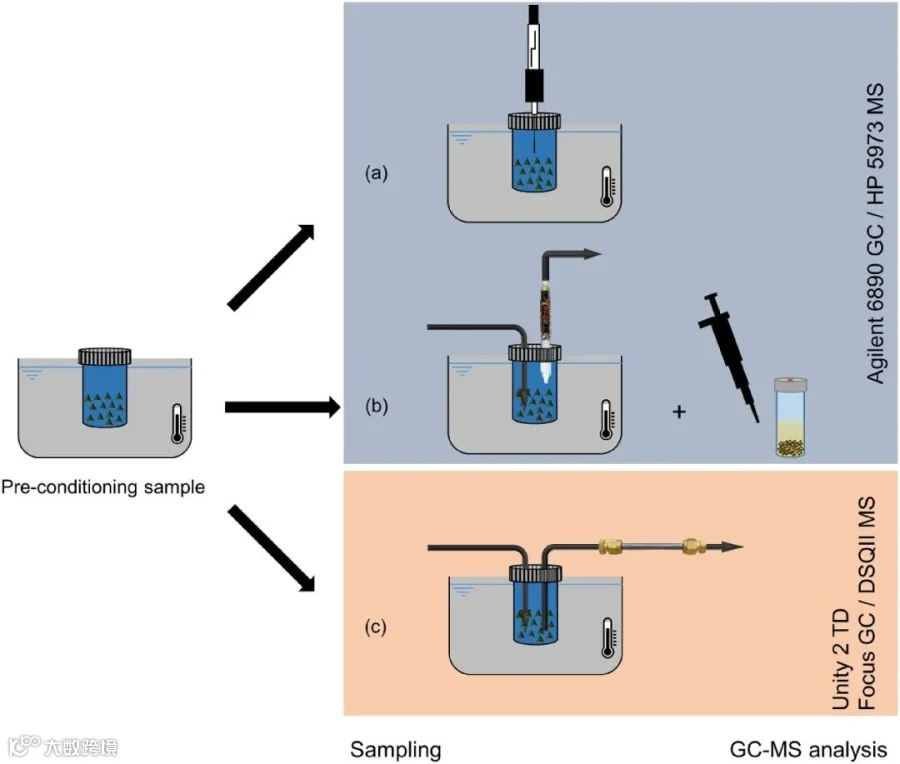
图2 应用采样技术概述:(a)SPEM采样;(b)活性炭取样和溶剂解吸;(c)Tenax-TA管取样和热解吸

图3 附聚材料的SPME(Agilent 6890 GC程序)、溶剂解吸(Agilent 6890 GC程序)和热解吸(Thermo Scientific Focus GC程序)的色谱图比较。

图4 热解吸和溶剂解吸检测的组分关于log Kow、沸点和分子量的函数

图5 废料液膜、洗涤液膜和重颗粒材料的顶部空间组成:(a)热解吸取样;(b)溶剂解吸取样

原文信息

Abstract
Europe is strongly committed to the recycling of plastics, especially packaging. In the development of closed loop recycling processes, recyclates must have appropriate properties, including lack of odour. The main objective of this study was to develop a technique to qualitatively and semi-quantitatively analyse the volatile contaminants in these complex plastic waste matrices before and after washing procedures. Three sampling methods were explored, SPME and purge and trap methods (activated carbon with solvent desorption and Tenax-TA with thermal desorption). All analyses were then carried out using gas chromatography-mass spectrometry. SPME was not repeatable due to the heterogeneity of the waste samples and the static character of the method. Solvent desorption with CS2 (RSD 14,5 %) and thermal desorption (RSD 13,4 %), were capable of measuring the removal efficiency of pollutants in a semi-quantitative way. A broad spectrum of chemically different, but mostly apolar volatiles can be detected. In addition, it became clear that also the analysis of the less volatile components is essential, as these are strongly adhered to the hydrophobic polymer matrix. A post-consumer film waste stream was analysed, before and after washing and pelletizing. A general decrease of 97 % and 44 %, was measured with respectively thermal and solvent desorption for the screened components. However, after reprocessing potentially odour-causing compounds are again released or formed, showing the complexity of odour removal processes in plastic recycling.


本期编辑
仲维辰,吉林大学新能源与环境学院,硕士研究生
研究方向:能源、经济与环境管理
更多优秀论文
尽在RCR
Resources 丨 Conservation 丨 Recycling
2019年影响因子:8.086
欢迎加入公众号编辑团队,简历请投至邮箱:
rcr-office@umich.edu
谈笑有鸿儒:请留言!
都说点赞会变美!不信你试试
