


原文链接: https://www.sciencedirect.com/science/article/pii/S0921344920303438

图片来源于网络(侵删)
文章导读

2016年11月4日《巴黎协定》正式生效。这一气候变化协定的参与国承诺将全球气温升高幅度控制在2℃的范围之内。然而承诺国报告的碳排放量及其减排目标主要基于区域或生产者标准,忽视了国际贸易在其中的作用。现有的标准也都没有关注跨国公司的碳排放责任。
在本研究中,作者将基于控制的会计准则应用于欧盟境内经营的跨国公司。首先,将跨国公司的碳排放责任划分给控制国(也就是在欧盟境内运营有分支机构的跨国公司的实际控制国),由此计算出跨国公司的碳足迹。利用计算出的碳足迹,量化每个欧盟国家的跨国公司在排放产生方面的作用。并评估各国的碳排放责任在考虑企业所有权时将如何变化。最后,计算这种方法下欧盟内部的碳排放责任分配。
文章摘要

以领土为基础的环境承诺概念忽视了跨国企业在全球温室气体产生中的关键作用。这种误解阻碍了跨国公司实现其承诺的减排目标,并免除了跨国公司控制国对其在国外产生碳排放的全部责任。本文提出了一种基于跨国公司控制主体的新的分配准则,即基于控制的会计准则。我们首次将其应用于在欧盟境内经营的跨国公司分支机构,并估算欧盟国家在基于控制的准则下的二氧化碳排放责任。也就是说,将外国控制公司产生的排放量分配给公司的控制国,而不是东道国。我们发现,德国和法国是欧盟国家中以控制为基础的碳排放责任最大的国家,而波兰、捷克和匈牙利在这种分配方式下承担的责任要比其他分配方式少得多。作为一个非欧盟国家,美国在欧盟境内通过分支机构对实际产生的碳排放负有最大责任。以气候政策为目标,引导母公司和控制国计算并减少其分支机构的碳足迹,将使跨国公司处于应对气候变化的前沿。

图1 生产者足迹(PF,producer footprint)核算与基于生产和基于消费的方法的异同
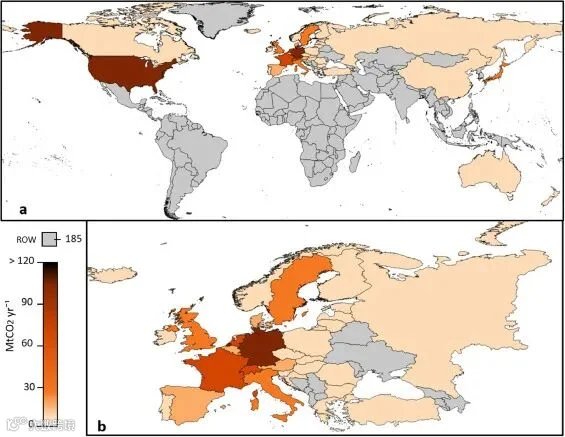
图2 按控制国划分的欧盟境内外国分支机构的PF。a.世界各国;b.欧洲国家缩放

图3 按东道国和从主要控制地区流向其目的地的外国分支机构的PF

图4 按行业和控制国划分的欧盟内外国分支机构的PF

图5 欧盟内部按国家划分的PF流量平衡

图6 按国家划分的基于控制的责任,PBA(production-based accounting,基于生产的核算)(a)和CBA(consumption-based accounting,基于消费的核算)(b)。条形图表示绝对数的偏差(左轴),而百分比的偏差则由紫红色三角形(右轴)表示

图7 基于控制的欧盟内外实际排放份额
原文信息


Abstract
The territory-based conception of environmental commitments disregards the crucial role of multinational enterprises (MNEs) in the global generation of greenhouse gases. Such a misconception discourages MNEs from pledging own emissions reduction goals as global agents and exempts their origin country of any responsibility for the emissions they generate abroad. We propose a new allocation criterion based on who has the ability to take MNEs’ decisions called the control-based accounting. We apply it for the first time to the MNEs’ foreign affiliates operating in the EU and estimate the CO2 emissions responsibility of EU countries under the control-based criterion, that is, assigning emissions generated by foreign-controlled companies to the origin country of the firms (controlling country) instead of the host country (as in the territory-based approach). We found that Germany and France are the EU countries with the highest control-based responsibilities; whereas Poland, the Czech Republic and Hungary bear significantly less responsibility under this approach compared to other allocation methods. The United States is the non-EU country with the greatest responsibility for emissions physically generated within the EU's territory through foreign affiliates. Targeting climate policies towards inducing parent companies and controlling countries to calculate and reduce the carbon footprint of their affiliates would place MNEs at the forefront of the fight against climate change.
本期编辑:
胡蕾,南昌大学,研究方向:循环经济。
更多优秀论文
尽在RCR
Resources 丨 Conservation 丨 Recycling
2019年影响因子:8.086
欢迎加入公众号编辑团队,简历请投至邮箱:
rcr-office@umich.edu
谈笑有鸿儒:请留言!
都说点赞会变美!不信你试试

由于近期微信更改了订阅号的推送规则,很多朋友不能快速找到我们,其实我们每天都在推送!您可以将RCR期刊设置为星标,就能在微信订阅号中快速找到我们,查看每天订阅。
