


原文链接:
https://www.sciencedirect.com/science/article/pii/S0921344920305784

图片来源于网络(侵删)
(1)揭示了以回收利用替代焚烧的碳减排潜力。
(2)推进了循环政策中MRC (Materially Retained Carbon, 物质残留碳)概念的研究。
(3)代表MRC回收效益的直接碳减排仅是冰山一角。
(4)间接碳减排(产业链上游的碳减排)比直接碳减排多了1.4倍。
(5)引入适当的回收法规有机会实现390万吨的碳减排。
为了降低能源生产带来的碳排放,世界各国已经在碳捕捉、碳储存、碳利用及以可再生能源替代化石能源等议题上达成了共识。除了能源生产,产品消费也是碳排放的重要来源之一。焚烧处于EoL(end-of-life,生命末期)的含碳产品将产生大量的二氧化碳。而对这类产品中的含碳材料进行回收利用,能延长MRC的周期,规避焚烧产生的碳排放,并有助于削减产业链各部门的产量,进而大幅降低由生产带来的碳排放。
以往的研究聚焦于回收的材料和技术,仅揭示了含碳材料回收的部分碳减排潜力。回收过程中由技术使用消耗能源带来的碳排放,也被包含在碳减排潜力中。本文试图克服以往研究的缺陷,量化含碳材料回收的碳减排潜力。本研究结合2011年日本家庭消费数据和投入产出方法,对产品中可回收碳和产业链上游隐含碳排放的碳减排潜力进行量化。研究结果能够为家庭消费的EoL产品设定回收MRC的目标提供参考。
对于能源供应脱碳以外的深度碳减排,回收释放到大气中的MRC直接减排潜力巨大。回收材料的使用,间接地减少了原始材料全生命周期产生的碳足迹,否则,这些原始材料将进入人类活动周期。这些事实在以往关于回收技术的生命周期评价和碳足迹核算的研究中已经被充分揭示。然而,聚焦于特定的废弃物和回收技术有可能限制回收活动的未来发展。本研究运用基于投入产出的物质流分析,全面量化回收活动的碳减排潜力。在本文中,我们量化了2011年日本整体经济的碳减排潜力。研究表明,如果最大限度地从家庭回收MRC,将减少1280万吨的直接碳排放和1750万吨的间接碳排放,远远超过由废弃物焚烧所带来的潜在碳减排量(310万吨)。此外,我们发现,焚烧未被纳入回收法规的含塑料产品可能导致390万吨的碳排放。这些是对围绕整个国家经济结构的消费后回收的碳减排潜力的初步估计。这一估计不包含回收过程中由能源消耗引起的碳排放,也并未考虑回收活动中必要的能源使用。价值链上既定的直接和间接减排结构可以有效地引导回收技术和政策朝着社会深度脱碳的方向发展。

图1 碳减排潜力的冰山示意图

图2 十大包含MRC的可回收产品

图3 含碳量(x轴)与含碳材料的隐含碳排放(y轴)

图4 2011年回收日本家庭消费后的MRC材料的碳减排潜力冰山示意图

图5 十大碳减排产品
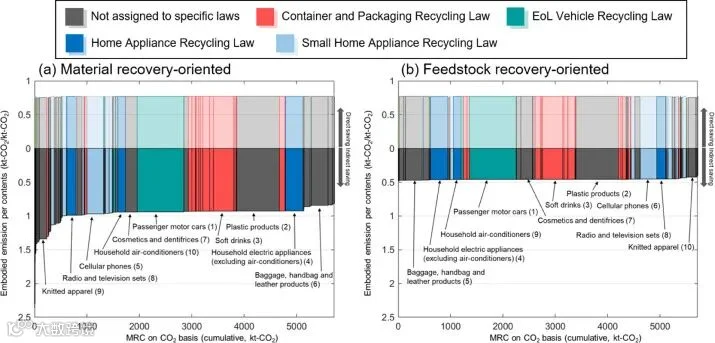
图6 冰山图与塑料回收法规之间的关系:
(a)以材料回收为导向的回收
(b)以原料回收为导向的回收
Abstract
For deep carbon emission reductions beyond decarbonization of the energy supply, among reduction streams, recycling-induced elimination of materially retained carbon (MRC) releases to the atmosphere have a great direct reduction potential. Moreover, the use of recycled materials indirectly avoids the manifestation of cradle-to-gate carbon footprints of virgin materials that would otherwise enter anthropogenic cycles. These facts have been individually revealed by preceding studies on lifecycle assessment of recycling technologies and carbon footprint accounting. However, the limited focus on specific wastes and technologies for recycling might narrow the range for the future development of recycling activities. This study comprehensively quantifies the carbon emission reduction potential of recycling activities through an input-output based material flow analysis. Here, we reveal the Japanese economy-wide potential emission savings, both direct (12.8 × 10⁶ t-CO2) and indirect (17.5 × 10⁶ t- CO2), that could have been achieved through maximal MRC recycling from households (i.e. post-consumer recycling) in 2011, outweighing potential energy recovery through waste incineration (3.1 × 10⁶ t-CO2). Further, we found that incineration of plastic-containing products currently not covered by recycling laws is likely to cause 3.9 × 10⁶ t-CO2 emission. These are first-order estimates of reduction potentials of post-consumer recycling encompassing the entire national economic structure. Energy-induced carbon emissions in recycling activities are excluded from these estimates, allowing for deduction of acceptable energy usage for recycling activities. The identified structures of direct and indirect reductions on value chains allow for efficiently directing the advancement of recycling technologies and policies toward the deep decarbonization of society.
刘祎炜,南昌大学经济管理学院,硕士研究生
更多优秀论文
尽在RCR
Resources 丨 Conservation 丨 Recycling
2019年影响因子:8.086
欢迎加入公众号编辑团队,简历请投至邮箱:
rcr-office@umich.edu
谈笑有鸿儒:请留言!
都说点赞会变美!不信你试试

