


原文链接:
https://www.sciencedirect.com/science/article/abs/pii/S0921344921001415

图片来源于网络(侵删)
01
文章导读
以牺牲自然资源和生态环境为代价的经济发展在发展中国家经常发生,特别是在中国。改革开放以来,中国经济快速增长,创造了举世闻名的“增长奇迹”。相应地,多处自然资源被过度开发,生态环境遭到破坏。无论是环境库兹涅茨曲线还是资源诅咒的假设被证明在中国已经发生了。不考虑可持续性的经济发展导致环境恶化和资源枯竭,这危及人类和环境的福祉。国民经济增长速度已不再适合评价经济发展质量,绿色经济效率(GEE)成为新的衡量指标。随着后发经济的优势逐渐消失,地方政府的关注重点已从鼓励模仿技术创新转向自主创新。技术创新提高了生产要素的投入产出比,改善了资源利用率,提高了总要素的生产力。文献分析表明,关于技术创新与GEE关系的研究较少,并缺乏两者作用机制相关的研究。本研究选择技术创新作为核心解释变量来探讨创新对 GEE 的影响。
02
文章亮点
1.用数据包络分析和交叉效率博弈模型来评估278个中国城市的绿色经济效率。
2.运用空间计量经济学模型来探索技术创新对绿色经济效率的影响。
3.本研究将自然资源和城市化作为中介变量。
4.不同地区的技术创新对绿色经济效率的影响不同。
03
原文摘要
理解技术创新和绿色经济效率之间的关系和机制,可以促进新兴经济体的城市绿色经济的增长。以中国的278个地级城市为例,本文运用数据包络分析和交叉效率博弈模型来测算2003到2017年的绿色经济效率。此外,本文还运用空间计量经济学模型,从自然资源和城市化的角度上探讨技术创新和绿色经济效率之间的关系和转化机制。同时,本文也考虑了城市发展的异质性。本文的主要结论如下:(1)绿色经济效率空间正相关;(2)在全国范围内,技术创新的集聚效应是显著的并且可以促进绿色经济效率的提高;(3)由于城市发展的异质性,技术创新与绿色经济效率之间的联系与机制存在较大的差异。因此,“单边”的绿色经济策略可能达不到预期的效果。因此,临近城市应该积极地打造绿色经济城市群,实现区域共同发展。东部地区政府应该加快城市经济地转型,并通过技术创新来促进产业地绿色标准地升级。中部地区的政府应该引导科研人员改变研究重点,而西部地区则需要依靠吸引科研人员来实现绿色经济发展。我们的研究结论不仅丰富了相关的文献,也对新兴经济体的政策制定城市规划具有一定的指导意义。

图1 分析框架

图2 调节效应检验的流程图
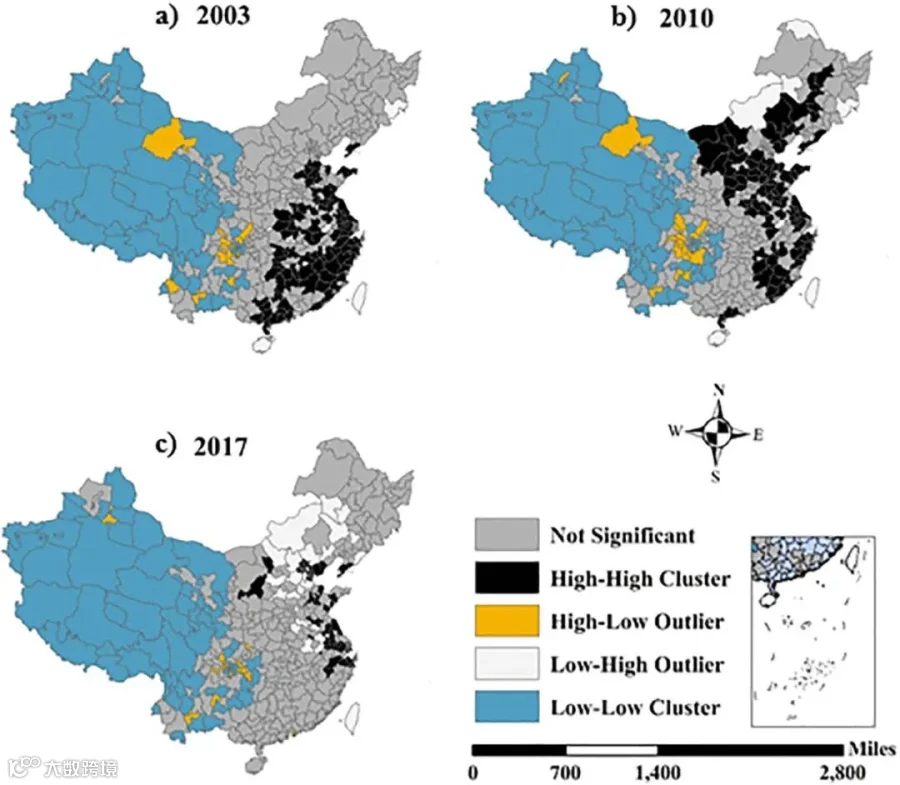
图3 中国GEE的LISA聚类图
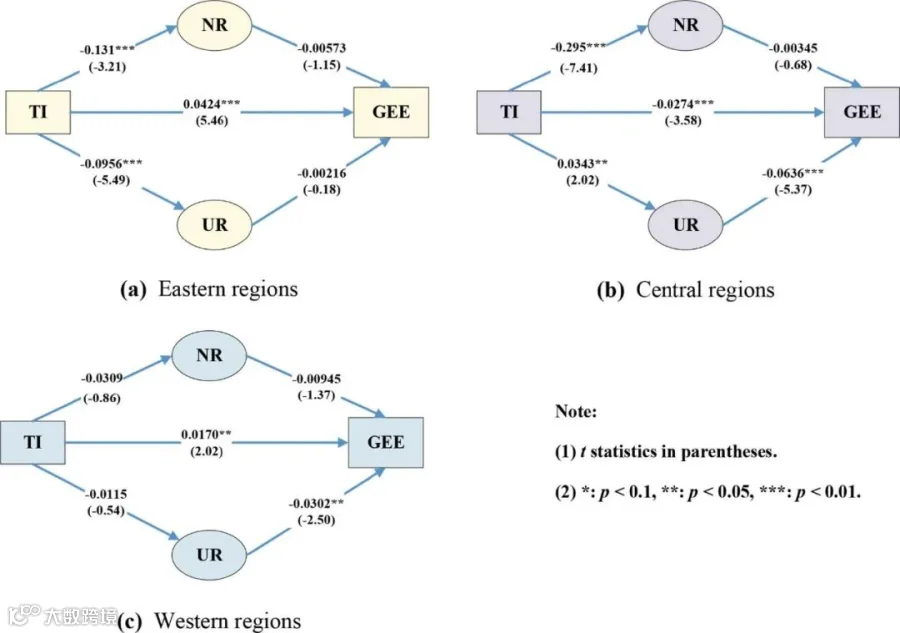
图4 中国东、中和西部地区技术创新对GEE的影响和转化机制
04
原文信息

Abstract
Clarifying the relationship and mechanism between technological innovation and the green economy efficiency (GEE) will improve the growth of the urban green economy for emerging economies. In the case of 278 Chinese prefecture cities, the data envelopment analysis game cross-efficiency model was used to measure the GEE between 2003 and 2017. In addition, the spatial econometric model was employed to explore the relationship and the transmission mechanism between technological innovation and the GEE from the perspectives of natural resources and urbanization. The heterogeneity of urban development was also brought into the analysis. The main results are as follows. (1) The GEE had positive spatial correlations. (2) Nationally, the intensive effect of technological innovation was significant and could considerably improve the GEE. (3) Due to the heterogeneity of urban development, there were large differences in the relationships and mechanisms between technological innovation and the GEE. Accordingly, that “unilateral” green economy construction efforts may not achieve ideal results. Therefore, neighboring cities should actively create green economy city cluster to achieve regionally common development. The eastern local governments could accelerate the transformation of the urban economy and promote the upgrading of green standards in industry through technological innovation. It is important for the central city governments to guide researchers to change the focus of their research, whereas the western region relies on attracting researchers to realize green economic development. Our results not only contribute to advancing the existing literature, but also are of considerable interest to policy makers and urban planners in emerging economies.
本期编辑
董朝晖 吉林大学博士研究生,研究方向:闭环供应链和可持续运营管理

点击蓝字
关注我们