




原文信息

原文标题:
Recovery of phosphate from municipal wastewater as calcium phosphate and its subsequent application for the treatment of acid mine drainage
原文作者:
Collen Nepfumbada, Nikita Tawanda Tavengwa, Vhahangwele Masindi, Spyros Foteinis,
Efthalia Chatzisymeon
作者单位:
文达大学数学与自然科学学院化学系
关键词:
酸性和含金属排水(AMD)和酸性岩石排水(ARD)、可持续废水管理、水资源回收、废水稳定化、矿物合成和回收、零液体排放(ZLD)和循环经济
原文链接:
https://doi.org/10.1016/j.resconrec.2022.106779

文章摘要

本文提出了城市污水(MWW)和酸性矿山排水(AMD)的联合管理,其中从MWW回收的低值磷用于处理AMD。具体而言,MWW使用氢氧化钙(Ca(OH)2)进行处理,氢氧化钙是一种低成本且易于获得的材料,通过汽提,氨含量大大降低(89%),磷酸盐几乎被消除(>99%)。回收的低值磷材料,以磷酸钙(Ca3(PO4)2)的形式,然后用于处理来自煤矿的AMD。AMD中含有的金属会清除磷,形成新的矿物质,而碱性的增加导致了磷的沉淀。最佳处理条件为接触时间90分钟。在这些条件下,AMD的金属含量(Fe、Mn、Cr、Cu、Ni、Pb、Al和Zn)几乎耗尽(去除率>99%),硫酸盐(SO4)显著降低(90.6%)。结果得到了FTIR、FIB/SEM、EDS/SEM、XRF和XRD的支持。总的来说,这种间接共处理方法对两种废水基质的可持续管理具有巨大的前景,可以为它们的共同管理提供一种简单有效的解决方案,特别是在发展中国家,这也有助于推进联合国的可持续发展目标。

文章亮点

1、成功地进行了酸性矿山排水和城市污水的混合处理。
2、确定了有效处理酸性矿井排水的最佳条件。
3、使用先进和最先进的分析技术来验证化学物种的命运。
4、对城市污水进行选矿,回收磷合成磷酸钙。
5、合成的磷酸钙被稳定化以有效地处理酸性矿井排水。
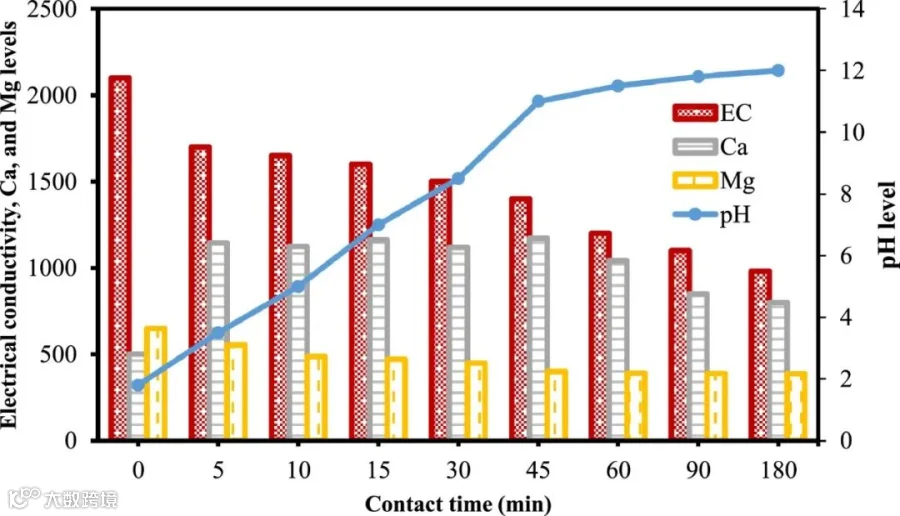
电导率变化(EC)(mS cm−1) ,pH,Ca(mg L−1) 和Mg(Mg L−1) 在用Ca3(PO4)2处理酸性矿井排水(AMD)期间(剂量为10 g/1000 mL,混合速度为250 rpm,室温),随着接触时间的增加(范围为5–180 min)。
。

使用SEM-EDS光谱测定(a)Ca(OH)2、(b)Ca3(PO4)2和(c)生成污泥的元素组成。

FIB-SEM图像显示了在a–c)1μm、d-f)200 nm和g–i)100 nm放大倍数下Ca(OH)2、Ca3(PO4)2和生成污泥的微观结构和形态特征。

Ca(OH)2、Ca3(PO4)2和生成的污泥以及确定的官能团的FTIR光谱。

原文信息


Abstract
Here, the co-managment of municipal wastewater (MWW) and acid mine drainage (AMD) is proposed, where the recovered low-value phosphorus from MWW is used for the treatment of AMD. Specifically, MWW was treated using calcium hydroxide (Ca(OH)2), a low-cost and readily available material, with the ammonia content being greatly reduced (89%) through stripping and phosphates practically eliminated (>99%). The recovered low-value phosphorus material, in the form of calcium phosphate (Ca3(PO4)2), was then used for the treatment of AMD from coal mining. Metals contained in AMD scavenged phosphorous, forming new minerals, and the increased alkalinity led to their precipitation. The optimum treatment conditions were 90 min contact time, 10 g L−1 Ca3(PO4)2 dosage, and room temperature and ambient pH. Under these conditions, AMD's metal content (Fe, Mn, Cr, Cu, Ni, Pb, Al, and Zn) was practically depleted (>99% removal) and sulphate (SO4) greatly reduced (90.6%). Results were underpinned by FTIR, FIB/SEM, EDS/SEM, XRF, and XRD. Overall, this indirect co-treatment method holds great promise for the sustainable management of both wastewater matrices and can provide a simple and effective solution for their co-management, particularly in the developing world context where it could also help in advancing the UN's sustainable development goals.
本期编辑
刘钰沁,中国科学技术大学环境科学与工程系研究生。

由于近期微信更改了订阅号的推送规则,很多朋友不能快速找到我们,其实我们每天都在推送!您可以将RCR期刊设置为星标,就能在微信订阅号中快速找到我们,查看每天订阅。

点击蓝字
关注我们