



01
文章信息
原文标题:
Unveiling the changes of carbon emissions along supply chains: Drivers and sustainable mitigation strategies
原文作者(*通讯):
Jizhe Li , Guohe Huang *, Yongping Li, Lirong Liu
第一作者单位:
Department of Earth System Science, Ministry of Education Key Laboratory for Earth System Modeling, Tsinghua University, Beijing, China
关键词:
气候变化、减缓策略、碳排放、结构路径分解
原文链接:https://www.sciencedirect.com/science/article/pii/S0921344924000429
02
文章导读
本文研究的目标是开发一种面向供应链的方法,用于调查由主要或中间投入(即附加值)驱动的层级和路径级排放变化的驱动因素,以便可以以与需求方驱动因素一致的方式检查供应方驱动因素。然后将进行案例研究,以支持减排政策的制定。具体而言,这一目标包括:
(1)开发基于路径的结构分解方法,以探索供应链和需求链上路径级排放变化的关键驱动因素;
(2)开发基于层的结构分解方法,以评估由初级和中间投入驱动的层级排放变化的主要驱动因素;
(3)从供给和需求的角度研究主要驱动因素对层级和路径级排放变化的影响,并在更高层次的细节上探索理想的减排政策。供应链和需求链上主要驱动因素的影响比较;进一步探讨与部门发展建议相关的预期缓解战略。
03
文章摘要
中国的年碳排放量在2013-2016年期间逐年下降,2016年后有所上升。这种波动引发了关于驱动减少和增加的因素以及维持持续减少的理想途径的重要问题。在考虑供需关系的基础上,我们定量评估了供应链中碳排放变化的社会经济驱动因素。这里我们发现,从供给角度来看,产业调整对服务驱动路径的减排有负面影响。对于涉及发电部门的路径,一次投入结构的调整对路径层面的减排有积极影响(自2007年以来)。建筑部门可调整其消费结构,助力加快系统低碳转型。对于供需导向路径,如果更多的部门参与生产活动,排放强度的缓解效应将会减弱。进一步减排可能依赖于降低排放强度和最大限度地减少深加工产品的利用。

图1.图形摘要

图2. 涉及多个生产层的全部门经济供应链的层级和路径级排放示意图(a)碳排放归因;(b)层级排放和层级排放变化的主要驱动因素;(c)路径级排放和路径级排放变化的主要驱动因素。
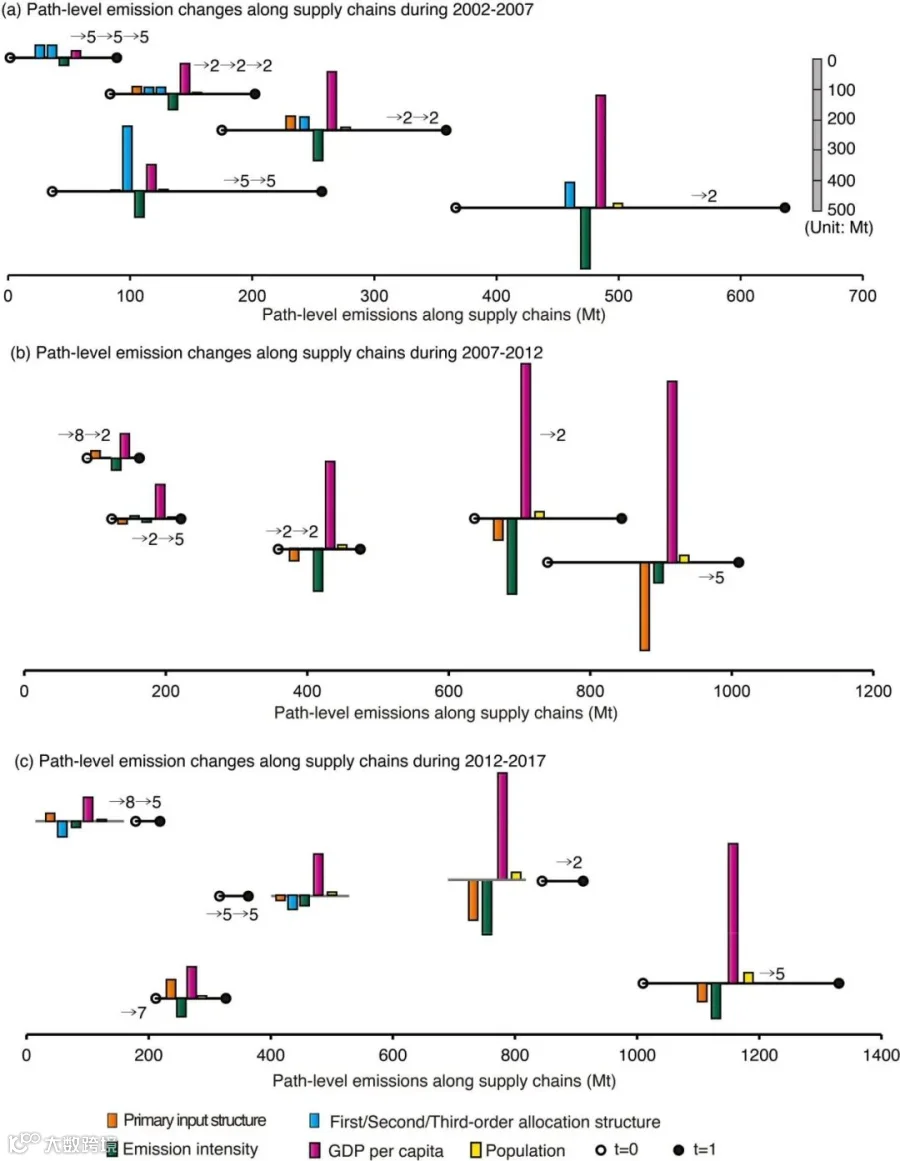
图3. 在(a)2002-2007年、(b)2007-2012年和(c)2012-2017年期间,供应链路径级排放变化最显著的前5条路径。

图4. 在(a)2002-2007年、(b)2007-2012年和(c)2012-2017年期间,需求链上路径级排放变化最显著的前5条路径。

图5. 多种社会经济驱动因素对供应链层级排放变化的贡献。

图6.多种社会经济驱动因素对需求链层面级放变化的贡献。

图7. 涉及一个(a)、两个(b)、三个(c)和四个(d)部门的路径级排放变化的驱动因素贡献分布。驱动因素1AS、2AS、3AS、EI、pGDP、PIS和Pop分别代表一阶、二阶、三阶分配结构、排放强度、人均GDP、初级投入结构和人口。

图8.涉及一个(a)、两个(b)、三个(c)和四个(d)部门的路径级排放变化的驱动因素贡献分布。驱动因素1CS、2CS、3CS、EI、FDS、pGDP和Pop分别代表一阶、二阶、三阶消费结构、排放强度、最终需求结构、人均GDP和人口。
04
原文信息

China’s annual carbon emissions decreased year by year during 2013–2016 and increased after 2016. Such fluctuation prompts important questions about the factors that drove the decrease and increase, and the desired pathway(s) to sustain a continuous reduction. With the consideration of supply-demand relationships, we quantitatively evaluate the socioeconomic drivers of carbon emission changes along supply chains. Here we find that from a supply perspective, industrial adjustment has negative impacts on the emission reduction of servicedriven paths. For paths involving the electricity-generation sector, the adjustment of primary input structure has positive effects on path-level emission reduction (since 2007). The construction sector can adjust its consumption structure to help accelerate the system’s low-carbon transition. For the supply- and demand-oriented paths, the mitigation effects of emission intensity will weaken if more sectors are involved in production activities. Further emission reductions may rely on both reducing emission intensity and minimizing the utilization of deepprocessed products.
本期编辑
张茹雪,北京林业大学环境科学与工程学院,硕士研究生

由于近期微信更改了订阅号的推送规则,很多朋友不能快速找到我们,其实我们每天都在推送!您可以将RCR期刊设置为星标,就能在微信订阅号中快速找到我们,查看每天订阅。