



图片来源网络(侵删)
文章信息
原文标题:
The convenience economy: Product flows and GHG emissions of returned apparel in the EU
原文作者(*通讯):Rotem Roichman, Benjamin Sprecher, Vered Blass, Tamar Meshulam, Tamar Makov*
作者单位:以色列内盖夫本·古里安大学
关键词:
电子商务、消费者退货、纺织品销毁、温室气体排放、网上购物、服饰、循环经济
原文链接:
https://www.sciencedirect.com/science/article/pii/S0921344924004051
文章导读
消费者退货(购买后不久退回给卖家的新产品)是零售业,尤其是电子商务的一个普遍现象。2021 年,平均有 20% 至 30% 的产品被退回,而通过实体店销售的产品退回率仅为 10%。退货率如此之高的部分原因是网上购物本身就具有更大的不确定性,因为消费者在购买前无法触摸、感受或试用产品。据估计,德国每年的消费者退货管理成本为 55 亿欧元,英国为 600 亿英镑。时尚电子商务的份额大幅增长,并预测将继续扩大,高退货率所带来的挑战可能只会越来越大。尽管人们对于快时尚对环境的影响越来越感兴趣,但针对退货产生的温室气体 (GHG) 排放的研究却很少,而且对其整个生命周期的影响仍然知之甚少。
文章亮点
·调查结果显示,22%−44% 的退回服装产品从未到达二级消费者手中。
·未使用的退回产品产生的温室气体排放量可能是退货后运输、包装和加工过程中所有排放量总和的 16 倍。
·研究结果表明,零售业对环境的影响可能一直被低估,尤其是在退货率通常较高的服装电子商务领域。
·高级分级等循环退货管理实践可以显著减少退货对环境的影响。
文章摘要
每年,消费者都会向零售商退回数十亿件新产品。尽管人们对产品销毁的担忧日益增加,但人们对退货后的产品流向了解甚少,退货对整个生命周期的环境影响仍然知之甚少。基于一个欧盟 63 万多件退货服装的数据集,我们绘制了在可持续和传统管理实践下退货产品的流向,并使用两个说明性服装案例研究量化了退货对整个生命周期的影响。我们发现 22%-44% 的退货产品从未到达其他消费者手中。此外,与未使用退货的生产和分销相关的温室气体排放量可能是所有退货后运输、包装和加工排放量总和的 2-16 倍。我们的研究结果表明,如果不考虑退货,电子商务(尤其是服装)对环境的影响可能会被系统性地低估,并强调迫切需要推广循环管理实践,以最大限度地利用退货产品。

图1 系统边界图示

图2 按场景简化的产品流

图3 退货后供应链温室气体排放(按产品和退货管理情景划分)
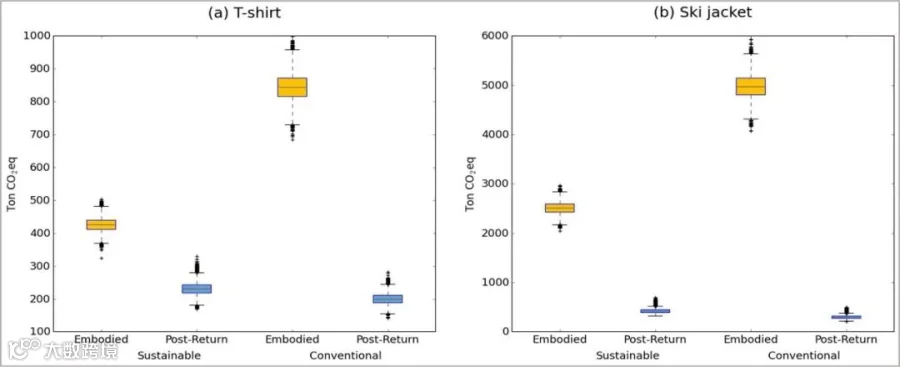
图4 按产品和情景划分的隐含供应链温室气体排放量与退货后供应链温室气体排放量
原文信息
Abstract
Each year, consumers return billions of new products to retailers. Despite growing concern over product destruction, post-return product flows are not well understood, and the full lifecycle environmental impacts of returns remain largely unknown. Building on a unique dataset covering over 630k returned apparel items in the EU, we map the flow of returned products under sustainable and conventional management practices, and quantify the full lifecycle impacts associated with returns using two illustrative apparel case studies. We find that 22%-44% of returned products never reach another consumer. Moreover, the GHG emissions associated with the production and distribution of unused returns can be 2–16 times higher than all post-return transport, packaging, and processing emissions combined. Our findings suggest that the environmental impacts eCommerce and specifically online apparel, may be systematically underestimated when returns are not accounted for, and highlight the urgent need to promote circular management practices that maximize use of returned products.
本期编辑
孙赟,天津大学环境科学院与工程学院,博士研究生。
