



01 文章信息
Article Information
原文标题:
Real-time plastic waste segmentation for sustainable resource recovery in construction
原文作者:
Iman Ranjbar a, Yiannis Ventikos b, Mehrdad Arashpour c
作者单位:
a博士研究生,莫纳什大学土木与环境工程系,澳大利亚墨尔本,VIC 3800
b 教授,莫纳什大学机械与航空航天工程系,澳大利亚墨尔本,VIC 3800
c 副教授,莫纳什大学土木与环境工程系,澳大利亚墨尔本,VIC 3800
关键词:
塑料分类;深度学习;目标检测;翻新;废弃物;YOLO
原文链接:
https://www.sciencedirect.com/science/article/pii/S0921344925005968

02 文章导读
Article Background
本研究旨在开发和评估实时实例分割模型,以识别废弃的建筑与拆除(C&D)塑料废弃物,并评估其优缺点。研究中使用的数据集专门设计,以模拟实际的C&D废弃物环境,包含混乱的垃圾桶、遮挡的物体、变形的塑料和混合材料。通过捕捉这些挑战,数据集确保模型的表现能够反映真实的建筑、翻新和拆除废弃物条件,从而使自动化塑料废物分离更加实用,并适应实际场景。此外,这些模型能够显著降低错过可回收塑料物体的概率,这些物体通常由于高度混杂和材料重叠而在人工分离中被忽视。通过最小化漏分,所提方法提高了废物回收效率,减少了资源损失,并改善了建筑行业的整体回收成果。

03 文章摘要
Article Recap
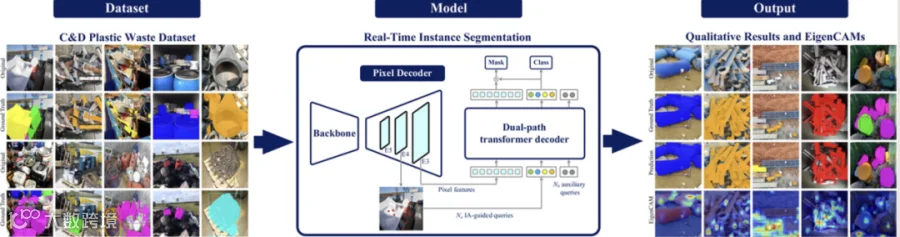
图形摘要
摘要
建筑与拆除(C&D)行业是澳大利亚总废弃物的主要来源,相关报告显示其年废弃物量持续增长。在这些废弃物中,废弃塑料是一种具有重要回收潜力的可回收材料。然而,由于C&D废弃物的高度混杂和异质性,塑料废弃物的有效分离仍然面临挑战。本研究聚焦于利用先进的实例分割模型对C&D塑料废弃物进行检测与分割,以实现高效的废物分类和回收。研究中构建了一个大型的专业数据集,涵盖了C&D塑料废弃物的复杂且常常变形的特点,数据集包含七个关键类别:桶、电缆、油桶、保温材料、液体容器、管道和PVC型材。该数据集每张图像包含高密度对象,确保了在实际场景中模型的训练与泛化能力。我们对包括FastInst、RTMDet-Ins、YOLOv9和YOLOv11在内的最先进实例分割模型进行了训练和评估。其中,YOLOv11表现最佳,达到51.3的平均精度均值(mAP),并保持每秒89帧(FPS)的实时推理速度。本文还对模型的优缺点进行了系统分析,突出分析了分割高度混杂和重叠对象的挑战。此外,采用EigenCAM可视化方法对模型的决策过程进行了深入解读。研究结果表明,所提模型能够实现C&D塑料废弃物的精准分割,有助于提高资源回收率,并推动建筑行业循环经济的发展。

图1. C&D塑料废物数据集概述

图2. 实例分割架构的说明

图3. 真实标注分割与YOLOv11模型预测结果的定性结果比较
表1.C&D塑料废弃物实例分割模型的性能比较

表2. 非实时基准模型(Mask2Former,采用Swin Transformer骨干网络)在C&D塑料废弃物分割数据集上的性能表现


04 原文信息
Paper Information

Abstract
The construction and demolition (C&D) sector is a major contributor to Australia’s total waste, with reports indicating continuous annual growth. Among this waste, end-of-life plastic represents a valuable recyclable material with significant recovery potential. However, effective separation of plastic waste remains a challenge due to the highly cluttered and heterogeneous nature of C&D waste. This study focuses on the detection and segmentation of C&D plastic waste using advanced instance segmentation models to enable efficient waste sorting and recycling. A large, specialised dataset is curated, capturing the complex and very often deformed nature of C&D plastic waste across seven key categories: buckets, cables, drums, insulation, liquid containers, pipes, and PVC profiles. The dataset features a high density of objects per image, ensuring robust model training and generalisation in real-world scenarios. State-of-the-art instance segmentation models, including FastInst, RTMDet-Ins, YOLOv9, and YOLOv11, are trained and evaluated on this dataset. Among these, YOLOv11 demonstrated the highest performance, achieving a mean Average Precision (mAP) of 51.3 while maintaining a real-time inference speed of 89 frames per second (FPS). A systematic analysis of the models’ strengths and limitations is provided, highlighting challenges associated with segmenting highly cluttered and overlapping objects. Additionally, EigenCAM visualisations are used to interpret the model’s decision-making process. The findings demonstrate that the proposed models achieve accurate segmentation of C&D plastic waste, contributing to improved resource recovery and the advancement of a circular economy within the construction industry.

本期编辑

李倩文,江南大学商学院副教授、博士生导师,RCR编辑组组长。
由于近期微信更改了订阅号的推送规则,很多朋友不能快速找到我们,其实我们每天都在推送!您可以将RCR期刊设置为星标,就能在微信订阅号中快速找到我们,查看每天订阅。
点击蓝字
关注我们