



01
文章信息
文章标题:
Dietary structure transformation continues to influence the resources utilization of agricultural waste in China
文章作者(*通讯):
Ke Pana, Bin Liua,b,* , Tingting Fenga, Yang Weic,d, Wenjing Zhub, Qinxiang Wangb
作者单位:
a 成都理工大学管理科学学院
b 成都理工大学数学科学学院
c 国家电网四川电力公司电力科学研究院
d 四川省电力系统安全与运行重点实验室
关键词:
AWB、生物能源经济-能源-环境、动态评估框架、膳食结构转变
原文链接:
https://www.sciencedirect.com/science/article/pii/S0921344926000522
02
文章导读
在平台经济与数字技术快速发展的背景下,在线外卖已成为重塑居民饮食结构的重要力量,但其对食物消费模式及环境影响的系统性认知仍相对不足。针对这一研究空白,本文基于大规模外卖订单数据,创新性融合文本挖掘与生命周期评价方法,从消费结构与碳排放耦合的视角,对中国在线外卖食品的组成特征及其温室气体排放进行了定量分析。研究表明,外卖消费呈现出明显的结构性偏差,即高动物性食品占比与低蔬菜摄入并存,其中肉类消费显著高于家庭烹饪水平,是推动碳足迹上升的关键因素。生命周期分析进一步揭示,尽管部分高排放食材消费频次有限,但其对整体碳排放贡献突出,从而放大了外卖饮食的环境负担。相较家庭膳食,外卖消费模式整体碳足迹显著增加,反映出便利性背后的隐性生态成本。
在此基础上,文章通过情景模拟表明,若依据《中国膳食指南》优化外卖消费结构,可大幅降低碳排放水平,有效对冲外卖增长带来的环境压力。这一发现不仅强调了膳食结构调整在实现低碳转型中的核心作用,也为数字消费场景下的个体行为引导与平台治理提供了量化依据。总体而言,本文构建了面向新型消费模式的“文本挖掘—生命周期评价”综合分析框架,为理解在线外卖行为与环境影响之间的内在机制提供了新的研究路径,也为推动健康与可持续协同的饮食转型提供了重要科学支撑。
03
文章摘要
在能源安全与低碳转型双重挑战的背景下,本研究旨在通过提出一个动态的“经济-能源-环境”评估框架,全面探讨农业废弃物生物质(AWB)的资源利用潜力。研究聚焦中国居民膳食结构的转变,并基于四种主流生物能源技术的示范工厂数据,分析了膳食趋势演变下生物能源供应链的动态变化。通过扩展Bass扩散模型以模拟生物能源技术的渗透效应,评估了2023年至2045年间 AWB 在能源供应和减排方面的潜力。研究结果表明:(1)示范工厂的发电成本与生物质收集半径呈显著正相关,而与生物质分布密度呈负相关;(2)尽管中国膳食模式未发生根本性转变,但肉类需求(人均286.8~304.8公斤)已逐渐超过谷物作物需求(人均248.7~250.2公斤),两者差值约为55公斤。牲畜粪便产量增加3%。这一增长使得牲畜粪便发电成本降低,降幅在–0.021至–0.039元/千瓦时之间。(3)在所评估的四项技术中,黑龙江省、河南省和山东省表现出卓越的综合性能,各项综合评分均超过0.7。到2045年,生物能源的应用可减少高达235.4×10 ⁸吨当量CO2的排放,同时发电量达7.7拍瓦时。这些结果凸显了饮食结构转型对生物能源技术应用的多重影响,并证实了基于 AWB 的资源利用方案的可行性和潜在效益。

Fig. 1. Research frame
图1.研究框架

Fig. 2. Comprehensive evaluation of biomass power generation costs across China's 31 provinces
图2.中国31个省份生物质发电成本的综合评估

Fig. 3. Assessment of emission reduction potential from bioenergy technologies
图3.生物能源技术减排潜力评估

Fig. 4.Predictions of China's dietary structure from 2022 to 2045: (a) dietary changes in Taiwan (China), Korea and Japan; (b) trends in China's dietary structure changes; (c) comparison of dietary structures in 2022 and 2045; (d) differences in the contributions of agricultural systems of China's 31 provinces to dietary demand supply
图4.2022至2045年中国膳食结构预测:(a) 台湾(中国)、韩国和日本的膳食结构变化;(b) 中国膳食结构变化趋势;(c) 2022年与2045年膳食结构对比;(d) 中国31个省份农业体系对膳食需求与供给贡献度的差异

Fig. 5. Changes in the operation status of the demonstration factory in 2045
图5.2045年示范工厂运营状态的变化
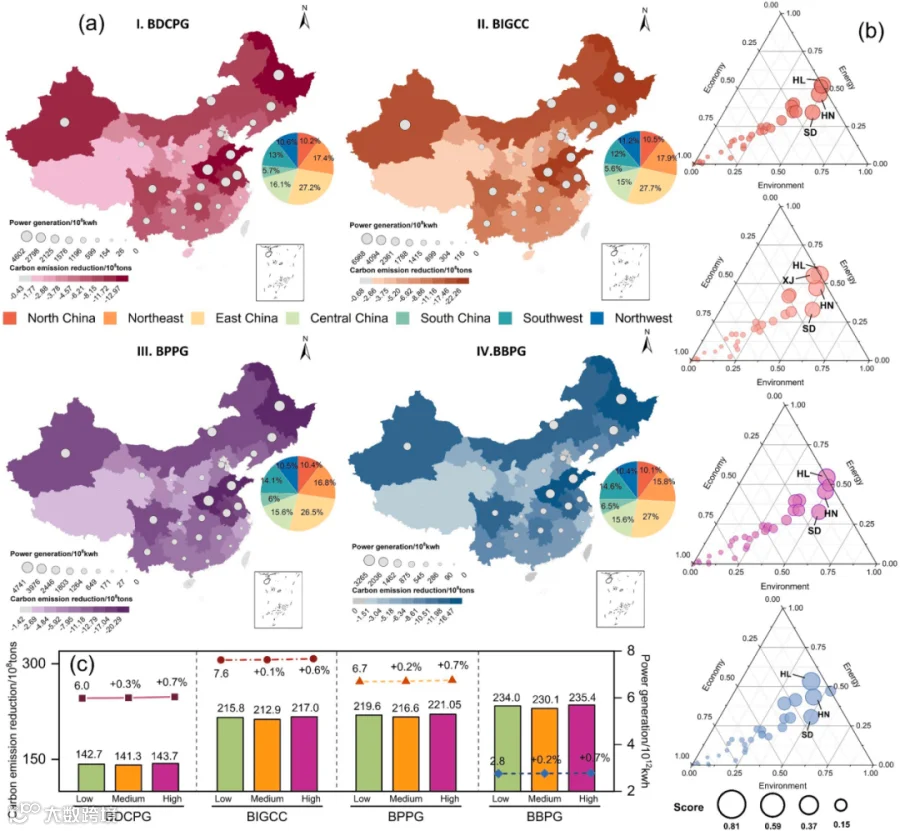
Fig. 6.Simulation results of AWB resource utilization: (a) cumulative carbon emission reduction and power generation from bioenergy (2023–2045); (b) the
omprehensive performance scoring results of the 31 provinces; (c) carbon reduction and total power generation under three scenarios
图6.AWB 资源利用仿真结果:(a) 生物能源累计碳减排量与发电量(2023–2045年);(b) 31个省份综合绩效评分结果;(c) 三种情景下的碳减排量与总发电量
04
原文信息

Abstract
Against the backdrop of dual challenges in energy security and low-carbon transition, this study aims to comprehensively investigate the resource utilization potential of agricultural waste biomass (AWB) by proposing a dynamic “Economy-Energy-Environment” assessment framework. Focusing on the transition in Chinese residents' dietary structure, and based on demonstration plant data corresponding to four mainstream bioenergy technologies, this study analyzes the dynamic changes in the bioenergy supply chain under evolving dietary trends. By extending the Bass diffusion model to simulate the penetration effects of bioenergy technologies, the energy supply and emission reduction potential of AWB from 2023 to 2045 are evaluated. The findings reveal that: (1) The power generation cost of demonstration plants exhibits a significant positive correlation with biomass collection radius, but a negative correlation with biomass distribution density. (2) Although no fundamental shift has occurred in Chinese dietary patterns, meat demand (286.8~304.8 kg per capita) has gradually surpassed that of grain crops (248.7~250.2 kg per capita), resulting in an approximate 55.3% increase in livestock manure production. This growth leads to a reduction in the power generation cost of livestock manure, with a decrease ranging from –0.021 to –0.039 CNY/kWh. (3) Among the four technologies considered, Heilongjiang, Henan, and Shandong provinces demonstrate outstanding comprehensive performance, each achieving a comprehensive score above 0.7. By 2045, bioenergy deployment could reduce emissions by up to 235.4 × 10⁸ tonnes eq CO2 while generating 7.7 PWh of electricity. These results underscore the multiple impacts of dietary transition on bioenergy technology deployment and confirm the feasibility and potential benefits ofAWB-based resource utilization.
本期编辑
杨礼玮,西南交通大学环境科学与工程学院研究生

由于近期微信更改了订阅号的推送规则,很多朋友不能快速找到我们,其实我们每天都在推送!您可以将RCR期刊设置为星标,就能在微信订阅号中快速找到我们,查看每天订阅。
点击蓝字
关注我们