



英国皇家化学会(RSC)是一个拥有175年历史的面向全球化学家的非营利会员制机构,旗下拥有43种期刊,其中很多在化学领域有很高影响力。为了进一步帮助广大读者追踪科技前沿热点,X-MOL团队与英国皇家化学会合作,从本周开始,推出英国皇家化学会期刊主编推荐的精彩文章快览。如果大家对我们的解读有更多的补充和点评,欢迎点击“阅读原文”进入网页版,在文后发表您的高见!
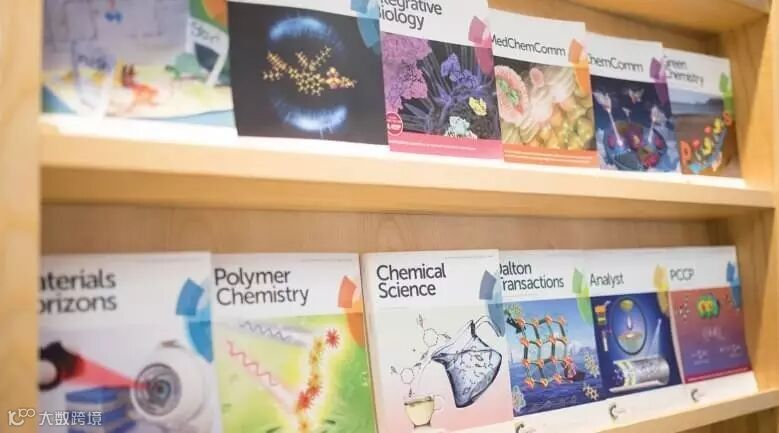
Chemical Science (IF: 9.144)
1. Multi-stimuli Responsive and Multi-functional Oligoaniline Modified Vitrimers
Chemical Science; DOI: 10.1039/C6SC02855A
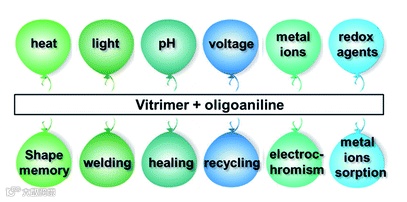
Oligoaline added to a vitrimer gives a covalently crosslinked material that can respond to six different stimuli (heat, light, pH, voltage, metal ions and redox chemicals) and perform six functions (shape memory, welding, healing, recycling, electro-chromism and adsorption of metal ions). New properties, which cannot be found in either neat vitrimers or oligoanilines, are generated. Authors say this is significant as currently difficult to combine more than 3 stimuli-responses/functionalities in one smart polymer.
现有的智能聚合物难以对3种以上的刺激反应做出响应或具备相应的功能,然而当苯胺低聚物加入到新型塑胶vitrimer时会形成一种共价交联材料。这种材料可以响应六种不同的刺激(热、光、pH值、电压、金属离子、氧化的化学物质),并发挥六种功能(形状记忆、焊接、复原、再利用、电致变色和金属离子的吸附)。这种新特性是单独的新型塑胶vitrimer或者苯胺低聚物所无法实现的。
Open Access(可免费阅读原文)
扫描或长按二维码,识别后直达原文页面

http://pubs.rsc.org/en/content/articlelanding/2016/sc/c6sc02855a
2. Stretchable supramolecular hydrogels with triple shape memory effect
Chemical Science; DOI: 10.1039/C6SC02354A
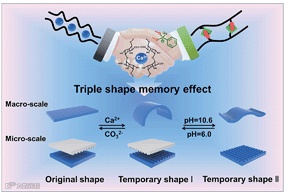
A shape-memory hydrogel that also has self-healing properties has been developed by scientists in China. The new material can repair itself and return to its original shape even after being cut into segments.
Both self-healing and shape-memory polymers have many potential uses, including in aerospace, textiles and biomedicine. Now, a team lead by Tao Chen and Jiawei Zhang from the Ningbo Institute of Material Technology and Engineering has developed a material that combines both of these useful properties.
中国科学院宁波材料技术与工程研究所的陈涛和张佳玮团队研发了具有自修复功能的形状记忆水凝胶。这种水凝胶即使在被切成几段的情况下也可以恢复原状,所以在包括航空航天、纺织和生物医药等很多方面都具有潜在的用途。
Open Access(可免费阅读原文)
扫描或长按二维码,识别后直达原文页面

http://pubs.rsc.org/en/Content/ArticleLanding/2016/SC/C6SC02354A
Materials Horizons (IF: 9.095)
1. Programming the shape-shifting of flat soft matter: from self-rolling/self-twisting materials to self-folding origami
Materials Horizons, DOI: 10.1039/C6MH00195E
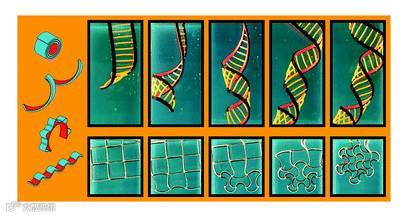
3D-printed flat materials are taught how to self-fold into complex structures for medical implants.
3D 打印的平展材料被预先“编程”,可以自折叠成为可用于医疗植入的复杂结构
Open Access(可免费阅读原文)
扫描或长按二维码,识别后直达原文页面

http://pubs.rsc.org/en/Content/ArticleLanding/2016/MH/C6MH00195E
2. A “Writing” Strategy for Shape Transition with Infinitely Adjustable Shaping Sequences and in situ Tunable 3D Structures
Materials Horizons, DOI: 10.1039/C6MH00295A
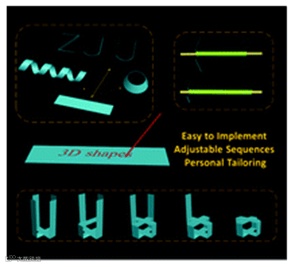
Researchers at Zhejiang University present a new “light writing” approach to allow facile generation of sequential and tailored complex 3D shape transitions using tunable NIR irradiation. Unlike previous approaches, the strategy can simultaneously modulate both the shape transition process and the target shape, without needing to tune the material composition or structure.
浙江大学的研究团队提出了一种新的“光写作”方法,使用可调谐近红外辐射就可以很容易地使材料三维形状发生连续和个性化定制的复杂转变。与以前的方法不同的是,这种新方法无需调整材料的组成或结构即可同时调节的形状转变过程和最终的目标形状。
扫描或长按二维码,识别后直达原文页面

http://pubs.rsc.org/en/Content/ArticleLanding/2016/MH/C6MH00295A