

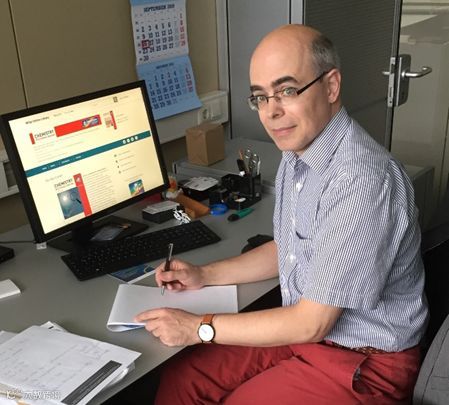
Haymo Ross博士毕业于基尔大学(University of Kiel)。他于1997年加入Wiley-VCH,并在Wiley-VCH多个化学期刊中担任过编辑职位。目前,Haymo Ross是Chemistry – A European Journal主编以及Wiley-VCH欧洲化学出版协会(ChemPubSoc Europe)系列期刊的出版人。
关于期刊
I took over a well-managed journal, so there was no need for major changes of the journal’s aims and scope. We publish a good mix of Communications, Full Papers, Concepts, Minireviews and Reviews and cover all areas of chemistry. We have been working hard to reduce our manuscript processing times and now our times from submission to Accepted Article Online are as good as those of Chem. Comm. – or even better when we consider communications only. I should mention, of course, that Yan Li who is based in Wiley’s Beijing office has joined the editorial team as Senior Associate Editor early in 2018 to improve our editorial presence in China. Given that China is our most important market these days this was an important step. For the future, we expect more growth from China and it is important to reach out to the community. By the way, next year we are going to celebrate the 25th anniversary of the journal.
2019年是“国际化学元素周期年”(IYPT2019),作为一本国际顶尖的化学期刊,您能介绍一些今年Chemistry – A European Journal举办的庆祝活动吗?
IYPT2019 was a nice occasion for some “extracurricular activities” of editors at Chemistry – A European Journal. For example, we were running an artwork competition that was open toauthors, readers and researchers of all ages. Any and all forms of artwork related to the periodic table could be submitted and we received over 40 great entries from all over the world. The prizes winners who received an iPad were announced at the IUPAC Congress in Paris in July. Then there is the “In my element series: We have published more than 30 personal articles from our Editorial Board Members about their favourite elements. These are still free to read for everyone. Our Spotify songlist containing songs with chemical elements in the title is also very popular.
Chemistry – A European Journal是一本代表欧洲化学出版协会出版的期刊。欧洲化学出版协会由16个欧洲国家化学学会组成。能请您简单介绍一下欧洲化学出版协会以及它所出版的期刊吗?
Chemistry – A European Journal is the flagship journal of the ChemPubSoc Europe group of journals. It was the first journal that was launched jointly by several European chemical societies. At that time this group of societies did not have a name – that came later after the launch of the first sister journals of Chemistry – A European Journal, i.e. Eur. J. Org. Chem., Eur. J. Inorg. Chem., ChemBioChem andChemPhysChem. Meanwhile we publish 15 journals covering all fields of chemistry on behalf of the ChemPubSoc Europe societies and more will be launched next year. Actually, most of the journals are jointly owned by our partner societies and Wiley-VCH, Chemistry – A European Journal and two others are even fully owned by the societies.
投稿与科研看法
您如何评价来自中国的投稿质量?您对中国作者一些关于写作高质量论文有什么建议?
Until about 15 years ago we did not receive many manuscripts from China. Since then the number of submissions has increased enormously. To be perfectly honest, in the beginning many of the papers were not very impressive. But it did not take long before Chinese authors caught up with authors from other countries. Generally, research output from China is now bigger than from any other country, and the same holds true for chemistry. The development over the past few years has been remarkable not only regarding quantity – today there are many high-profile research groups in China and the labs I have seen are often more modern and better equipped than before.
Currently we receive more papers from China than from any other country and one out of four papers we publish have a corresponding author or at least a co-author from China.
My advice to authors writing a research paper is to use precise language. I like to quote the Austrian philosopher Ludwig Wittgenstein who wrote “what can be said at all can be said clearly”. Titles and abstracts, in particular, should be kept simple and informative as they are usually the first parts of an article a reader will look at. After all, there is no second chance to make a first impression, so the wording of the title and abstract is vital for making the reader decide whether or not to look at the article further.
您认为理想的科研评价体系应该是怎样的?您对影响因子等评价指标有何看法?
An ideal scientific research evaluation system should take into account several parameters but, regrettably, currently evaluation of research performance is almost exclusively based on citation counts. That said, I have a firm opinion about the Impact Factor. It is nothing more than a journal metric and should, therefore, not be used for other purposes. The Impact Factor tells you something – certainly not everything – about a journal but as an average number, obviously, it cannot reveal any information about individual papers. In high-profile journals you may find publications that are hardly ever cited, or are not cited at all, even after a few years. But let’s face it: The Impact Factor, and similar citation-based metrics, are likely to prevail and will continue to be used for evaluating not only journals but also researchers who publish in them, so this here is my plea to authors: Please pay more attention to the citations, bearing in mind their implications. I have written an editorial on this topic that will be published in Chemistry – A European Journal soon.
相关阅读
带你走近Wiley顶尖化学期刊Chemistry—A European Journal
关于 Chemistry – A European Journal

期刊链接

https://onlinelibrary.wiley.com/journal/15213765