

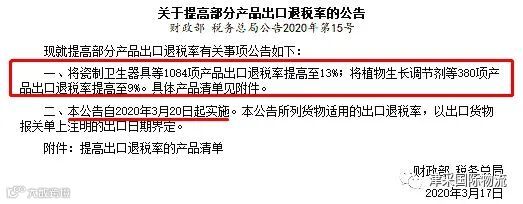
3月17日,国家财政部、税务总局联合发布公告,将瓷制卫生器具等1084项产品出口退税率提高至13%;将植物生长调节剂等380项产品出口退税率提高至9%。。本公告自2020年3月20日起实施。本公告所列货物适用的出口退税率,以出口货物报关单上注明的出口日期界定。
具体来说15号公告一是将瓷制卫生器具等1084项产品出口退税率提高至13%。其中:出口退税率由10%提高至13%的有979项,由6%提高至13%的有103项,由免税和征税调整至13%的各1项;二是将植物生长调节剂等380项产品出口退税率由6%提高至9%。
原来已经放弃出口退税,选择免税或征税的出口货物,由于这次新政策提高了其出口退税率,觉得重新选择恢复出口退税比免税或征税划算,则可以重新选择恢复出口退税,不受放弃适用出口退(免)税政策未满36个月不得重新选择恢复出口退税的政策限制。
On March 17, the Ministry of Finance and the State Administration of Taxation jointly issued an announcement to raise the export tax rebate rate of 1084 products such as porcelain sanitary wares to 13% and 380 products such as plant growth regulators to 9%.. This announcement will be implemented from March 20, 2020. The export tax rebate rate applicable to the goods listed in this announcement shall be defined by the export date indicated on the export goods declaration form.
Specifically, Announcement No. 15 first is to raise the export tax rebate rate of 1084 products such as porcelain sanitary wares to 13%. Among them, 979 items increased from 10% to 13%, 103 items increased from 6% to 13%, and 1 item adjusted from tax exemption and taxation to 13%; the second is to increase the export tax rebate rate of 380 products such as plant growth regulators from 6% to 9%.
Implementation time
The announcement will be implemented from March 20, 2020. That is to say, the export date on the declaration form of export goods is March 20, 2020 and later 1464 kinds of export goods are subject to the new export tax rebate rate. The goods exported today and tomorrow are generally three tax points less than the goods with the same product code exported two days later. If possible, tax planning can be done to enjoy the dividend of tax refund policy as much as possible.
Matters needing attention
For the export goods that have abandoned the export tax rebate and have chosen to be duty-free or taxed, since the new policy has increased the export tax rebate rate, if it is more cost-effective to choose to restore the export tax rebate than to tax-free or taxed, it can choose to restore the export tax rebate again, which is not limited by the policy of not choosing to restore the export tax rebate after 36 months of abandoning the applicable export tax rebate (Exemption) policy.
清单中将122种钢铁类产品的出口退税率提升至13%。
其中,以下玻璃产品出口退税率提高:废碎玻璃及玻璃块料(产品编码70010000),液晶或有机发光二极管(OLED)显示屏用原板玻璃,包括保护屏用含碱玻璃(铸、轧制的非夹丝玻璃板、片,未着色,透明及不具吸收层的,未经其他加工)(产品编码7003190001),液晶或有机发光二极管(OLED)显示屏用原板玻璃,包括保护屏用含碱玻璃(非夹丝浮法玻璃板、片)(产品编码7005290002),阴极射线管用其他玻壳及零件(产品编码70112090),电子管未封口玻璃外壳及玻璃零件(未装有配件)(产品编码70119010)等产品调整后退税率均为13%。
另外,从清单中可以看到,化工行业涉及到的产品包含:乙烯、丙烯、1-丁烯、2-丁烯、异戊二烯、乙炔、环己烷、环氧树脂、聚酯、丁苯橡胶、聚苯乙烯、ABS等,都调整了出口退税,并且出口退税率设置为13%。其中,乙烯首次由10%上调至13%,丙烯由9%上调至13%,苯乙烯由10%上调至13%。并且,多个化工品出现了3个点的上行幅度。
商务部外贸司司长李兴乾12日介绍,1-2月,受春节因素特别是疫情影响,中国进出口总额为4.12万亿元,下降9.6%。其中,出口2.04万亿元,下降15.9%;进口2.08万亿元,下降2.4%。
一是对传统市场进出口下降,对东盟等新兴市场小幅增长。对美国、欧盟、日本等传统市场分别下降19.6%、14.2%和15.3%。对东盟、“一带一路”国家等新兴市场进出口分别增长2%和1.8%。
二是劳动密集型产品出口恢复较慢,机电产品好于整体。劳动密集型产品出口下降18.8%,机电产品出口好于整体1个百分点。
三是加工贸易降幅较深,一般贸易韧性强。加工贸易进出口下降16.4%,跌幅大于整体6.8个百分点,一般贸易进出口下降9.2%,好于整体0.4个百分点。
四是各经营主体普遍面临困难挑战。民营企业、外资企业、国有企业出口分别下降12.8%、20.4%和12.4%。
一是企业新兴市场开拓能力不断提升,对新兴市场出口占比提升3.7个百分点至51.8%。
二是集成电路、汽车等部分高质量高技术高附加值产品出口逆势增长,分别增长10.5%和0.3%。
三是大宗商品等进口保持增长,原油、铁矿砂、煤等大宗商品进口分别增长16.7%、19.3%和27.8%,合计拉动进口增长3.2个百分点。肉类进口量增加69.6%,其中猪肉增加1.6倍。
四是新业态新模式活力充沛,跨境电商充分利用线上下单、“不见面”交易等优势,化危为机,积极拓展业务,展现较强适应性和自主发展能力。
一是加强机制建设。发挥双边经贸合作机制作用,加快推进自贸区建设,推动与更多国家商签高标准自贸协定、商建贸易畅通工作组,营造良好的国际贸易环境。
二是加大政策支持。进一步完善出口退税政策,减轻企业负担,扩大外贸信贷投放,满足贸易融资需求,支持有市场、有订单的企业有效履约。进一步扩大出口信用保险短期险覆盖面,促进费率合理下降。
三是优化公共服务。支持地方、行业组织、贸促机构搭建公共服务平台,为企业提供必要的法律和信息服务,帮助企业参加境内外贸易促进活动。
四是鼓励创新发展。发挥跨境电商、市场采购等贸易新业态、新模式对进出口的促进作用,支持企业建设一批高质量的海外仓,完善国际营销网络体系。
The export tax rebate rate of 122 kinds of steel products was increased to 13% in the list.
Among them, the export tax rebate rate of the following glass products is increased: waste broken glass and glass block (Product Code: 70010000), original plate glass for liquid crystal or organic light-emitting diode (OLED) display screen, including alkali containing glass for protection screen (cast and rolled non laminated glass plate and sheet, not colored, transparent and without absorption layer, No other processing (product code 7003190001), original plate glass for LCD or OLED display screen, including alkali glass (non wired float glass plate, sheet) (product code 7005290002), other glass shell and parts (product code 70112090) for cathode ray tube, unsealed glass shell and glass parts (without accessories) (product code 70112090) Code 70119010) and other products, the tax rebate rate after adjustment is 13%.
In addition, it can be seen from the list that the products involved in the chemical industry include: ethylene, propylene, 1-butene, 2-butene, isoprene, acetylene, cyclohexane, epoxy resin, polyester, styrene butadiene rubber, polystyrene, ABS, etc., and the export tax rebate rate is set to 13%. For the first time, ethylene was increased from 10% to 13%, propylene from 9% to 13%, and styrene from 10% to 13%. In addition, there are three upsides of chemicals.
Li Xingqian, director of the Department of foreign trade of the Ministry of Commerce, said Monday that in January February, China's total import and export volume was 4.12 trillion yuan, down 9.6% due to the Spring Festival, especially the epidemic. Among them, export was 2.04 trillion yuan, down 15.9%; import was 2.08 trillion yuan, down 2.4%.
On December 12, the Ministry of Commerce held a regular press conference. Li Xingqian made the above statement when introducing the foreign trade operation from January to February 2020.
Li Xingqian said that from January to February, foreign trade operation has four main characteristics:
First, imports and exports to traditional markets have declined, while those to emerging markets such as ASEAN have grown slightly. For the traditional markets such as the United States, the European Union and Japan, they dropped by 19.6%, 14.2% and 15.3% respectively. Imports and exports of one ASEAN and one belt, one road country and other emerging markets increased by 2% and 1.8% respectively.
Second, the export recovery of labor-intensive products is slow, and mechanical and electrical products are better than the whole. The export of labor-intensive products decreased by 18.8%, and the export of mechanical and electrical products was better than the overall 1%.
Third, the decline of processing trade is deep, and the general trade is resilient. The import and export of processing trade decreased by 16.4%, more than the overall 6.8 percentage points, while the import and export of general trade decreased by 9.2%, better than the overall 0.4 percentage points.
Fourth, all business entities generally face difficulties and challenges. The export of private enterprises, foreign-funded enterprises and state-owned enterprises decreased by 12.8%, 20.4% and 12.4% respectively.
Li Xingqian pointed out that although the overall operation is under pressure, China's foreign trade has great potential and strong competitiveness, and enterprises have strong innovation awareness and market development ability, showing some highlights.
First, the development capacity of enterprises in emerging markets has been continuously improved, and the proportion of exports to emerging markets has increased by 3.7 percentage points to 51.8%.
Second, the export of high-quality, high-tech and high-value-added products such as integrated circuits and automobiles bucked the trend, increasing by 10.5% and 0.3% respectively.
Third, the import of bulk commodities and other commodities continued to grow. The import of crude oil, iron ore, coal and other bulk commodities increased by 16.7%, 19.3% and 27.8% respectively, driving the import growth by 3.2 percentage points in total. The import of meat increased by 69.6%, of which pork increased by 1.6 times.
Fourth, the new business model is full of vitality. Cross border E-commerce makes full use of the advantages of online order and "no see" transaction to turn crisis into opportunity, actively expand business, and demonstrate strong adaptability and independent development ability.
Li Xingqian said that China's foreign trade development is supported by positive factors. Since the outbreak of the epidemic, the Ministry of Commerce, together with all localities and departments, has issued a series of supporting policies and measures to solve the problems of foreign trade enterprises in an all-round way, including resumption of production, finance and taxation, finance, credit insurance, exhibition, legal aid, epidemic prevention material guarantee, etc. With the effect of various policies to stabilize foreign trade issued intensively gradually appearing, the resumption of production of foreign trade enterprises around the country is accelerating the recovery trend.
Next, the Ministry of Commerce will thoroughly implement the decision-making and deployment of the CPC Central Committee and strive to stabilize foreign trade. We need to work with all departments horizontally and with local governments and enterprises vertically to ensure that all policies are implemented early and effective. We should further develop diversified markets, optimize the layout of international markets, and support the rapid development of new forms of foreign trade. We should actively expand imports, improve the level of trade facilitation, effectively reduce the burden of foreign trade enterprises, strengthen communication and coordination with economic and trade partners, create a good domestic and foreign environment for the development of foreign trade, make full efforts to stabilize the basic board of foreign trade, and make positive contributions to building a moderately prosperous society in an all-round way.
Ministry of Commerce: further improve the export tax rebate policy and reduce the burden of enterprises
On March 12, Li Xingqian, director of the Department of foreign trade of the Ministry of Commerce, said at a regular online press conference held by the Ministry of commerce that it is necessary to further improve the export tax rebate policy, reduce the burden on enterprises, expand the foreign trade credit, meet the demand for trade financing, and support enterprises with market and order to effectively perform the contract. We will further expand the coverage of short-term export credit insurance, and promote a reasonable reduction in rates.
Affected by the Spring Festival, especially the epidemic situation, China's total import and export from January to February totaled 4.12 trillion yuan, down 9.6%. Among them, export was 2.04 trillion yuan, down 15.9%; import was 2.08 trillion yuan, down 2.4%.
In response, Li Xingqian said that the operation of foreign trade from January to February this year showed that due to the impact of the epidemic superimposed on the Spring Festival, foreign trade production enterprises returned to work later than in previous years, so the import and export in the first two months, especially the export, declined to a certain extent.
In order to hedge the impact of the epidemic on foreign trade, the Ministry of Commerce, together with all localities and departments, intensively issued policies to stabilize foreign trade, supported foreign trade enterprises to return to work and resume production, and made every effort to protect the market, share and order. At present, the effect of the policy has gradually appeared, local enterprises speed up the process of resumption of production, and the ability of performance is improving.
In novel coronavirus pneumonia, the director general of the World Health Organization believes that the epidemic situation of the new crown pneumonia is already a pandemic. Over 110 countries and regions have confirmed cases, the pressure on Global trade and economic growth has increased, and the uncertainty of external development environment has increased.
Li Xingqian said that based on the analysis of the changes in the supply and demand situation, the core of China's current trade policy is to stabilize the basic foreign trade market. "We will resolutely implement the decision-making and deployment of the Party Central Committee and the State Council, pay close attention to the implementation of policies, fully support foreign trade manufacturers to return to work and achieve production, and restore normal market order as soon as possible."
Li Xingqian proposed that we should focus on four tasks.
First, strengthen the mechanism construction. We will give full play to the role of bilateral economic and trade cooperation mechanisms, accelerate the construction of free trade zones, promote the signing of high-standard free trade agreements with more countries, and work groups for smooth trade, so as to create a good international trade environment.
Second, increase policy support. We will further improve the export tax rebate policy, reduce the burden on enterprises, expand the supply of foreign trade credit, meet the demand for trade financing, and support enterprises with markets and orders to perform effectively. We will further expand the coverage of short-term export credit insurance, and promote a reasonable reduction in rates.
Third, optimize public services. Support local, industrial organizations and trade promotion agencies to build public service platforms, provide necessary legal and information services for enterprises, and help enterprises participate in domestic and foreign trade promotion activities.
Fourth, encourage innovation and development. We will give full play to the role of new trade formats and modes such as cross-border e-commerce and market procurement in promoting import and export, support enterprises in building a number of high-quality overseas warehouses, and improve the international marketing network system.
The General Administration of Customs further reduces the cost of customs clearance
Although novel coronavirus pneumonia has a certain impact on foreign trade and import and export in the short term, our foreign trade has strong resilience, adaptability and market development capability of the new company is strong, and the impact of the epidemic on imports and exports is temporary and phased, the head of the Customs General Administration said recently. With the positive results of epidemic prevention and control, the pace of foreign trade enterprises returning to work has been accelerated, and the long-term trend of foreign trade development has not changed.
According to statistics, in the first two months of this year, China's total import and export value of goods trade reached 4.12 trillion yuan, down 9.6% from the same period last year. Among them, export was 2.04 trillion yuan, down 15.9%; import was 2.08 trillion yuan, down 2.4%. Customs statistics show that one belt, one road and one ASEAN region, has maintained an increase in imports and exports in the first two months. The import and export to ASEAN reached 594.11 billion yuan, an increase of 2%. ASEAN has become China's largest trading partner. Over the same period one country and one belt, one road, and the total number of countries and regions together increased 1 trillion and 300 billion yuan, up 1.8% from the same period last year, which is 11.4 percentage points higher than China's foreign trade growth rate, accounting for 31.7%, and the proportion exceeds 30%.
In order to promote the return of enterprises to work and production and the steady growth of foreign trade, the General Administration of Customs recently introduced measures to further reduce the cost of customs clearance in import and export links from four aspects, namely, the reduction and exemption of late fees and late fees, customs guarantee insurance, verification and cancellation of processing trade, carry forward, domestic sales and other business delays. According to the new measures, for the imported goods that have arrived at the port before the outbreak but have not been declared in time due to the outbreak, and the imported goods that cannot be declared in time due to the operational difficulties or capital shortage of the enterprise after the resumption of work due to the outbreak, they can apply to the Customs at the place of declaration for reduction or exemption of the delayed declaration fee in accordance with the measures for collection of delayed declaration fee for imported goods by the customs. At the same time, in case of overdue cancellation of manual (account) books due to delayed resumption of work during the epidemic period, the enterprise may apply to the competent customs for temporary extension of the validity of manual (account) books.