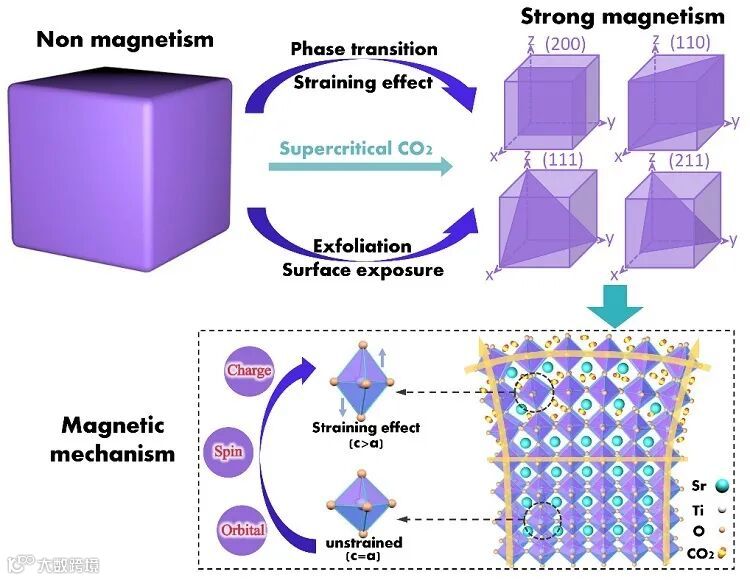
Figure 1. Magnetic manipulation of SrTiO3(top) and the related magnetic mechanism proposed (bottom) in this work.
该工作的磁性调控手段及室温铁磁性产生机理如图1所示。
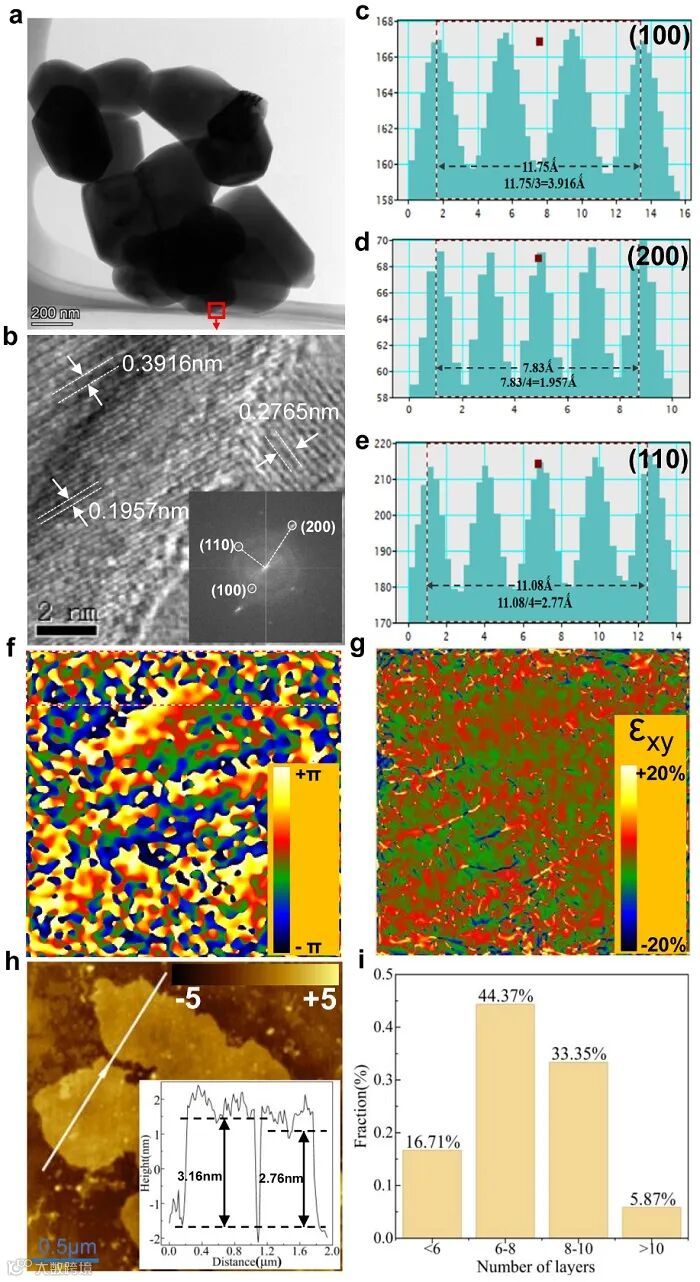
Figure 2. Characterizations of SrTiO3 treated with SC CO2 under 14 MPa. a) Low-magnification TEM image. b) High-magnification TEM image. Inset: Fast Fourier transform of b. c-e) The line contour of the plane spacing in the previous image. f) The phase map performed on the HRTEM image by geometric phase analysis (GPA). When the color varies from black to white, suggesting the phase conversion from -π~+π. g) The corresponding strain map of shear strain ɛxy. Strain-values from -20%~+20% can be represented when color changes from black to white. h) AFM image. inset: sample thickness diagram of the line in k. i) Thickness distribution diagram of k.
SC CO2处理后SrTiO3样品的晶格结构和晶体尺寸等形态表征如图2所示。低倍率透射电子显微镜图像在电子束下略显透明,验证了SrTiO3纳米片层数较少 (图2a)。为了揭示纳米片的详细结构信息,利用高倍透射电子显微镜 (图2b) 对图2a红色矩形所选区域进行表征。从图2b的HRTEM图像中计算出的晶面间距分别为0.3916、0.1957和0.2770 nm (图2c-e),与标准SrTiO3相比略有增加,这表明SrTiO3在SC CO2处理中被拉伸。为了更直观地评估SrTiO3结构中的晶格应变文中对HRTEM图像进行了几何相位分析 (GPA)。结果显示,SrTiO3纳米片的应变效应可以在图2f-g中清晰地观察到。因此,SC CO2处理后SrTiO3中存在明显的晶格应变,导致SrTiO3从立方相转变为四方相。
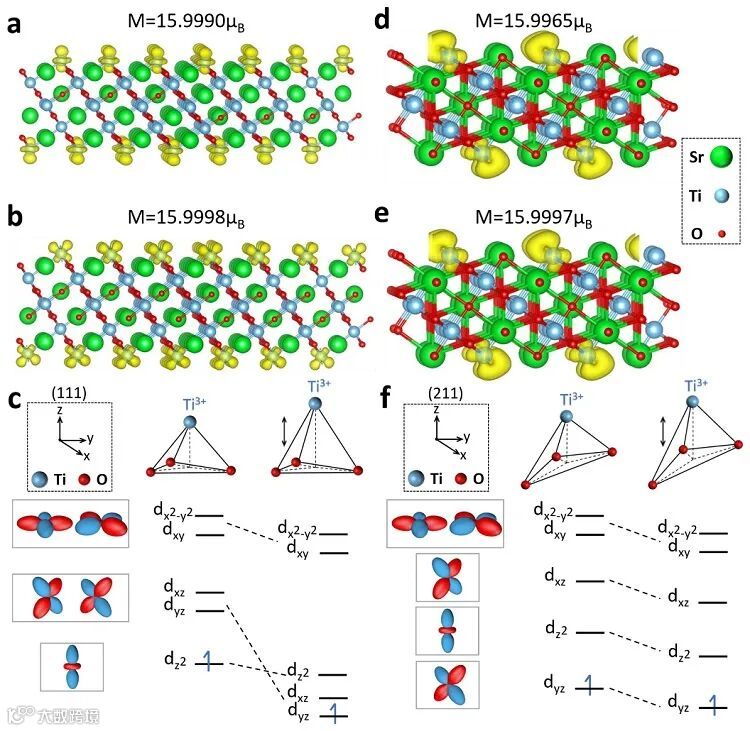
Figure 3. Electronic Structure Analysis. a) Spin charge density distribution of (111) plane without straining effect. b) Spin charge density distribution of (111) plane under 0.40% stretching ratio. c) The energy state of d orbital of Ti on (111) plane. d) Spin charge density distribution of (211) plane without straining effect. e) Spin charge density distribution of (211) plane under 0.20% stretching ratio. f) The energy state of d orbital of Ti on (211) plane.
文中进一步利用晶体场论的分子轨道图对其机理进行了探讨(图3)。分子轨道分析表明,在SC CO2的应变作用下,晶面沿垂直方向被拉伸,晶格结构由立方相转变为四方相。因此,(111)和(211)表面三个配位Ti原子的最高占据分子轨道 (HOMO) 被稳定,从而促进了dyz轨道上的自旋密度,从而显著增强了磁矩。除了主要的磁性增强外,在缺陷(200)表面上的四配位Ti原子也观察到类似的现象,其中dyz轨道上的自旋密度随着拉伸而增强。这项工作表明,可以通过SC CO2诱导的电子结构调制实现磁优化。
相关研究结果发表在Small 上,文章的通讯作者为郑州大学许群教授,共同第一作者为郑州大学材料科学与工程学院硕士生李莲瑜和博士生高波。
原文(扫描或长按二维码,识别后直达原文页面):Strong Ferromagnetic Manipulation of SrTiO3 from CO2-Straining Effect on Electronic Structure ModulationLianyu Li, Bo Gao, Song Xu, Qun XuSmall, 2023, DOI: 10.1002/smll.202300765 导师介绍许群https://www.x-mol.com/university/faculty/35064课题组介绍http://www5.zzu.edu.cn/xuqun/index.htm
欢迎访问郑州大学许群教授课题组!欢迎热爱科学,有志于从事科学研究的同学加入我们!我们也衷心欢迎来自国内外相关领域的课题组与我们合作交流!
点击“阅读原文”,查看 化学 • 材料 领域所有收录期刊







 X-MOL资讯