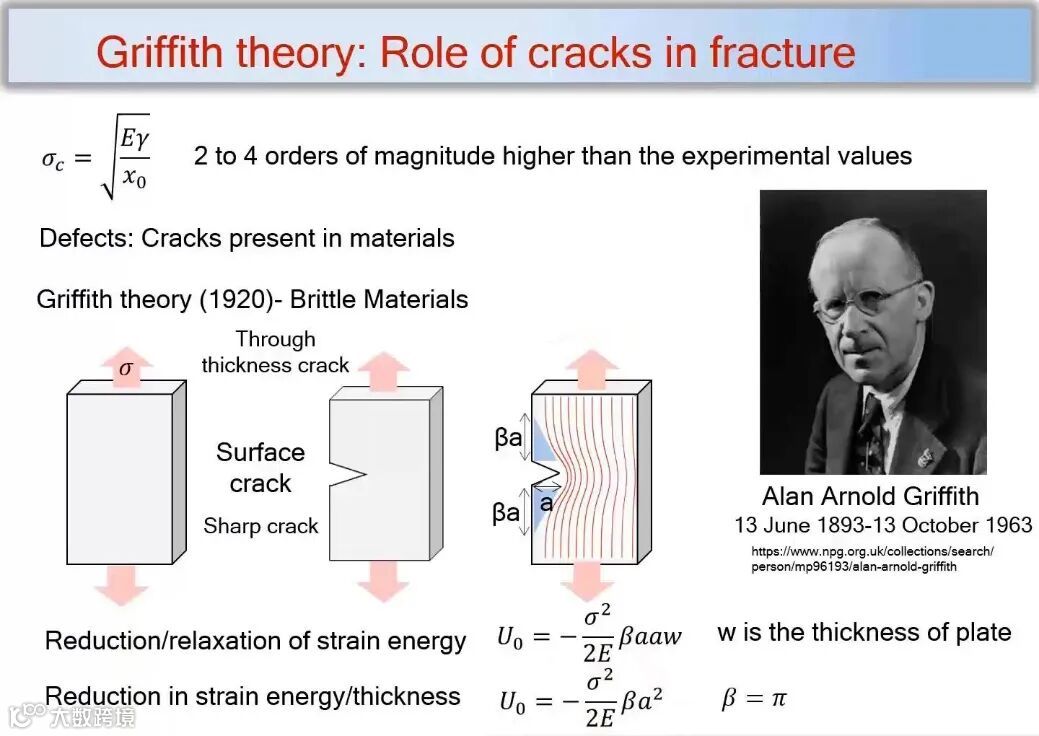
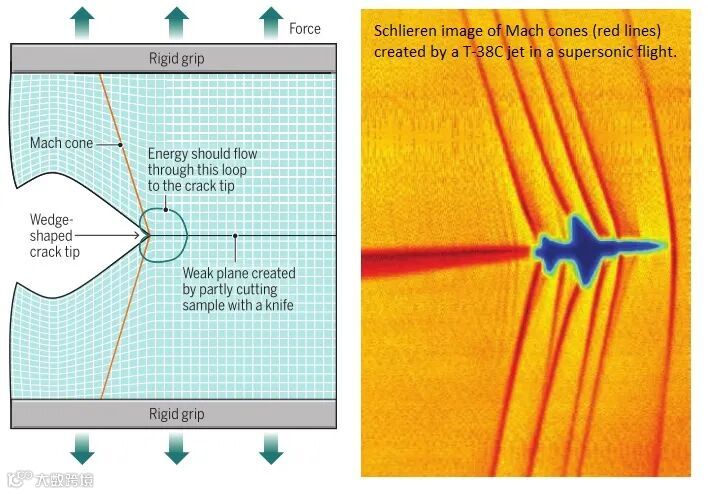
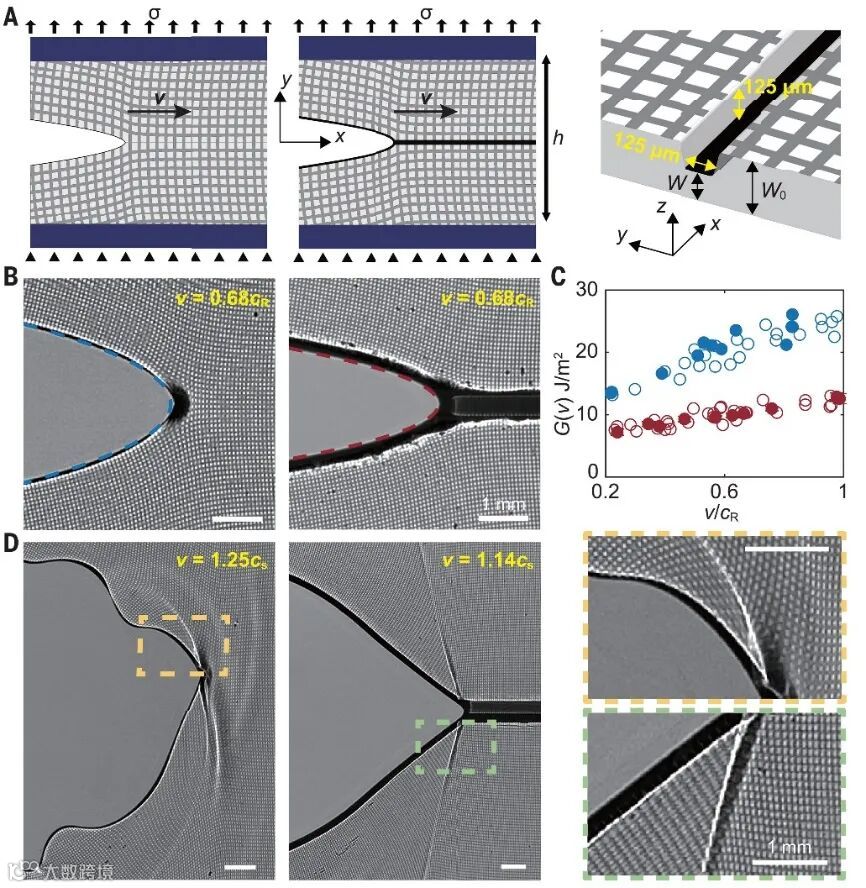
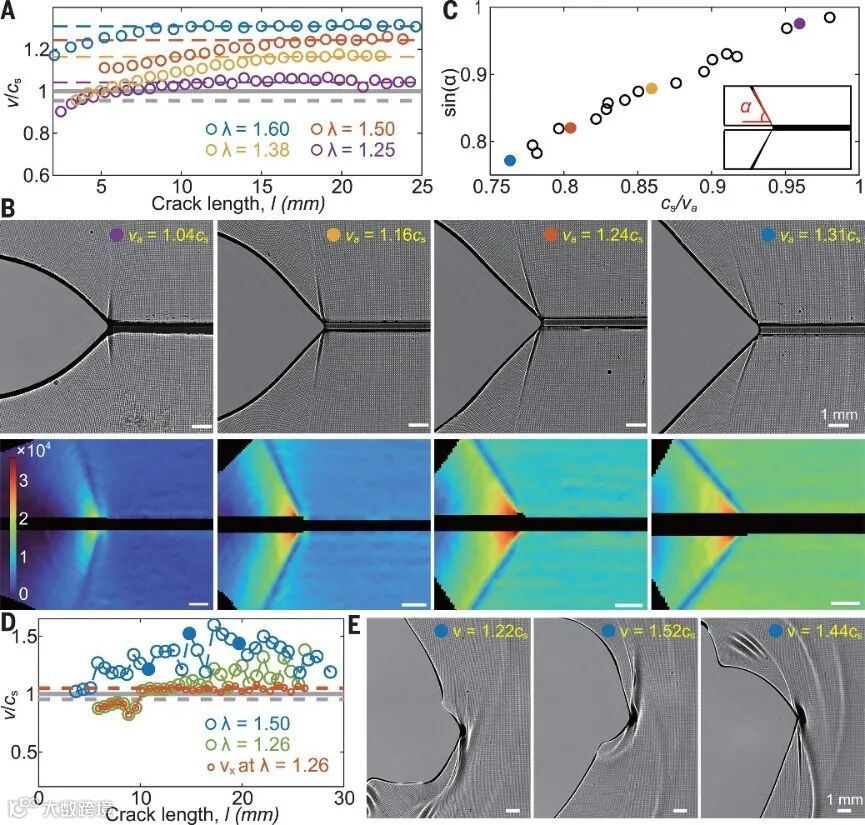
1921年,年轻的英国航空工程师格里菲斯(Alan Arnold Griffith)发现,当材料受到外力作用时,应力会在内部微小的裂纹周围集中,达到一定程度后使裂纹扩展导致材料断裂,并据此推导出著名的Griffith断裂理论,描述了断裂发生的临界应力条件,奠定了断裂力学的基石 [1]。30年后,Elizabeth H. Yoffe等人利用对表面波求和,实现了断裂动力学的精确计算,并且得出结论:裂纹传播速度受到表面波的限制,当裂纹尖端达到瑞利波速(Rayleigh wave speed, cR)时,能量表达式趋近于无穷大,既不存在大于瑞利波速的实数解 [2,3]。
“超剪切裂纹”的应变场依赖性。图片来源:Science
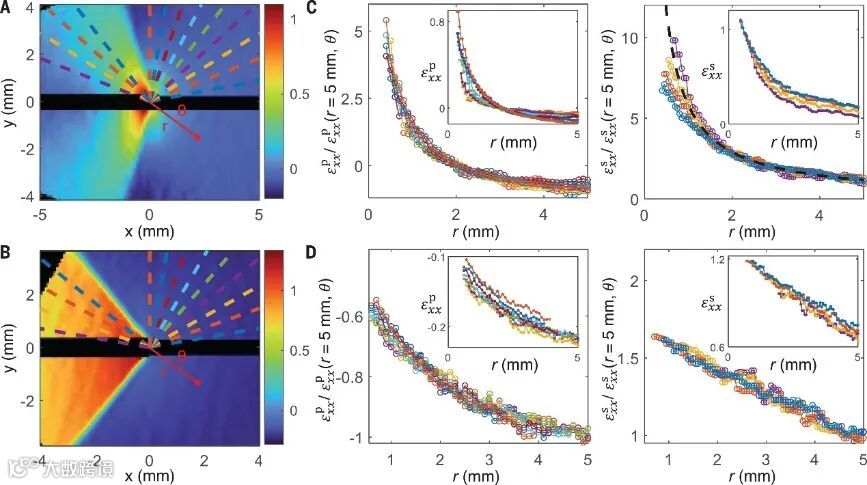
目前,研究者还不确定这种裂纹传播机理是否存在于所有材料中,以及材料的什么特性促使了这种裂纹的传播。不过,“这一发现代表了我们对材料断裂过程的理解的根本转变,”Jay Fineberg教授评论道,“通过证明超剪切裂纹的存在及其超过了经典速度极限,我们为研究断裂力学及其应用开辟了新的道路”[7]。 原文(扫描或长按二维码,识别后直达原文页面):Tensile cracks can shatter classical speed limitsMeng Wang, Songlin Shi, Jay FinebergScience, 2023, 381, 415-419. DOI: 10.1126/science.adg7693 参考文献:[1] A. A. Griffith, The phenomenon of rupture and flow in solids. Philos. Trans. R. Soc. Lond. 1921, 221, 163. DOI: 10.1098/rsta.1921.0006[2] E. H. Yoffe, The moving Griffith crack. Philos Mag. 1951, 7, 739-750.DOI: 10.1080/14786445108561302[3] L. Rayleigh, On Waves Propagated along the Plane Surface of an Elastic Solid. P. Lond. Math. Soc. 1885, 4, 1-17.DOI: 10.1112/plms/s1-17.1.4[4] D. Andrews, Rupture velocity of plane strain shear cracks. J. Geophys. Res. 1976, 81, 5679-5687. DOI: 10.1029/JB081i032p05679[5] R. Burridge, et al. The stability of a rapid mode II shear crack with finite cohesive traction. J. Geophys. Res. 1979, 84, 2210. DOI: 10.1029/JB084iB05p02210[6] M. Marder, Cracks break the sound barrier. Science 2023, 381, 375-376, DOI: 10.1126/science.adj0963[7] Tensile Cracks Can Shatter Classical Speed Limitshttps://en.huji.ac.il/news/tensile-cracks-can-shatter-classical-speed-limits (本文由小希供稿)


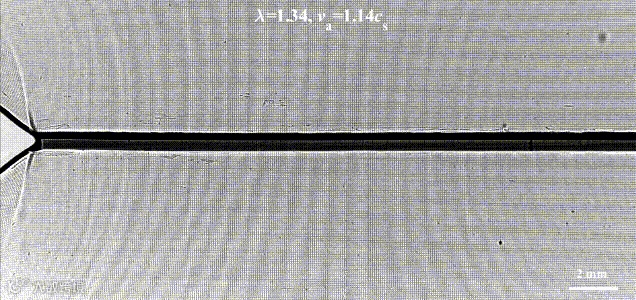
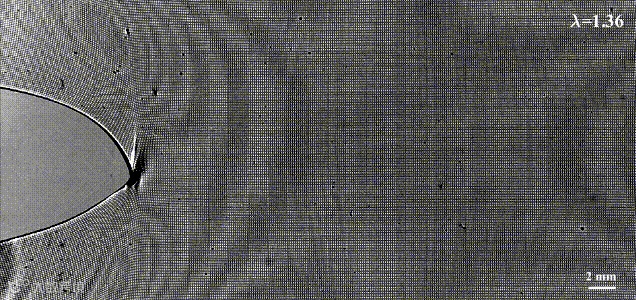



 X-MOL资讯