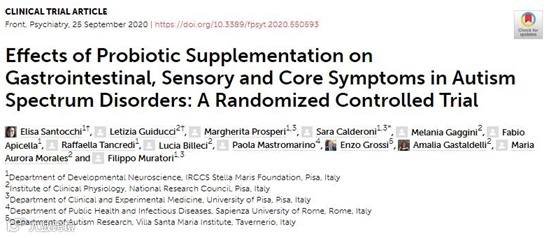
ID:10.3389 / fpsyt.2020.550593
微生物-肠-脑轴最近被认为是神经精神健康的关键调节剂。在这种框架下,益生菌(最近称为“精神抗生素”)可以调节大脑的活动和功能,可能改善自闭症谱系障碍(ASD)儿童的行为特征。
在一项针对85名ASD学龄前儿童(平均年龄4.2岁;84%的男孩)的双盲、随机、安慰剂对照试验中,我们评估了益生菌对自闭症的影响。参与者被随机分配六个月的益生菌(De Simone配方)(n = 42)或安慰剂(n = 43)。63名(74%)儿童完成了试验。
益生菌补充剂是DSF,已经被批准用于儿童。每个分组包含450个十亿8种益生菌菌株:嗜热链球菌,短双歧杆菌,长双歧杆菌,婴儿双歧杆菌,嗜酸乳杆菌,植物乳杆菌,干酪乳杆菌,乳杆菌德氏亚种,保加利亚乳杆菌。该研究方案要求口服DSF,在治疗的第一个月内直接将其溶于口腔或溶于冷的,非碳酸的液体中,治疗的第一个月为2包/天,随后的5个月为1包/天。父母或孩子的法定监护人在家中对孩子进行这种治疗。安慰剂的包装和感官特性与益生菌相同,并包含4.4 g的麦芽糖和二氧化硅。父母/照顾者填写每周食物日记,在日记中,他们报告了实验治疗和任何伴随药物或食物补充剂的停药。不需要暂停ASD当前指南中有效和推荐的任何其他干预措施。
在主要结局指标“总自闭症诊断观察表-校正严重程度评分(ADOS-CSS)”中未检测到组之间的差异。对有或没有胃肠道症状的儿童亚组进行的探索性次要分析(GI组,n = 30;NGI组,n = 55)显示,与安慰剂组相比,益生菌治疗的NGI组ADOS得分显着下降,六个月内平均ADOS CSS总数减少了0.81,社会影响ADOS CSS减少了1.14。
在益生菌治疗的胃肠道组中,我们发现一些胃肠道症状,适应性功能和感觉特征的改善比安慰剂治疗的胃肠道组更大。
结果表明,益生菌对一部分自闭症儿童的核心自闭症症状具有潜在的积极影响,而与益生菌对胃肠道症状的特异性调节无关。
参考文献:
1. American PsychiatricAssociation. Diagnosticand statistical manual of mental disorders. 5th ed. Washington, DC: AmPsychiatric Publishing (2013).
2.Cryan JF, Dinan TG. Mind-altering microorganisms: the impact of the gutmicrobiota on brain and behaviour. Nat Rev Neurosci (2012) 13:701–12. doi:10.1038/nrn3346
PubMed Abstract | CrossRef Full Text | Google Scholar
3.Collins SM, Bercik P. The relationship between intestinal microbiota and thecentral nervous system in normal gastrointestinal function and disease. Gastroenterology (2009)136:2003–14. doi: 10.1053/j.gastro.2009.01.075
PubMed Abstract | CrossRef Full Text | Google Scholar
4.Rhee SH, Pothoulakis C, Mayer EA. Principles and clinical implications of thebrain-gut-enteric microbiota axis. Nat Rev Gastroenterol Hepatol (2009)6:306–14. doi: 10.1038/nrgastro.2009.35
PubMed Abstract | CrossRef Full Text | Google Scholar
5.Bezawada N, Phang TH, Hold GL, Hansen R. Autism Spectrum Disorder and the GutMicrobiota in Children: A Systematic Review. Ann Nutr Metab (2020) 24:1–14. doi:10.1159/000505363
CrossRef Full Text | Google Scholar
6.Dinan TG, Cryan JF. Microbes, Immunity, and Behavior: PsychoneuroimmunologyMeets the Microbiome. Neuropsychopharmacology (2017)42:178–92. doi: 10.1038/npp.2016.103
PubMed Abstract | CrossRef Full Text | Google Scholar
7.Dinan TG, Cryan JF. Gut microbiota: a missing link in psychiatry. World Psychiatry (2020)19:111–2. doi: 10.1002/wps.20726
PubMed Abstract | CrossRef Full Text | Google Scholar
8.Iannone LF, Preda A, Blottiere HM, Clarke G, Albani D, Belcastro V, et al.Microbiota-gut brain axis involvement in neuropsychiatric disorders. Expert Rev Neurother (2019)19:1037–50. doi: 10.1080/14737175.2019.1638763
PubMed Abstract | CrossRef Full Text | Google Scholar
9.Holingue C, Newill C, Lee LC, Pasricha PJ, Daniele Fallin M. Gastrointestinalsymptoms in autism spectrum disorder: A review of the literature onascertainment and prevalence. AutismRes (2018) 11:24–36. doi: 10.1002/aur.1854
PubMed Abstract | CrossRef Full Text | Google Scholar
10.Fulceri F, Morelli M, Santocchi E, Cena H, Del Bianco T, Narzisi A, et al.Gastrointestinal symptoms and behavioral problems in preschoolers with AutismSpectrum Disorder. DigLiver Dis (2016) 48:248–54. doi: 10.1016/j.dld.2015.11.026
PubMed Abstract | CrossRef Full Text | Google Scholar
11.Prosperi M, Santocchi E, Balboni G, Narzisi A, Bozza M, Fulceri F, et al.Behavioral Phenotype of ASD Preschoolers with Gastrointestinal Symptoms or FoodSelectivity. JAutism Dev Disord (2017) 47:3574–88. doi: 10.1007/s10803-017-3271-5
PubMed Abstract | CrossRef Full Text | Google Scholar
12.Azhari A, Azizan F, Esposito G. A systematic review of gut-immune-brainmechanisms in Autism Spectrum Disorder. Dev Psychobiol (2019) 61:752–71. doi:10.1002/dev.21803
PubMed Abstract | CrossRef Full Text | Google Scholar
13.Adams JB, Johansen LJ, Powell LD, Quig D, Rubin RA. Gastrointestinal flora andgastrointestinal status in children with autism-comparisons to typical childrenand correlation with autism severity. BMC Gastroenterol (2011) 11:22. doi:10.1186/1471-230X-11-22
PubMed Abstract | CrossRef Full Text | Google Scholar
14.Louis P. Does the human gut microbiota contribute to the etiology of autismspectrum disorders? DigDis Sci (2012) 57:1987–9. doi: 10.1007/s10620-012-2286-1
PubMed Abstract | CrossRef Full Text | Google Scholar
15.Liu Z, Li N, Neu J. Tight junctions, leaky intestines, and pediatric diseases. Acta Paediatr (2005)94:386–93. doi: 10.1111/j.1651-2227.2005.tb01904.x
PubMed Abstract | CrossRef Full Text | Google Scholar
16.Catassi C, Bai JC, Bonaz B, Bouma G, Calabrò A, Carroccio A, et al. Non-CeliacGluten sensitivity: the new frontier of gluten related disorders. Nutrients (2013)5:3839–53. doi: 10.3390/nu5103839
PubMed Abstract | CrossRef Full Text | Google Scholar
17.Mead J, Ashwood P. Evidence supporting an altered immune response in ASD. Immunol Lett (2015)163:49–55. doi: 10.1016/j.imlet.2014.11.006
PubMed Abstract | CrossRef Full Text | Google Scholar
18.de Magistris L, Familiari V, Pascotto A, Sapone A, Frolli A, Iardino P, et al.Alterations of the intestinal barrier in patients with autism spectrumdisorders and in their first-degree relatives. J Pediatr Gastroenterol Nutr (2010)51:418–24. doi: 10.1097/MPG.0b013e3181dcc4a5
PubMed Abstract | CrossRef Full Text | Google Scholar
19.Babinska K, Tomova A, Celusakova H, Babková J, Repiská G, Kubranská A, et al.Fecal calprotectin levels correlate with main domains of the autism diagnosticinterview-revised (ADI-R) in a sample of individuals with autism spectrumdisorders from Slovakia. PhysiolRes (2017) 66:S517–22. doi: 10.33549/physiolres.933801
PubMed Abstract | CrossRef Full Text | Google Scholar
20.Desbonnet L, Clarke G, Shanahan F, Dinan TG, Cryan JF. Microbiota is essentialfor social development in the mouse. Mol Psychiatry (2014) 19:146–8. doi:10.1038/mp.2013.65
PubMed Abstract | CrossRef Full Text | Google Scholar
21.Hsiao EY, McBride SW, Hsien S, Sharon G, Hyde ER, McCue T, et al. Microbiotamodulate behavioral and physiological abnormalities associated withneurodevelopmental disorders. Cell (2013)155:1451–63. doi: 10.1016/j.cell.2013.11.024
PubMed Abstract | CrossRef Full Text | Google Scholar
22.de Theije CG, Wopereis H, Ramadan M, van Eijndthoven T, Lambert J, Knol J, etal. Altered gut microbiota and activity in a murine model of autism spectrumdisorders. BrainBehav Immun (2014) 37:197–206. doi: 10.1016/j.bbi.2013.12.005
PubMed Abstract | CrossRef Full Text | Google Scholar
23.de Theije CG, Koelink PJ, Korte-Bouws GA, Lopes da Silva S, Korte SM, OlivierB, et al. Intestinal inflammation in a murine model of autism spectrumdisorders. BrainBehav Immun (2014) 37:240–7. doi: 10.1016/j.bbi.2013.12.004
PubMed Abstract | CrossRef Full Text | Google Scholar
24.Dinan TG, Stanton C, Cryan JF. Psychobiotics: a novel class of psychotropic. Biol Psychiatry (2013)74:720–6. doi: 10.1016/j.biopsych.2013.05.001
PubMed Abstract | CrossRef Full Text | Google Scholar
25.Patusco R, Ziegler J. Role of Probiotics in Managing GastrointestinalDysfunction in Children with Autism Spectrum Disorder: An Update forPractitioners. AdvNutr (2018) 9:637–50. doi: 10.1093/advances/nmy031
PubMed Abstract | CrossRef Full Text | Google Scholar
26.Parracho HMRT, Gibson GR, Knott F, Bosscher D, Kleerebezem M, McCartney AL, etal. A double blind, placebo-controlled, crossover-designed probiotic feedingstudy in children diagnosed with autistic spectrum disorders. Int J Probiot Prebiot (2010)5:69–74.
27.Shaaban SY, El Gendy YG, Mehanna NS, El-Senousy WM, El-Feki HSA, Saad K, et al.The role of probiotics in children with autism spectrum disorder: Aprospective, open-label study. Nutr Neurosci (2018) 21:676–81. doi:10.1080/1028415X.2017.1347746
PubMed Abstract | CrossRef Full Text | Google Scholar
28.West DO ER, Sichel LS, Sichel J. Improvements in Gastrointestinal Symptomsamong Children with Autism Spectrum Disorder Receiving the Delpro® Probioticand Immunomodulator Formulation. Probiotics Health (2013) 1:102. doi:10.4172/2329-8901.1000102
CrossRef Full Text | Google Scholar
29.Santocchi E, Guiducci L, Fulceri F, Billeci L, Buzzigoli E, Apicella F, et al.Gut to brain interaction in Autism Spectrum Disorders: a randomized controlledtrial on the role of probiotics on clinical, biochemical and neurophysiologicalparameters. BMCPsychiatry (2016) 16:183. doi: 10.1186/s12888-016-0887-5
PubMed Abstract | CrossRef Full Text | Google Scholar
30.Le Couteur A, Lord C, Rutter M. Autism diagnostic interview-revised. Los Angeles,CA: Western Psychological Services (2003).
31.Schneider CK, Melmed RD, Barstow LE, Enriquez FJ, Ranger-Moore J, Ostrem JA.Oral human immunoglobulin for children with autism and gastrointestinaldysfunction: a prospective, open label study. J Autism Dev Disord (2006) 36:1053–64. doi:10.1007/s10803-006-0141-y
PubMed Abstract | CrossRef Full Text | Google Scholar
32.Lord C, Rutter M, DiLavore PC, Risi S, Gotham K, Bishop SL. Autism diagnosticobservation schedule, (ADOS-2), Part 1: Modules 1–4 (2nd ed.). Los Angeles:Western Psychological Services (2012).
33.Wiggins LD, Barger B, Moody E, Soke G, Pandey J, Levy S. Brief Report: The ADOSCalibrated Severity Score Best Measures Autism Diagnostic Symptom Severity inPre-School Children. JAutism Dev Disord (2019) 49:2999–3006. doi: 10.1007/s10803-017-3072-x
PubMed Abstract | CrossRef Full Text | Google Scholar
34.Gotham K, Pickles A, Lord C. Standardizing ADOS scores for a measure ofseverity in autism spectrum disorders. J Autism Dev Disord (2009) 39:693–705. doi:10.1007/s10803-008-0674-3
PubMed Abstract | CrossRef Full Text | Google Scholar
35.Sparrow SS, Cicchettim DV, Balla DA. Vineland adaptive behavior scales. 2nd ed. CirclePines, MN: AGS Publishing (2005).
36.Griffiths R. TheGriffiths mental developmental scales, Extended Revised. UK: Associationfor Research in Infant and Child Development, the Test Agency (2006).
37.Rutter M, Bailey A, Lord C. TheSocial Communication Questionnaire: Manual. Los Angeles: WesternPsychological Services (2003).
38.Dunn W. SensoryProfile user"s manual. San Antonio, Tx: Psychological Corporation(1999).
39.Lam KSL, Aman MG. The Repetitive Behavior Scale-Revised: Independent Validationin Individuals with Autism Spectrum Disorders. J Autism Dev Disord (2007) 37:855–66. doi:10.1007/s10803-006-0213-z
PubMed Abstract | CrossRef Full Text | Google Scholar
40.Achenbach TM, Rescorla LA. Manualfor the ASEBA Preschool forms and Profiles. Burlington, VT: University ofVermont, Research Center for Children, Youth, & Families(2000).
41.Abidin RR. ParentingStress Index (PSI) 3rd Edition. PAR: Psychological Assessment Resources,Inc (1995).
42.Narzisi A, Muratori F, Buscema M, Calderoni S, Grossi E. Outcome predictors inautism spectrum disorders preschoolers undergoing treatment as usual: insightsfrom an observational study using artificial neural networks. Neuropsychiatr Dis Treat (2015)11:1587–99. doi: 10.2147/NDT.S81233
PubMed Abstract | CrossRef Full Text | Google Scholar
43.McConachie H, Parr JR, Glod M, Hanratty J, Livingstone N, Oono IP, et al.Systematic review of tools to measure outcomes for young children with autismspectrum disorder. HealthTechnol Assess (2015) 19:1–506. doi: 10.3310/hta19410
PubMed Abstract | CrossRef Full Text | Google Scholar
44.Bieleninik L, Geretsegger M, Mossler K, Assmus J, Thompson G, Gattino G, et al.Effects of Improvisational Music Therapy vs Enhanced Standard Care on SymptomSeverity Among Children with Autism Spectrum Disorder: The TIME-A RandomizedClinical Trial. JAMA (2017)318:525–35. doi: 10.1001/jama.2017.9478
PubMed Abstract | CrossRef Full Text | Google Scholar
45.Luna RA, Savidge TC, Williams KC. The Brain-Gut-Microbiome Axis: What Role DoesIt Play in Autism Spectrum Disorder? Curr Dev Disord Rep (2016) 3:75–81. doi:10.1007/s40474-016-0077-7
PubMed Abstract | CrossRef Full Text | Google Scholar
46.Arnold LE, Luna RA, Williams K, Chan J, Parker RA, Wu Q, et al. Probiotics forGastrointestinal Symptoms and Quality of Life in Autism: A Placebo-ControlledPilot Trial. ChildAdolesc Psychopharmacol (2019) 29:659–69. doi: 10.1089/cap.2018.0156
CrossRef Full Text | Google Scholar
47.Siemann JK, Muller CL, Forsberg CG, Blakely RD, Veenstra-VanderWeele J, WallaceMT. An autism-associated serotonin transporter variant disrupts multisensoryprocessing. TranslPsychiatry (2017) 7:e1067. doi: 10.1038/tp.2017.17
PubMed Abstract | CrossRef Full Text | Google Scholar
48.Thye MD, Bednarz HM, Herringshaw AJ Sartin EB, Kana RK. The impact of atypicalsensory processing on social impairments in autism spectrum disorder. Dev Cognit Neurosci (2018)29:151–67. doi: 10.1016/j.dcn.2017.04.010
CrossRef Full Text | Google Scholar
49.Veenstra-VanderWeele J, Cook EH, King BH, Zarevics P, Cherubini M, Walton-BowenK, et al. Arbaclofen in Children and Adolescents with Autism Spectrum Disorder:A Randomized, Controlled, Phase 2 Trial. Neuropsychopharmacology (2017) 42:1390–8.doi: 10.1038/npp.2016.237
PubMed Abstract | CrossRef Full Text | Google Scholar
50.Hollander E, Uzunova G. Are there new advances in the pharmacotherapy of autismspectrum disorders? WorldPsychiatry (2017) 16:101–2. doi: 10.1002/wps.20398
PubMed Abstract | CrossRef Full Text | Google Scholar
51.Prosperi M, Guiducci L, Peroni DG, Narducci C, Gaggini M, Calderoni S, et al.Inflammatory Biomarkers are Correlated with Some Forms of Regressive AutismSpectrum Disorder. BrainSci (2019) 9:366. doi: 10.3390/brainsci9120366
CrossRef Full Text | Google Scholar
52.Kaluzna-Czaplinska J, Blaszczyk S. The level of arabinitol in autistic childrenafter probiotic therapy. Nutrition (2012)28:124–6. doi: 10.1016/j.nut.2011.08.002
PubMed Abstract | CrossRef Full Text | Google Scholar
53.Tomova A, Husarova V, Lakatosova S, Bakos J, Vlkova B, Babinska K, et al.Gastrointestinal microbiota in children with autism in Slovakia. Physiol Behav (2015)138:179–87. doi: 10.1016/j.physbeh.2014.10.033
PubMed Abstract | CrossRef Full Text | Google Scholar
54.Ng QX, Loke W, Venkatanarayanan N, Lim DY, Soh AYS, Yeo WS. A Systematic Reviewof the Role of Prebiotics and Probiotics in Autism Spectrum Disorders. Med (Kaunas) (2019)55:129. doi: 10.3390/medicina55050129
CrossRef Full Text | Google Scholar
55.d’Ettorre G, Rossi G, Scagnolari C, Andreotti M, Giustini N, Serafino S, et al.Probiotic supplementation promotes a reduction in T-cell activation, anincrease in Th17 frequencies, and a recovery of intestinal epithelium integrityand mitochondrial morphology in ART-treated HIV-1- positive patients. Immun Inflammation Dis (2017)5:244–60. doi: 10.1002/iid3.160
CrossRef Full Text | Google Scholar
56.Firth J, Teasdale SB, Allott K, Siskind D, Marx W, Cotter J, et al. Theefficacy and safety of nutrient supplements in the treatment of mentaldisorders: a meta-review of meta-analyses of randomized controlled trials. World Psychiatry (2019)18:308–24. doi: 10.1002/wps.20672
PubMed Abstract | CrossRef Full Text | Google Scholar
57.Anagnostou E, Jones N, Huerta M, Halladay AK, Wang P, Scahill L, et al.Measuring social communication behaviors as a treatment endpoint in individualswith autism spectrum disorder. Autism (2015) 19:622–36. doi:10.1177/1362361314542955
PubMed Abstract | CrossRef Full Text | Google Scholar
58.Jones RM, Carberry C, Hamo A, Lord C. Placebo-like response in absence oftreatment in children with Autism. Autism Res (2017) 10:1567–72. doi:10.1002/aur.1798
PubMed Abstract | CrossRef Full Text | Google Scholar
此文转载于网络,如有异议,请联系本公众号协商处理。