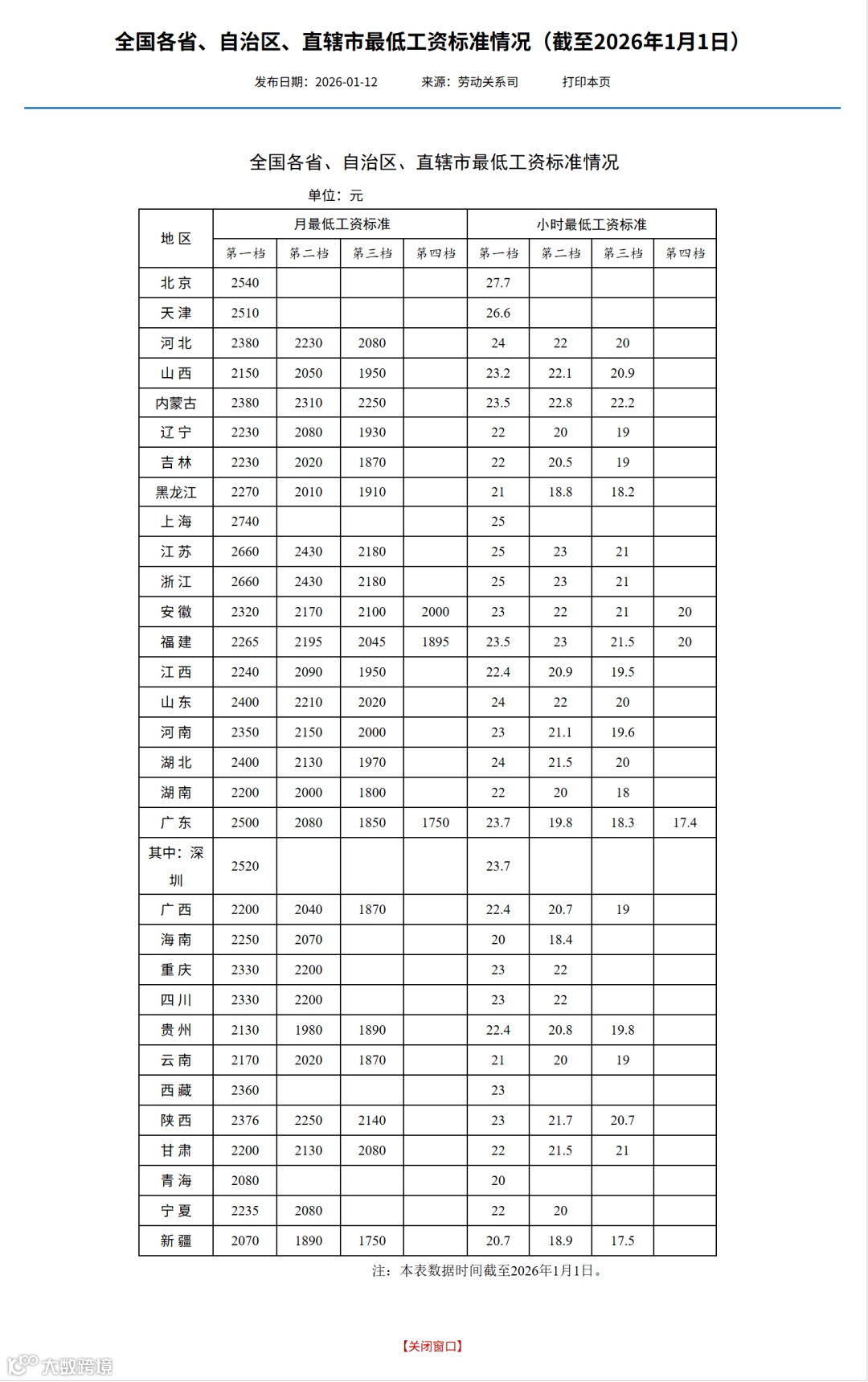
2026年1月12日,人力资源和社会保障部劳动关系司正式发布全国各省、自治区、直辖市最低工资标准(截至 2026年1月1日)。此次标准分为月最低工资标准(monthly minimum wage standard)和小时最低工资标准(hourly minimum wage standard)两类,各地根据经济发展水平设置 1-4 档梯度,既适配区域发展差异,也为劳动者权益保障提供明确依据。
On January 12, 2026, the Department of Labor Relations of the Ministry of Human Resources and Social Security (MOHRSS) officially released the minimum wage standards for provinces, autonomous regions, and municipalities directly under the Central Government nationwide (as of January 1, 2026). The standards are categorized into monthly minimum wage standards and hourly minimum wage standards, with 1-4 grades set by local governments based on their economic development levels. This gradient design not only adapts to regional development differences but also provides clear guidelines for protecting workers' rights and interests.
一、月最低工资标准核心特点 | I. Core Features of Monthly Minimum Wage Standards
1. 分档设置差异显著 | 1. Significant Differences Among Grades
-
多数地区实行2-4档分类,仅北京、天津、上海未设多档(仅第一档);安徽、广东、福建等省份分4档,精准匹配省内不同区域经济实力。 -
Most regions implement 2-4 grade classifications, with only Beijing, Tianjin, and Shanghai adopting a single grade (Grade 1). Provinces such as Anhui, Guangdong, and Fujian have 4 grades, accurately matching the economic strength of different regions within the province. -
第一档 TOP3:上海2740元(全国最高),北京2540元,天津2510元;最低档(第四档)TOP3:新疆1750元,贵州1890元,云南1870元,最高与最低档差距超56%。 -
Top 3 Grade 1 standards: Shanghai (2,740 yuan, the highest nationwide), Beijing (2,540 yuan), Tianjin (2,510 yuan); Top 3 lowest Grade 4 standards: Xinjiang (1,750 yuan), Guizhou (1,890 yuan), Yunnan (1,870 yuan), with a gap of over 56% between the highest and lowest grades. -
重点城市亮点:深圳作为广东省副省级市,月标准2520元(独立于广东省第一档2500元),位列全国第四,凸显其经济地位与用工需求。 -
Key city highlight: As a sub-provincial city of Guangdong Province, Shenzhen’s monthly standard is 2,520 yuan (independent of Guangdong’s Grade 1 standard of 2,500 yuan), ranking 4th nationwide, reflecting its economic status and labor demand.
2. 区域梯度格局清晰 | 2. Clear Regional Gradient Pattern
-
东部沿海省份(江苏、浙江、广东、福建等)第一档均超2400元,整体水平领先全国,适配其高物价、高经济活跃度特征; -
Eastern coastal provinces (Jiangsu, Zhejiang, Guangdong, Fujian, etc.) all have Grade 1 monthly standards exceeding 2,400 yuan, leading the nation overall, which adapts to their characteristics of high prices and high economic activity; -
中西部及东北地区第一档多在2000-2380元区间,部分省份低档位(第三、四档)下探至1800-1900元,平衡了当地企业承载能力与低收入群体基本生活保障。 -
Central, western, and northeastern regions mostly have Grade 1 standards ranging from 2,000 to 2,380 yuan, with the lower grades (Grade 3 and 4) in some provinces dropping to 1,800-1,900 yuan, balancing the bearing capacity of local enterprises and the basic living security of low-income groups.
二、小时最低工资标准核心特点 | II. Core Features of Hourly Minimum Wage Standards
1. 与月标准呈强正相关 | 1. Strong Positive Correlation with Monthly Standards
-
第一档 TOP3:北京27.7元(全国最高),天津26.6元,上海25元;最低档(第四档)TOP3:新疆17.5元,云南18.5元,贵州18.6元,与月标准最低档区域高度一致。 -
Top 3 Grade 1 standards: Beijing (27.7 yuan, the highest nationwide), Tianjin (26.6 yuan), Shanghai (25 yuan); Top 3 lowest Grade 4 standards: Xinjiang (17.5 yuan), Yunnan (18.5 yuan), Guizhou (18.6 yuan), which are highly consistent with the regions with the lowest monthly standards. -
分档数量适配灵活:多数省份小时标准分档数量与月标准对应,仅海南、青海等少数省份分 2 档,简化管理流程。 -
Flexible grade quantity: Most provinces have the same number of grades for hourly standards as monthly standards, with only a few provinces such as Hainan and Qinghai adopting 2 grades to streamline management.
2. 聚焦灵活就业保障 | 2. Focus on Protecting Flexible Employment
小时标准主要针对非全日制用工(如兼职、临时工),东部地区普遍超 20 元,中西部地区多在18-22元区间,既保障了灵活就业人员的劳动报酬权益,也为新业态用工薪酬设定提供参考基准。The hourly standard mainly targets non-full-time employment (such as part-time and temporary workers). Eastern regions generally have standards exceeding 20 yuan, while central and western regions mostly range from 18 to 22 yuan. This not only protects the labor remuneration rights of flexible workers but also provides a reference benchmark for setting salaries in new employment formats.