


中国湿地保护与荒漠治理成就获国际认可
九城获评国际湿地城市,两大绿色“长城”筑牢生态屏障
By GONG Qian
Nine Chinese cities were recognized as international wetland cities at the 15th Meeting of the Conference of the Contracting Parties to the Ramsar Convention on Wetlands on July 24, bringing China's total to 22 — the highest number worldwide.
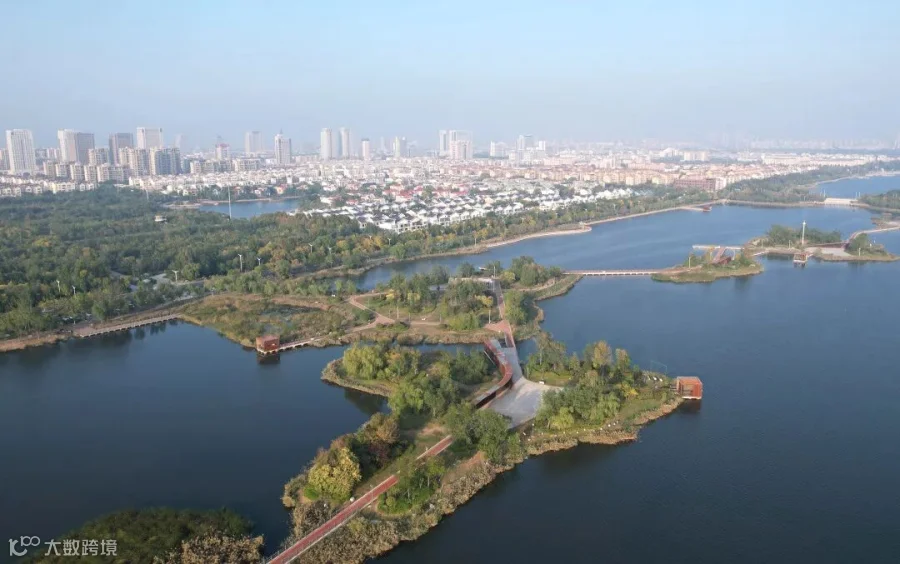
▲ A scenery in Dongying, east China's Shandong province, one of the world's first batch of "International Wetland Cities". (PHOTO: XINHUA)
Musonda Mumba, secretary general of the Convention on Wetlands, told Xinhua that China has played a major role in wetland preservation and its wetlands protection law, which took effect in June 2022, demonstrates its commitment.
Protection efforts require an enforcement mechanism. "China has done that very well, and those lessons can be shared with other countries to take forward so that other countries can learn from China," she added.
Beyond wetland conservation, China has also made significant progress in combating desertification. In early July, a 1,856-kilometer green barrier spanning the Badain Jaran, Tengger, and Ulan Buh deserts in north China's Inner Mongolia autonomous region was completed. This follows the completion of a major green belt across the Taklamakan Desert in Xinjiang in November 2024 — China's largest desert and the world's second-largest shifting sand desert.
The completion of these two large-scale afforestation projects marks a milestone in China’s decades-long ecological restoration efforts. Guided by the principle that “lucid waters and lush mountains are invaluable assets,” China has adopted a holistic approach to ecosystem management, integrating the governance of mountains, rivers, forests, farmland, grasslands, and deserts.
Scientific and technological innovation has significantly enhanced ecological restoration efficiency. In the Taklamakan Desert, intelligent robots are used to plant Apocynum venetum, a salt-tolerant species suited to harsh environments. These robots can afforest 15 mu (about 1 hectare) daily, with a survival rate 27% higher than manual planting.
Large-scale ecological programs have transformed environmental goals into actionable initiatives, strengthening national ecological security. As a responsible global actor, China shares its expertise through technology transfer and cooperation, including support for Africa’s Great Green Wall initiative. Drawing from its Three-North Shelterbelt Program, China has introduced drought-resistant afforestation techniques to the Sahara region, helping combat desertification and improve local livelihoods.
Through concrete actions, China continues to fulfill its ecological commitments, offering replicable models for global environmental governance and contributing to sustainable development worldwide.
END
Editor | SONG Ziyan
Supervisor | FANG Linlin