


13岁少年用AI写科幻小说赚2万元:Alpha世代如何重塑未来?
AI赋能新生代,教育变革与风险防范并重
By LONG Yun & FANG Linlin
In an era where technology is reshaping our world, growing concerns about the long-term impact of AI have been met with a striking example: 13-year-old Xu Mengmeng used generative AI to write a science fiction novel, AI Teen: The Mars Survival Challenge, earning 20,000 RMB in royalties.
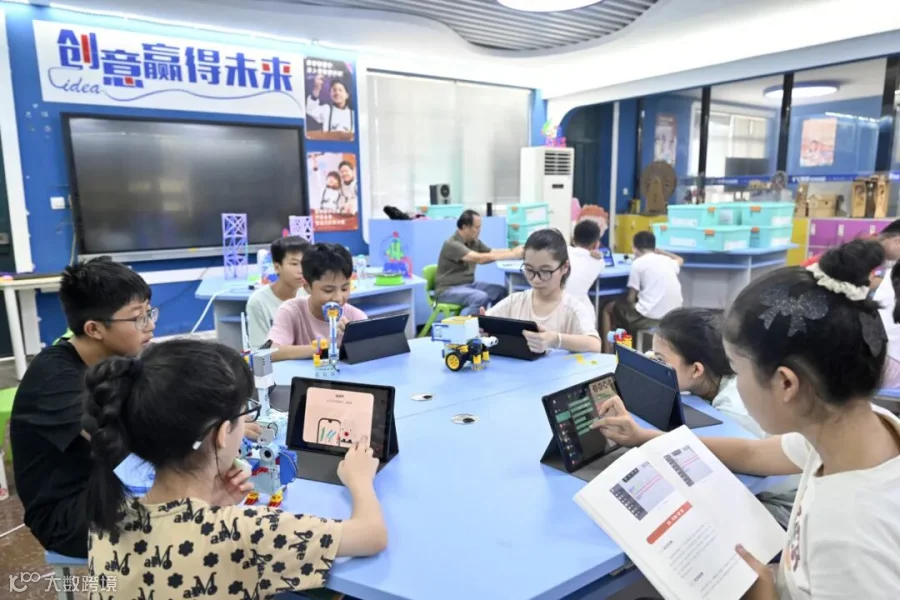
▲ Primary school students practice programming using AI under the guidance of teachers. (PHOTO: XINHUA)
Born after 2010, this so-called "Alpha Generation" is actively embracing AI—not just as users, but as creators and innovators.
A wave cannot be resisted
"Today, AI systems routinely exceed human performance on standard benchmarks," said Ray Perrault, Co-Director of the Stanford University AI Index 2024 report. This shift is transforming industries and redefining how young people learn and interact with the world. As Professor Mohamed Sawan from Westlake University noted, AI offers significant opportunities for socioeconomic development, especially in education and healthcare.
A Tencent survey reveals that 45.1% of Chinese youth have used AI products, while Common Sense Media reports 58% of U.S. teens aged 12–18 have used ChatGPT. These figures highlight a global trend: the Alpha Generation is not passively consuming technology, but actively using it to create and explore.
Educational institutions worldwide are responding by integrating AI into curricula. In China, the Ministry of Education has established 184 AI education bases in primary and secondary schools. Innovative programs—such as AI creative courses at Shanxi Experimental Primary School and the AI experimental zone at Shanghai’s Luwan High School—are paving the way for human-AI collaboration in learning.
Concerted efforts to mitigate risks
A July 2024 study published in Science Advances found that generative AI enhances creativity and writing quality, particularly for less experienced writers. However, AI-assisted stories tend to be more similar, raising concerns about reduced collective novelty.
Experts warn that overreliance on AI may lead to homogenized thinking and expose learners to "AI hallucinations"—false or inaccurate outputs that can distort critical judgment. Additionally, algorithmic bias remains a pressing issue. The OECD Digital Education Outlook 2023 cautions that biased algorithms could replicate or amplify societal inequalities, undermining the potential of digital education.
Hu Jiehui, professor at the University of Electronic Science and Technology of China, emphasized the need for collaborative governance: governments, tech companies, educators, and parents must work together to ensure responsible AI use.
Wang Xin from Tianjin University stressed the importance of developing native-language AI models that reflect local cultural values, ensuring educational relevance and social benefit.
Hu also highlighted the irreplaceable role of teachers in guiding students’ intellectual and emotional development, even as AI supports personalized learning.
Advanced human-AI interaction
For the new generation, mastering AI tools is no longer optional—it's essential for improving learning efficiency and unlocking creativity.
Experts agree that cultivating advanced cognitive skills is key. Professor Oguz A. Acar of King's College London emphasizes "problem formulation" as a vital skill: in an age of instant AI-generated answers, the ability to define, analyze, and creatively reframe problems becomes paramount.
Hu noted that effective human-AI interaction requires asking precise questions to extract meaningful responses and avoid misinformation.
Tang Xiao, associate professor at Tsinghua University, called for strengthening critical thinking, information discernment, logical reasoning, and aesthetic judgment in language and content—skills crucial for navigating AI-driven learning environments.
While many young users still lack the experience to ask high-quality questions, AI itself can serve as a training ground for curiosity and inquiry.
"To a certain extent, I am not worried about the impact of generative AI," Tang said. "The mission of education is to nurture the next generation with love and responsibility. Each generation faces its own challenges—and as long as they grow stronger than the last, they will overcome them."
END
Editor | SONG Ziyan
Supervisor | FANG Linlin