Sino-German SME Dialogue Marks Decade of Collaboration

On July 12, a China-Germany re-dialogue forum was held in Shanghai Hall of the China Financial Information Center. Titled Sino-German SME Dialogue After Ten Years (2012-2022) – 'Little Giants', 'Single Champions' and 'Hidden Champions', it was co-sponsored by several organizations including the Shanghai Sino-German Industrial Promotion Center, China SME Development Promotion Center, and others.
The event’s guiding departments included the China International Cooperation Association of SMEs, Shanghai Municipal Commission of Economy and Informatization, German Agency for International Cooperation, and more.
Online & Offline Communication
The forum combined an offline salon with an online live broadcast. Key participants included:
- Prof. Hermann Simon, known as the "Father of the World Hidden Champions"
- Lipo SHAN, Director of China Center for Promotion of SME Development
- Xiaohui ZHANG, Chief Economist of China International Cooperation Association of SMEs
- Zhiqin RONG, Director of Shanghai Service Enterprise Joint Conference Office
- Weiyong GUAN, President of Shanghai Federation of Industrial Economics
Representatives from over 20 world hidden champions and national-level “Specialized, Fine, Peculiar, Innovative” SMEs also attended the offline dialogue. The event was hosted by Boris Zhang, Director of the Shanghai Sino-German Industrial Promotion Center.
In his opening remarks delivered via video, Lipo SHAN expressed congratulations on the event's commencement and noted the significance of Germany's experiences in cultivating "Hidden Champions" for China’s development. He emphasized the importance of deepening Sino-German cooperation to create a new platform for mutual contributions.
Zhiqin RONG highlighted that Professor Hermann Simon’s speech offered valuable insights into SME development, advocating for fostering an inclusive environment to promote industrial cooperation between China and Germany. Additionally, he encouraged Shanghai’s "Specialized, Fine, Peculiar, Innovative" SMEs to explore overseas markets actively.
This forum marks the tenth anniversary since the 2012 Hannover Messe where China and Germany jointly held their first SME Forum. A decade later, experts reconvened virtually while on-site guests shared experiences and explored development paths.
The Launch Ceremony of "The Introduction of World Hidden Champions in Germany" (Volume 1) took place during the event. Several key figures presented two books authored by Professor Hermann Simon to corporate representatives. Moreover, four organizations signed a strategic cooperation agreement to advance Sino-German SME collaboration.
Keynote Speech Offers Insights Into Global Trade Dynamics
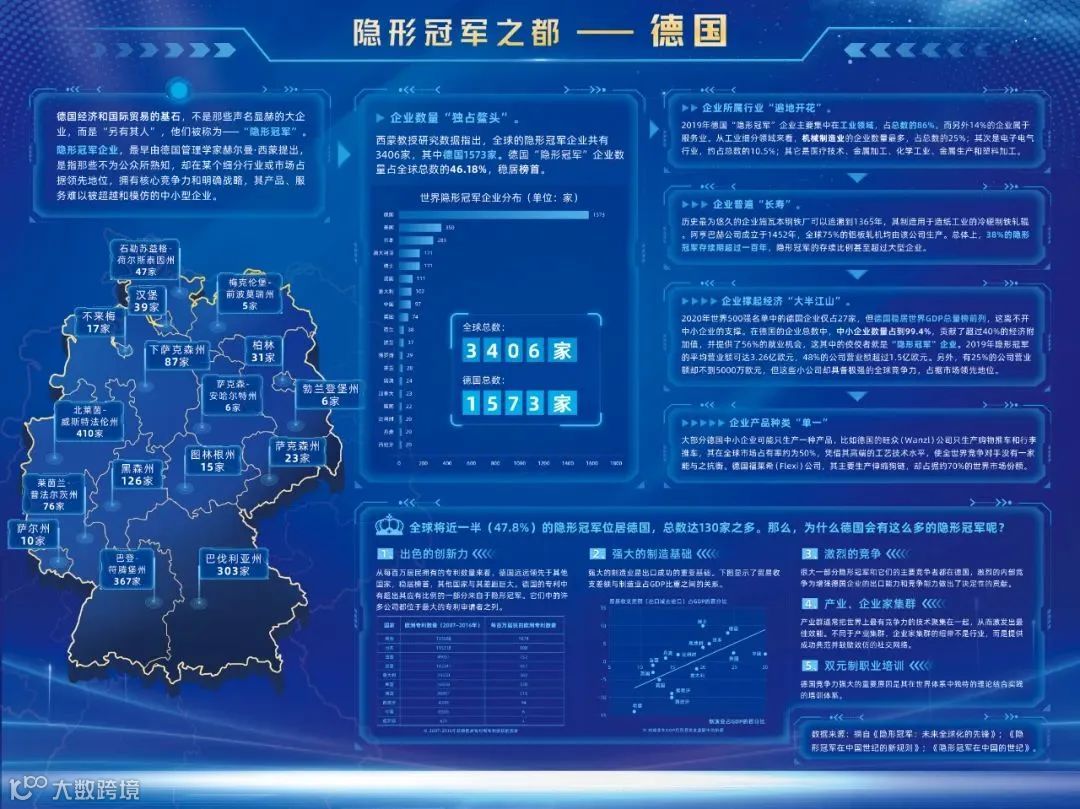
Professor Hermann Simon reviewed the progress of hidden champions globally over the past decade. Analyzing export data, he pointed out that China leads in total exports globally, followed by the United States and Germany. On a per capita basis, Germany ranks first, showcasing its efficiency in global trade. Both nations are thus winners of globalization—China excels in absolute value, whereas Germany stands out in per capita terms.
中国与德国的出口成功秘诀:中小企业与“隐形冠军”
他表示:“为什么是中国和德国?中国的特殊之处在于,中小出口商在中国非常强大。68%的中国出口来自于中小企业(SMEs),德国的比例与此相近。大公司固然重要,但要想在出口方面表现卓越,如中国和德国,就需要大量中小企业参与。这些企业必须是强大的出口商——‘隐形冠军’。这已成为中德经济成功的重要因素。”
中德全球化的五大经验总结
中小企业和“隐形冠军”是成功的关键驱动力。
全球化将继续,但外国直接投资将部分取代商品的直接出口。他认为,“隐藏冠军”战略意味着要处于第一梯队,因为全球竞争由第一梯队决定。
世界人口和全球经济将继续增长,但人口增长与经济增长之间的全球失衡不会消失。到2030年,全球商业趋势仍将由第一梯队决定。
追求卓越、专注、全球化和创新是“隐形冠军”的成功关键。
内部驱动力,包括领导者和员工。“隐形冠军”应具有高度的专业素质和极强的驱动力,追求卓越的文化以及高忠诚度的员工。
中德“隐形冠军”的战略对比
全球参与度:德国高,中国低。
研发人员:德国中等,中国非常高。
增长率:德国适度或逐渐增长,中国快速增长。
上市情况:德国保持家族企业模式,中国倾向于尽早上市,以筹集大量资本支持研发。
结论与未来方向
现在全球化已从出口转向外资直接投资,无论是在中国、德国、欧洲还是美国,找到世界上最佳位置至关重要。
追求卓越是“隐形冠军”的基础。
只有专注才能实现世界级发展,避免多元化。
站在第一梯队对全球化尤为重要,拥有超过80%的全球潜力。
不要模仿,务必创新。
注重数字化、B2B业务,企业生态系统对于管理复杂性至关重要。
可持续性可能是新的数字化形式。
打造极高的员工忠诚度。
云上对话:共同探索中小企业发展之道
对话环节中,首席经济学家张小辉与赫尔曼·西蒙教授再度交流,回顾过去十年间中德中小企业合作取得的显著成果。2022年标志着中德建交50周年,也是两国总理签署的“中小企业培训与管理合作协议”实施的第15年。西蒙教授深入解释了“隐形冠军”概念的标准设定、行业选择、细分领域划分及政府支持体系,体现了严谨细致的德国精神。
未来中小企业国际化道路将:增强国际合作多元化、东西方主导的并行线国际化的回归有限化或区域化合作。
上海中小企业发展服务中心主任魏炳武提出疑问:中国和德国为何能在众多国家中脱颖而出?是企业内因还是外部环境?此外还探讨了如何在新能源产业和汽车制造业抓住新机遇与挑战,以及中国企业走向全球的成功关键。
德国隐形冠军如何在中国市场立足
对话与启发:中小企业发展的重要意义
在中国市场环境下,德国隐形冠军如何占有一席之地?作为在华子公司,如何克服文化及工作流程差异,发挥领导力与激励作用,使中外员工更高效合作,充分发挥各自优势以实现协同效应?
王竹平、王正中、方海翔和李凡分别向西蒙教授提问。
西蒙逐一解答了上述问题。总结时,张小辉表示从对话中获益良多,并受到诸多启发。他提到,只有中小型企业(SMEs)发展良好,中国经济才能持续稳定增长。SMEs是中国社会稳定之温控器、经济繁荣的共创者、创业动力之源泉、营商环境之风向标、“大创新”助推器,以及“一带一路”共建中的中国文化传播者。通过对比分析“小巨人”、单项冠军与隐形冠军,得出结论:“小巨人”如同高中生,“单项冠军”好比研究生,而“隐形冠军”则是博士生。德国隐形冠军未来能否持续“领先”,答案或许就藏在中国。德国企业的未来在中国,中国的发展同样需要德国,唯有合作才有未来!
Ying Rose,上海中德产业促进中心副主任;Zhao Juan,副秘书长;Wu Xiaoyun,上海市商会主席协会投资促进部主管;Ding Wujun,宁波银行上海分行副行长及部分支行行长出席了此次活动。