

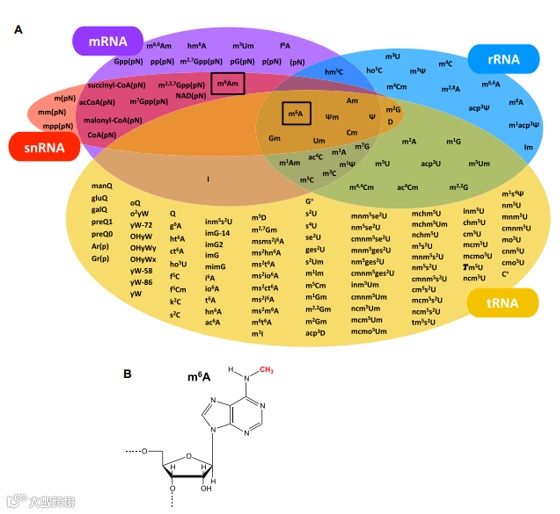
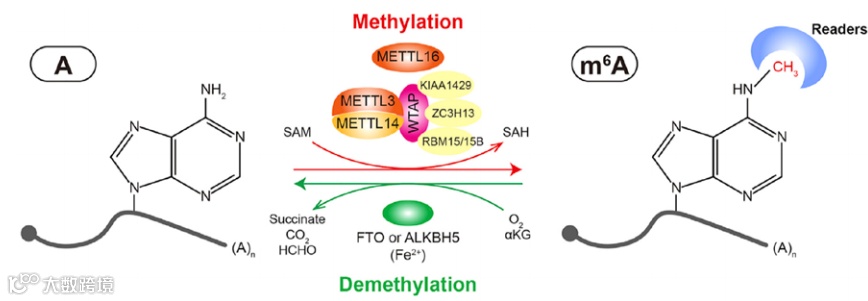
-
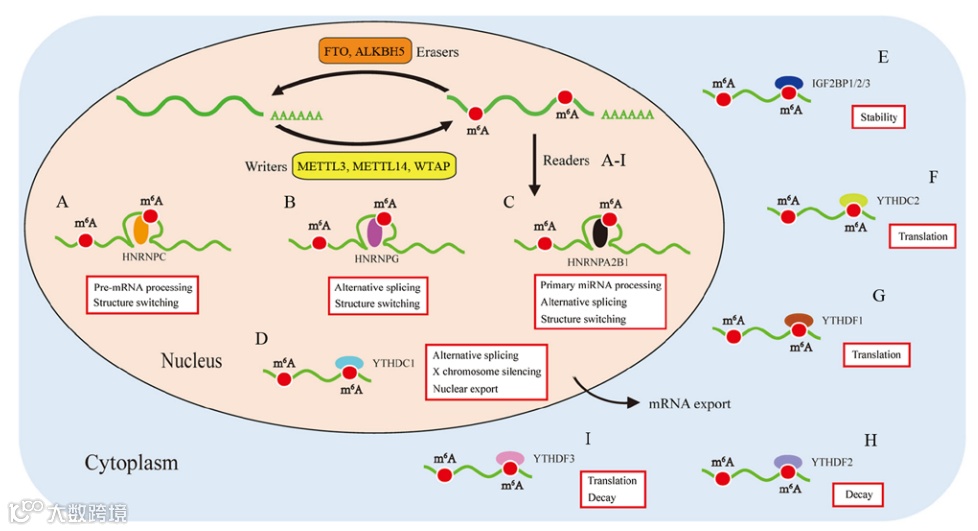
Writers:包括METTL3/14、WTAP和KIAA1429等,主要作用是催化mRNA上腺苷酸发生m6A修饰。 -
Erasers:包括FTO和ALKHB5等,作用是对已发生m6A修饰的碱基进行去甲基化修饰。 -
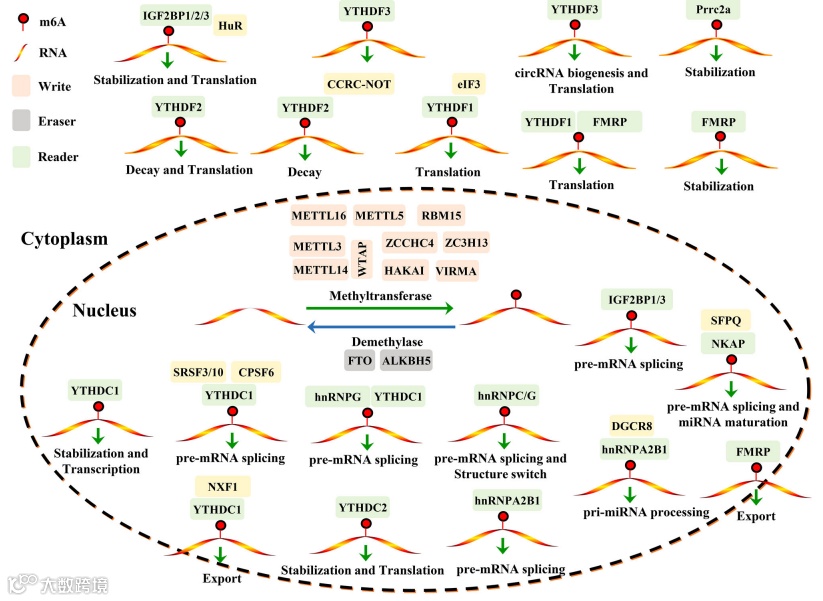
Reader:主要功能是识别发生m6A修饰的碱基,从而激活下游的调控通路如RNA降解、miRNA加工等。
-
琼脂糖凝胶电泳分析RNA降解程度以及是否有污染; -
Qubit 2.0对RNA浓度进行精确定量; -
Agilent 2100精确检测RNA的完整性。
-
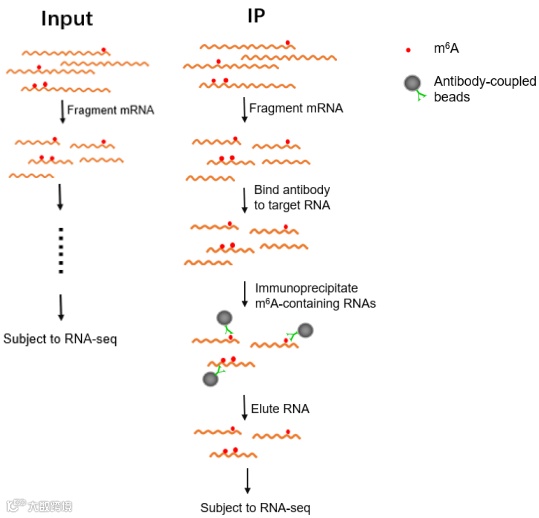
通过polyA捕获mRNA,或rRNA剔除去掉rRNA; -
将获得的mRNA打断成片段。
使用m6A抗体对片段化后的mRNA进行免疫共沉淀,富集并纯化m6A修饰的RNA片段。
-
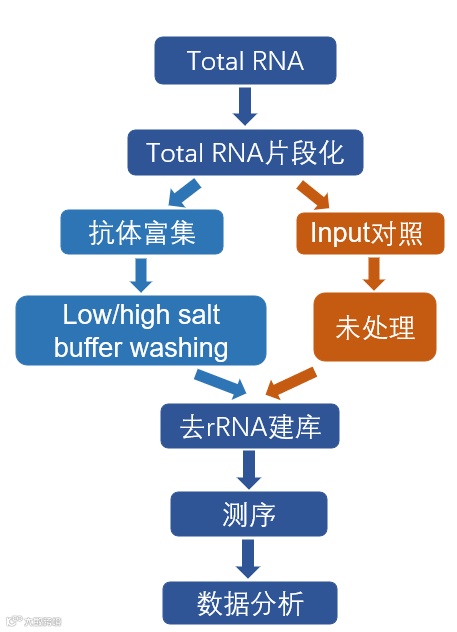
将IP buffer更换为低/高盐 buffer进行清洗,提高数据的信噪比。
直接针对total RNA进行m6A抗体富集,利用残留的rRNA增加RNA起始量,之后剔除rRNA进行建库。
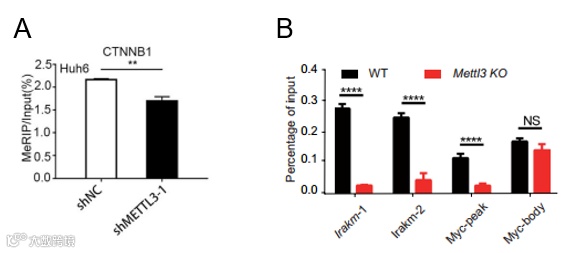
只有IP和Input的数据:展示%(IP/Input)值(图7)。
IP、IgG和Input均做:展示%(IP/Input)值、%(IgG/Input)值(图8)。
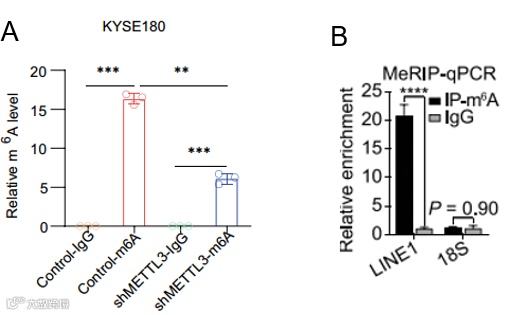
IP、IgG和Input均做:展示Fold enrichment值(%(IP/Input)和%(IgG/Input)的比值)(图9)。
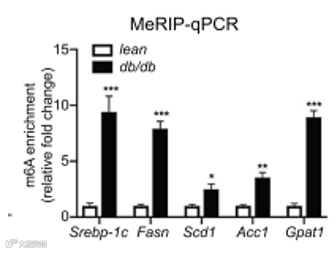
通过MeRIP-seq得到的差异peak是一个个片段,其分辨率并不是单碱基。上述的MeRIP-qPCR也是对MeRIP-seq获得的差异修饰基因或候选基因进行验证。所以想要检测特定单碱基的m6A修饰水平需要另外的技术,如SELECT法、OCPDIA法、m6A-Rol-LAMP等。
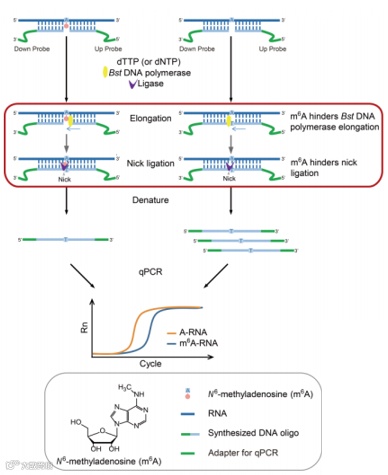
SELECT法是北京大学贾桂芳课题组在2018年发表在Angewandte Chemie International Edition上的一种检测单碱基位点m6A修饰水平的技术(Xiao et al 2018)。该技术主要利用m6A会阻碍DNA聚合酶的延伸活性和连接酶的连接效率的特点进行检测。
-
在m6A修饰位点上下游设计两个DNA探针:Up Probe和Down Probe(探针两端均带有固定序列,可成为最后的qPCR引物),探针与RNA退火杂交(m6A修饰位点形成gap); -
用Bst DNA polymerase和dTTP(或dNTP)进行延伸反应(若该位点存在m6A修饰,则延伸效率会降低); -
用SplintR ligase(该酶可以连接与RNA片段互补的两个ssDNA)进行连接反应(若该位点存在m6A修饰,则会降低连接效率); -
最后利用连接反应之后的DNA产物作为qPCR模板,通过qPCR定量检测该位点的m6A修饰水平。
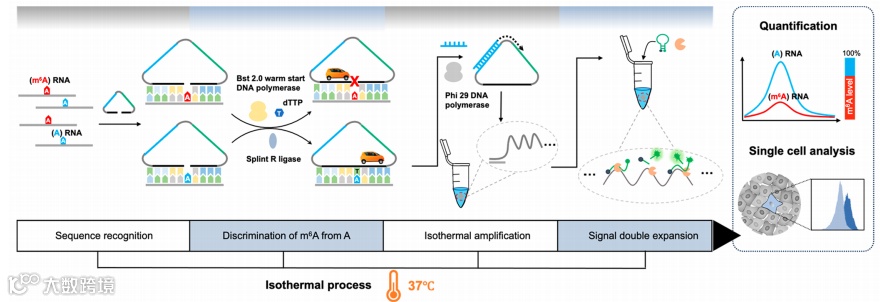
该技术在一定程度上与SELECT法类似,也是在单碱基分辨率下对发生m6A的RNA进行定量,但也有所不同,区别如下:
用挂锁探针取代m6A位点上下游探针;
由Bst 2.0 warm start DNA聚合酶和SplintR ligase分别执行延伸和连接反应,由于连接后的挂锁探针是环状的,因此利用Phi 29 DNA聚合酶进行滚环扩增反应(rolling circle amplication,RCA);
之后利用Nb.BsmI限制性内切酶切割扩增产物中的固定分子信标(Molecular beacons,MBs)序列,然后MBs会进一步结合在扩增产物上实现二次荧光信号放大;
所有反应过程均在等温扩增反应下进行。
随着对RNA甲基化修饰,尤其是m6A修饰在细胞功能中作用的深入理解,MeRIP-seq技术已成为研究这一领域的重要工具。从常规MeRIP-seq到微量MeRIP-seq的优化,这一技术的应用范围不断扩大,为珍稀样本的研究提供了可能。此外,MeRIP-qPCR、SELECT法和OCPDIA法等后续验证技术的应用,进一步提高了我们对m6A修饰位点的认识精度。这些技术的综合应用不仅加深了我们对RNA甲基化在疾病发生发展中作用的理解,也为未来的治疗策略提供了新的视角。随着技术的不断进步和创新, MeRIP-seq及其相关技术将在未来的分子生物学和医学研究中发挥更加重要的作用。


-
参考文献:
-
An and Duan. The role of m6A RNA methylation in cancer metabolism. Mol Cancer, 2022 -
Chen et al. Nuclear m6A reader YTHDC1 regulates the scaffold function of LINE1 RNA in mouse ESCs and early embryos. Protein Cell, 2021 -
Dominissini et al. Transcriptome-wide mapping of N6-methyladenosine by m6A-seq based on immunocapturing and massively parallel sequencing. Nat Protoc, 2013 -
Liu et al. m6A mRNA methylation regulates CTNNB1 to promote the proliferation of hepatoblastoma. Mol Cancer, 2019 -
Ma et al. One-base-gap circular probe-mediated dual amplification for isothermal detection of N6‑methyladenosine modifications. Anal Chem, 2023 -
Ma et al. The interplay between m6A RNA methylation and noncoding RNA in cancer. J Hematol Oncol, 2019 -
Oerum et al. A comprehensive review of m6A/m6Am RNA methyltransferase structures. Nucleic Acids Research, 2021 -
Qin et al. Role of m6A RNA methylation in cardiovascular disease. Int J Mol Med, 2020 -
Tong et al. Pooled CRISPR screening identifies m6A as a positive regulator of macrophage activation. Sci Adv, 2021 -
Wang et al. METTL3 promotes tumour development by decreasing APC expression mediated by APC mRNA N6-methyladenosine-dependent YTHDF binding. Nat Commun, 2021 -
Xiao et al. An elongation and ligation-based qPCR amplification method for the radiolabeling-free detection of locus-specific N6-methyladenosine modifications. Angew Chem Int Ed, 2018 -
Xu et al. m6A mRNA methylation is essential for oligodendrocyte maturation and CNS myelination. Neuron, 2020 -
Zeng et al. Refined RIP-seq protocol for epitranscriptome analysis with low input materials. Plos Biol, 2018 -
Zhou et al. N6 -Methyladenosine Reader Protein YT521-B Homology Domain-Containing 2 Suppresses Liver Steatosis by Regulation of mRNA Stability of Lipogenic Genes. Hepatology, 2021 -
Zhu et al. Crosstalk between m6A modification and alternative splicing during cancer progression. Clin Transl Med, 2023

精选合集,欢迎收藏哟!