


Invited Talk
讲座预告
8月13日-8月19日


1
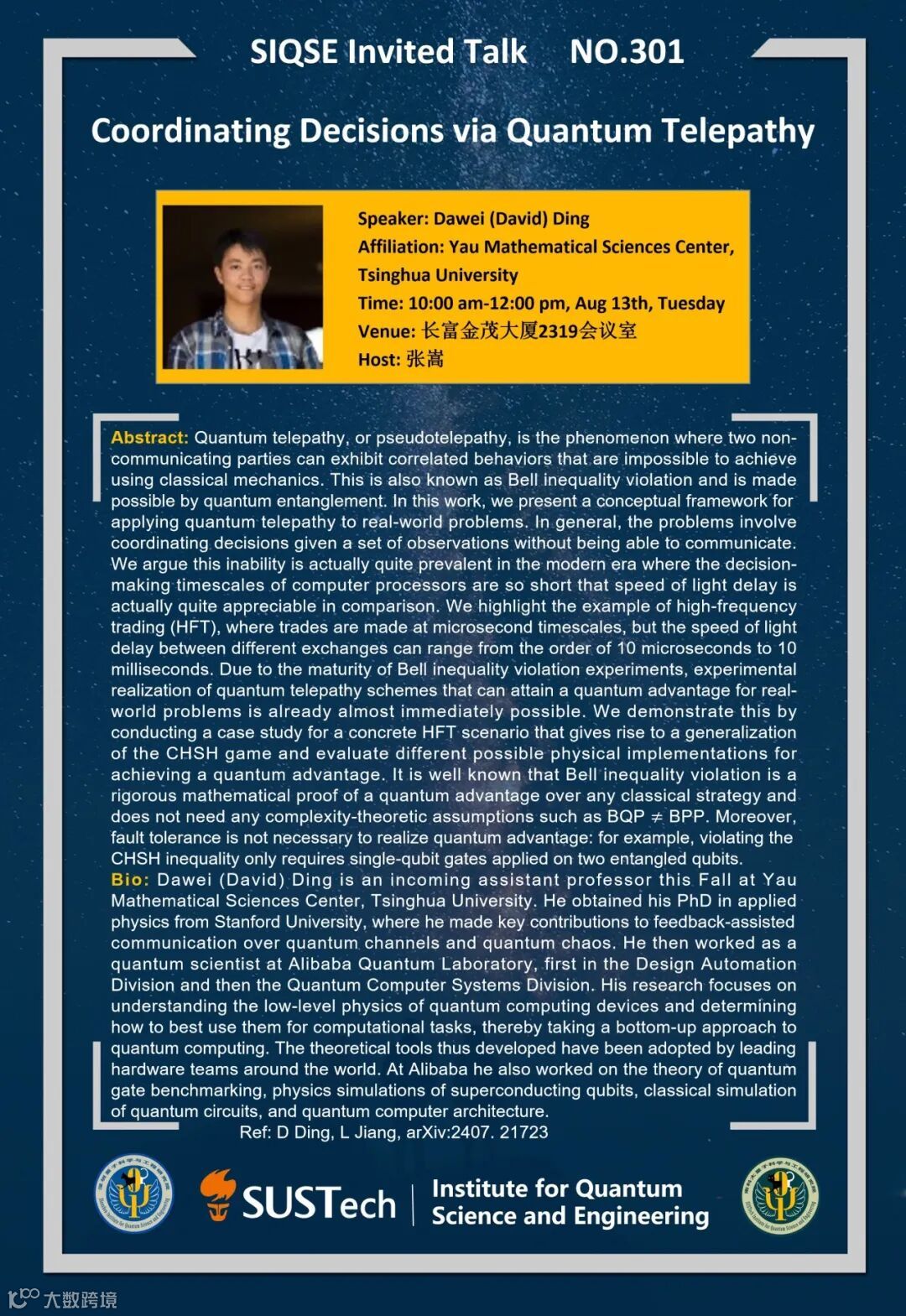
NO.301
主题/TOPIC:
Coordinating Decisions via Quantum Telepathy
主讲人/SPEAKER:
Dawei (David) Ding
时间/TIME:
10:00 am-12:00 pm, Aug 13th, Tuesday
地点/VENUE:
长富金茂大厦2319会议室
主持人/HOST:
Song Zhang(张嵩)
报告人简介
Dawei (David) Ding is an incoming assistant professor this Fall at Yau Mathematical Sciences Center, Tsinghua University. He obtained his PhD in applied physics from Stanford University, where he made key contributions to feedback-assisted communication over quantum channels and quantum chaos. He then worked as a quantum scientist at Alibaba Quantum Laboratory, first in the Design Automation Division and then the Quantum Computer Systems Division.
His research focuses on understanding the low-level physics of quantum computing devices and determining how to best use them for computational tasks, thereby taking a bottom-up approach to quantum computing. The theoretical tools thus developed have been adopted by leading hardware teams around the world. At Alibaba he also worked on the theory of quantum gate benchmarking, physics simulations of superconducting qubits, classical simulation of quantum circuits, and quantum computer architecture.
报告摘要
Quantum telepathy, or pseudotelepathy, is the phenomenon where two non-communicating parties can exhibit correlated behaviors that are impossible to achieve using classical mechanics. This is also known as Bell inequality violation and is made possible by quantum entanglement. In this work, we present a conceptual framework for applying quantum telepathy to real-world problems.
In general, the problems involve coordinating decisions given a set of observations without being able to communicate. We argue this inability is actually quite prevalent in the modern era where the decision-making timescales of computer processors are so short that speed of light delay is actually quite appreciable in comparison. We highlight the example of high-frequency trading (HFT), where trades are made at microsecond timescales, but the speed of light delay between different exchanges can range from the order of 10 microseconds to 10 milliseconds. Due to the maturity of Bell inequality violation experiments, experimental realization of quantum telepathy schemes that can attain a quantum advantage for real-world problems is already almost immediately possible.
We demonstrate this by conducting a case study for a concrete HFT scenario that gives rise to a generalization of the CHSH game and evaluate different possible physical implementations for achieving a quantum advantage. It is well known that Bell inequality violation is a rigorous mathematical proof of a quantum advantage over any classical strategy and does not need any complexity-theoretic assumptions such as BQP ≠ BPP. Moreover, fault tolerance is not necessary to realize quantum advantage: for example, violating the CHSH inequality only requires single-qubit gates applied on two entangled qubits.
海报
2
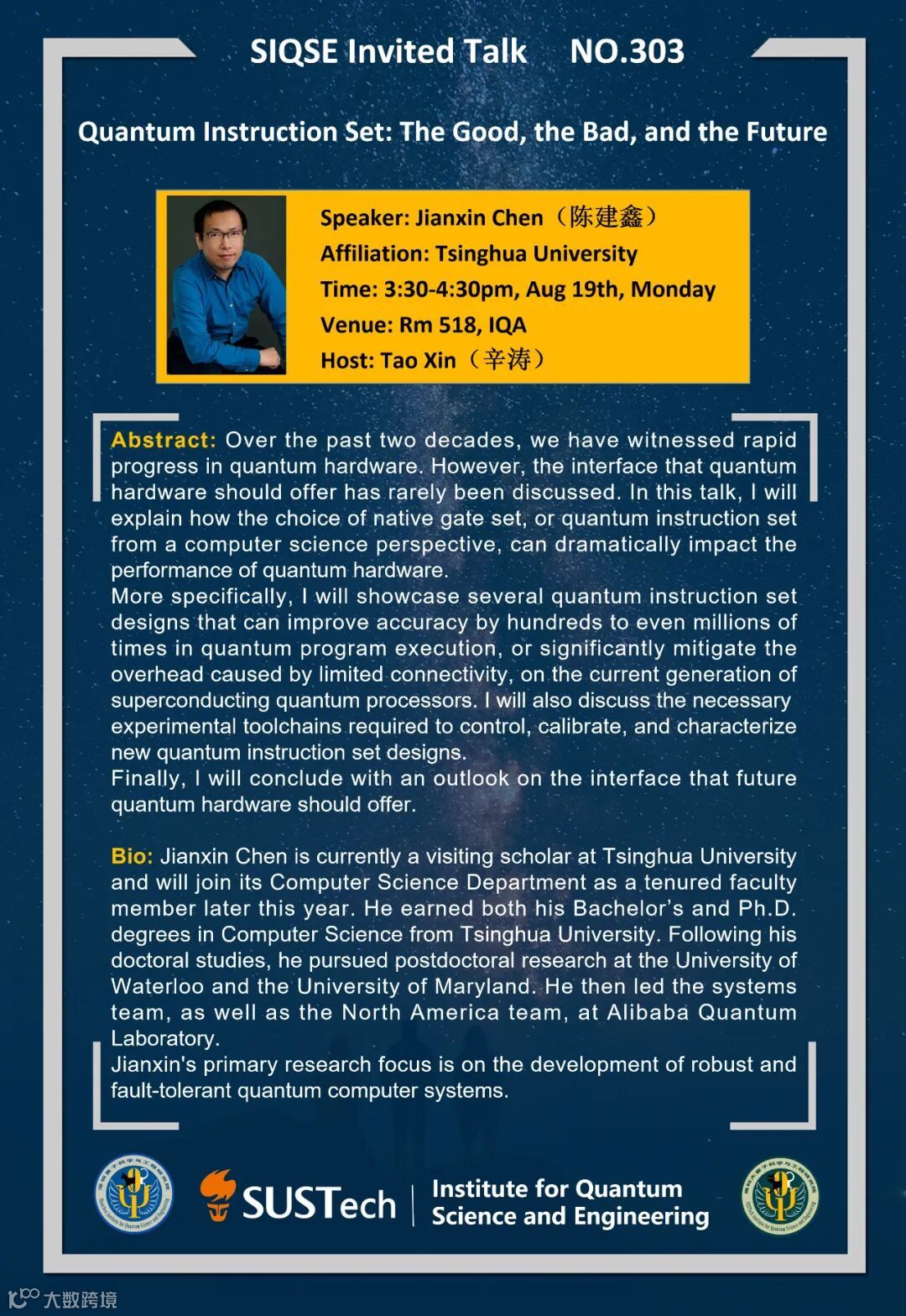
NO.303
主题/TOPIC:
Quantum Instruction Set: The Good, the Bad, and the Future
主讲人/SPEAKER:
Jianxin Chen(陈建鑫)
时间/TIME:
3:30-4:30pm, Aug 19th, Monday
地点/VENUE:
Rm 518
主持人/HOST:
Tao Xin(辛涛)
报告人简介
Jianxin Chen is currently a visiting scholar at Tsinghua University and will join its Computer Science Department as a tenured faculty member later this year. He earned both his Bachelor’s and Ph.D. degrees in Computer Science from Tsinghua University. Following his doctoral studies, he pursued postdoctoral research at the University of Waterloo and the University of Maryland. He then led the systems team, as well as the North America team, at Alibaba Quantum Laboratory.
Jianxin's primary research focus is on the development of robust and fault-tolerant quantum computer systems.
报告摘要
Over the past two decades, we have witnessed rapid progress in quantum hardware. However, the interface that quantum hardware should offer has rarely been discussed. In this talk, I will explain how the choice of native gate set, or quantum instruction set from a computer science perspective, can dramatically impact the performance of quantum hardware.
More specifically, I will showcase several quantum instruction set designs that can improve accuracy by hundreds to even millions of times in quantum program execution, or significantly mitigate the overhead caused by limited connectivity, on the current generation of superconducting quantum processors. I will also discuss the necessary experimental toolchains required to control, calibrate, and characterize new quantum instruction set designs.
Finally, I will conclude with an outlook on the interface that future quantum hardware should offer.
海报
3
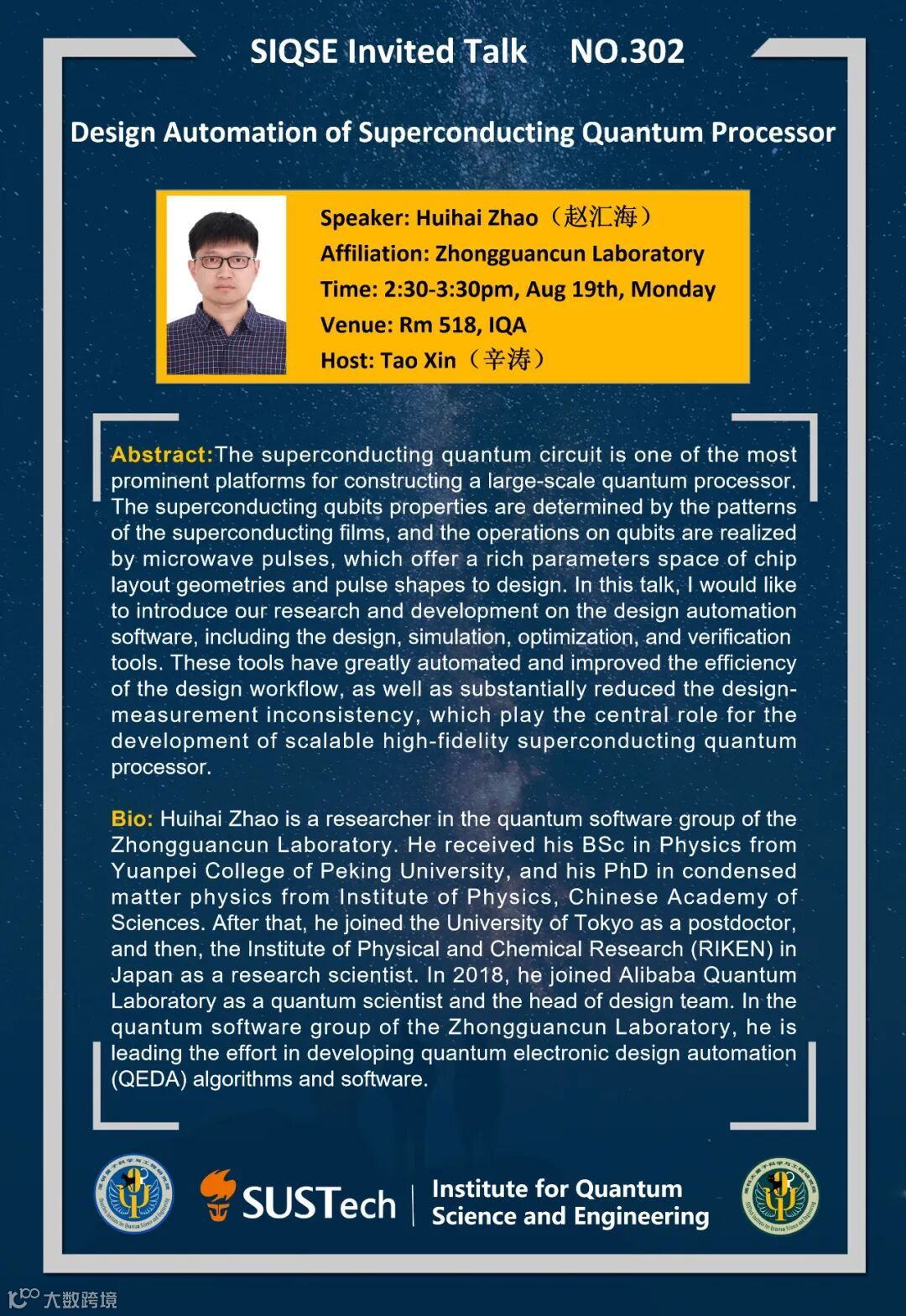
NO.302
主题/TOPIC:
Design Automation of Superconducting Quantum Processor
主讲人/SPEAKER:
Huihai Zhao(赵汇海)
时间/TIME:
2:30-3:30pm, Aug 19th, Monday
地点/VENUE:
Rm 518
主持人/HOST:
Tao Xin(辛涛)
报告人简介
Huihai Zhao is a researcher in the quantum software group of the Zhongguancun Laboratory. He received his BSc in Physics from Yuanpei College of Peking University, and his PhD in condensed matter physics from Institute of Physics, Chinese Academy of Sciences. After that, he joined the University of Tokyo as a postdoctor, and then, the Institute of Physical and Chemical Research (RIKEN) in Japan as a research scientist. In 2018, he joined Alibaba Quantum Laboratory as a quantum scientist and the head of design team. In the quantum software group of the Zhongguancun Laboratory, he is leading the effort in developing quantum electronic design automation (QEDA) algorithms and software.
报告摘要
The superconducting quantum circuit is one of the most prominent platforms for constructing a large-scale quantum processor. The superconducting qubits properties are determined by the patterns of the superconducting films, and the operations on qubits are realized by microwave pulses, which offer a rich parameters space of chip layout geometries and pulse shapes to design. In this talk, I would like to introduce our research and development on the design automation software, including the design, simulation, optimization, and verification tools. These tools have greatly automated and improved the efficiency of the design workflow, as well as substantially reduced the design-measurement inconsistency, which play the central role for the development of scalable high-fidelity superconducting quantum processor.
海报
• end •
立足大湾区 面向全世界
欢迎扫码关注量子研究院