01
Case Review
Medical History
Breed: Labrador Retriever
Age: 5 years old
Gender: Female
This dog was presented with recurrent signs of estrus approximately every 6–7 months, including vulvar swelling, bloody discharge, and attraction to male dogs.The dog had undergone ovariohysterectomy 3 years ago, and surgical records confirmed complete removal of both ovaries and the uterus.
Ultrasound Findings
Transabdominal ultrasound revealed a well-defined, oval hypoechoic mass (approx. 1.5 cm in diameter) caudal to the left kidney, in the retroperitoneal region. The lesion contained multiple anechoic cystic areas (largest ~ 0.8 cm), resembling developing follicles — strongly suggestive of residual ovarian tissue.
Final Diagnosis
Based on the medical history (periodic estrus after sterilization), clinical symptoms, and ultrasound findings, this dog is highly suspected of having ovarian remnant syndrome. The hypoechoic mass with follicular structures and abundant blood flow found on ultrasound in the retroperitoneal region is very likely residual ovarian tissue.
02
Understanding ORS in Dogs
What Is Ovarian Remnant Syndrome?
Ovarian Remnant Syndrome (ORS) refers to the presence of functional ovarian tissue in a spayed female dog or cat.Despite ovariohysterectomy, this tissue can continue to produce reproductive hormones, leading to recurring heat-like signs such as vulvar swelling and bloody discharge.
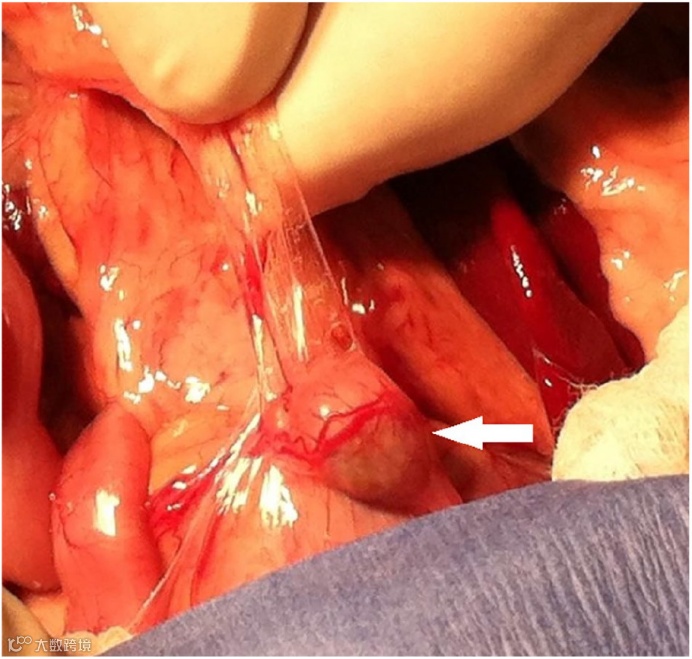
Left ovarian remnant was found (white arrow) and removed.
Image from Hyperandrogenism associated with an ovarian remnant in a spayed female cat.
What Is the Clinical Signs of ORS?
The most common sign of ovarian remnant syndrome in both dogs and cats is the recurrence of heat cycles even after they’ve been spayed. Other symptoms may include:
* Swelling of the vulva.
* Vaginal discharge.
* Behavioral changes associated with being in heat, such as restlessness, increased affection, or aggression.
* Attraction of male animals due to pheromones released during heat.
* Mammary gland enlargement.
What Causes ORS?
ORS in dogs and cats usually occurs due to:
* Incomplete removal of the ovaries during spaying surgery.
* Fragmentation of the ovarian tissue during the surgical procedure.
* Sometimes, there can be ectopic ovarian tissue, where small pieces of the ovary exist outside their normal location, which can be inadvertently left behind.
Which Breeds Are at Risk?
While ORS can occur in any breed, it is reported more frequently in medium to large dogs such as Labrador and Golden Retrievers.Deep-chested or obese dogs may pose greater surgical challenges during ovariohysterectomy, increasing the risk of incomplete removal.
Why Is It Dangerous?
⚠️Persistent hormone secretion leads to repeated heat cycles, causing discomfort and behavioral changes.
⚠️Prolonged estrogen exposure can trigger stump pyometra, ovarian cysts, or even mammary tumors.
⚠️Misdiagnosis may delay treatment, allowing progressive reproductive or metabolic complications to develop.
03
Why Ultrasound Is Key
in Diagnosis
Ultrasound plays an essential role in detecting and characterizing ovarian remnants:
Ultrasound Advantages
Clinical Significance
High-resolution imaging locates small residual tissue near kidneys or ovarian pedicles
Enables targeted surgical exploration
Cystic structures with follicle-like appearance
Suggests hormonal activity
Color Doppler assessment
Confirms vascularized, functional tissue
Non-invasive, repeatable
Useful for monitoring or pre-surgical planning
In this case, the identification of a cystic, hypoechoic mass in the left retroperitoneal region was diagnostic for residual ovarian tissue — guiding definitive surgical management.
Ovarian Remnant Syndrome, though uncommon, remains an important differential diagnosis in spayed females showing signs of heat.
Ultrasound examination, with its ability to visualize even tiny residual tissues, is indispensable for accurate diagnosis and surgical guidance — helping clinicians achieve better outcomes for their patients.
References
Ovarian Remnant Syndrome in Dogs and Cats,Wendy Brooks, DVM, DABVP,Revised: July 25, 2024
Ovarian remnant syndrome (ORS),Updated Aug. 2024
Ovarian Remnant Syndrome in Small Animals, ByClare M. Scully, DVM, DACT, Department of Veterinary Clinical Sciences, School of Veterinary Medicine, Louisiana State University,Reviewed ByAngel Abuelo, DVM, PhD, DABVP, DECBHM, FHEA, MRCVS, Michigan State University, College of Veterinary Medicine,Reviewed/Revised Jul 2023 | Modified Sept 2024
Canine and Feline Ovarian Remnant Syndrome (ORS),
Hollinshead FK, Walker C, Hanlon DW. Determination of the normal reference interval for anti-Müllerian hormone (AMH) in bitches and use of AMH as a potential predictor of litter size. Reprod Domest Anim. 2017 Apr;52 Suppl 2:35-40.
Themmen APN, Kalra B, Visser JA, Kumar A, Savjani G, Gier J, Jaques S. The use of anti-Müllerian hormone as diagnostic for gonadectomy status in dogs. Theriogenology 86 (2016) 1467–1474.
Yilmaz O, Toydemir T, Kirsan I, Ucmak Z, Karacam E. Anti-Mullerian hormone as a diagnostic tool for ovarian remnant syndrome in bitches. Vet Res Commun. First published online June 24, 2015. (Full-Text available upon request)
Follow CHISON for growth