
China-Europe freight train services start the new year with intensive departures, strengthening the Eurasian trade corridor
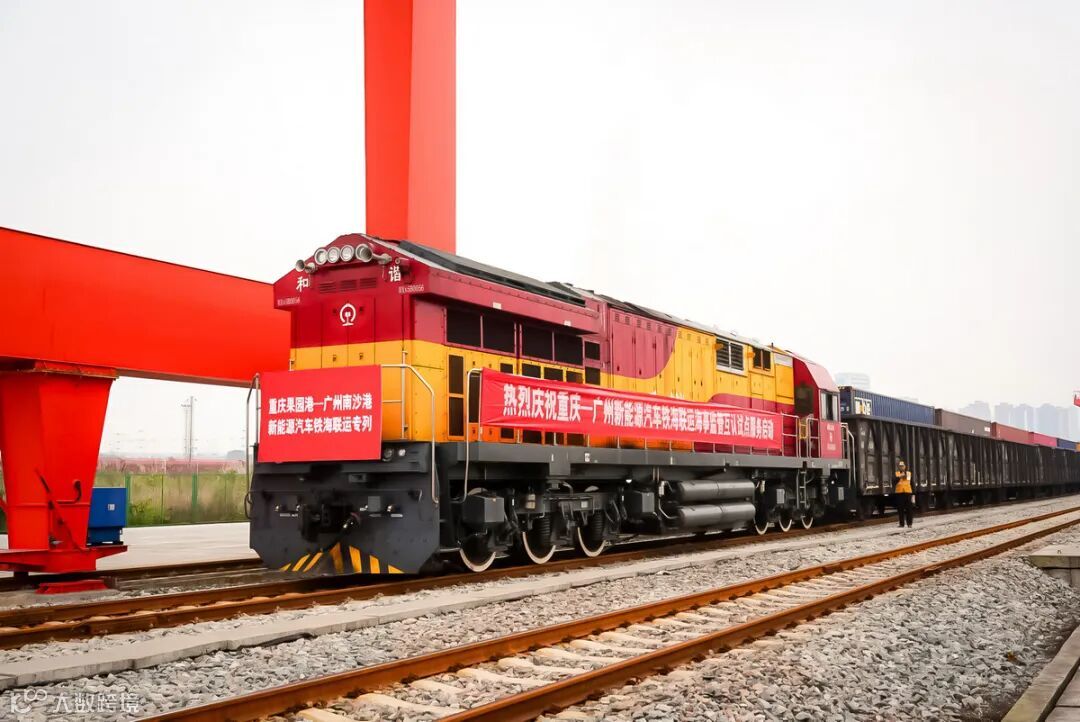
A freight train carrying new-energy vehicles made in Southwest China's Chongqing departs Yuzui Station at Guoyuan Port in Chongqing on January 7, 2026. The freight train is scheduled to reach Nansha Port in South China's Guangzhou in 48 hours before shipping onward to the Middle Eastern market. Photo: Courtesy of Chongqing International Logistics Hub Park
On January 1, the Guangdong-Hong Kong-Macao Greater Bay Area (GBA)'s first China-Europe freight train in 2026 departed from Zengcheng West Station at the Guangzhou Eastern Road-rail Intermodal Transport Hub under customs supervision. The train is scheduled to exit China via the Horgos border port and reach Malaszewicze, Poland, in around 14 days, marking the official launch of the China-Europe overland trade corridor for the new year, according to the General Administration of Customs (GAC).
The train carried 110 twenty-foot equivalent units (TEUs) with a total cargo value of about 20 million yuan ($2.8 million), mainly electronics, daily consumer goods and textile products manufactured in the GBA.
As a key hub linking the GBA with countries participating in the China-proposed Belt and Road Initiative (BRI), Zengcheng West Station has opened 14 outbound routes and eight return routes, reaching 34 cities in 17 countries across Europe, Central Asia and ASEAN, with its operating volume ranking the highest in Guangdong Province.
Beyond the GBA, freight trains also departed from multiple regions on New Year's Day in 2026, reflecting broad-based and coordinated launches across the network.
On January 1, a China-Europe freight train carrying goods such as ventilation systems departed from Wuhan Wujiashan Station, capital of Central China's Hubei Province, for Copenhagen, Denmark, marking both the city's first China-Europe service of the year and Hubei's first direct rail link to a Nordic capital, according to China Railway Wuhan Group Co.
In Northwest China, Xi'an International Port Station also dispatched its first China-Europe freight train of the year, carrying 50 standard containers bound for Azerbaijan, highlighting the continued extension of the rail network toward Central Asia, according to China State Railway Group.
The strong start in early 2026 builds on solid momentum from the previous year. In 2025, China-Europe (Asia) freight trains made about 34,000 trips and carried 3.17 million TEUs, up 9.8 percent and 7.6 percent year on year respectively, with China-Europe services alone accounting for more than 20,000 trips. Meanwhile, freight volume on the New Western Land-Sea Corridor surged 47.5 percent to 1.42 million TEUs in 2025, China State Railway Group said in a statement it sent to the Global Times.
Trade flows by rail
Judging from the cargo mix, the first China-Europe freight trains of the new year were not limited to a single category but carried a broad range of goods, including home furnishings, electromechanical equipment, HVAC products (heating, ventilation, and air conditioning products) and daily consumer items. These higher value-added shipments, more closely aligned with end-market demand across Central Asia and Europe, suggest the rail service is moving beyond its early role as a supplementary route toward a more stable, regular trade channel.
Several exporters in Yiwu and Shenzhen said that amid volatile global shipping rates and growing uncertainty on some maritime routes, rail transport, valued for its stable transit times and predictability, is increasingly becoming a preferred option, particularly for orders with tight delivery deadlines.
Arkadiusz Filipowski, CEO of Polish logistics firm Fulfilio Sp. z o.o., said in a previous interview with the Global Times that a significant share of the company's cargo is transported via China-Europe freight trains, citing their reliability and faster transit times compared with sea shipping.
He said Fulfilio sees strong potential in deepening cooperation with Chinese partners. "It's important for us to understand how Chinese companies do business and what they value in international cooperation," he said, adding that the company is committed to building long-term relationships in the Chinese market.
Wang Peng, an associate research fellow at the Beijing Academy of Social Sciences, told the Global Times on Sunday that the New Year's "strong start" of China-Europe freight trains reflects the continued release of the corridor's long-term competitiveness.
A key shift, he noted, is the transformation in cargo structure - from mainly basic goods in the early years to higher value-added products such as auto parts, machinery and electronic equipment - signaling that the service has evolved from a simple logistics route into an integral link in the global industrial chain.
Meanwhile, the growth of return trips has become a key indicator of the corridor's value. In recent years, the balance between outbound and inbound services has steadily improved, with some hubs achieving near two-way equilibrium. Many return trains now bring European goods such as cosmetics, agricultural products and machinery into China, helping to form a more balanced, two-way trade flow and optimize the trade structure across the Eurasian continent, China State Railway Group told the Global Times.
Sun Zhang, a mass transit expert and professor at Shanghai Tongji University, told the Global Times that the rising share of return services shows the China-Europe freight trains are shifting from one-way exports to a healthier, two-way trade corridor, helping make Eurasian trade more balanced and sustainable.
Amid the rapidly evolving international dynamics between China and the US, the expanding network of China-Europe freight trains is expected to further facilitate the circulation of high-tech products among China, Central Asia, Europe and Southeast Asia, Sun said.
The corridor as a stabilizer
Amid an increasingly complex global trade environment, the China-Europe freight trains have evolved beyond a logistics service to become a stabilizer of Eurasian trade, offering exporters more reliable options while underpinning cross-regional industrial cooperation and supply chain resilience, analysts said.
Wang noted that a multi-corridor, mutually reinforcing network is a key strength of the China-Europe freight trains in managing external uncertainties. As southern, western and northern routes continue to expand, the system no longer relies on a single pathway, effectively dispersing geopolitical and operational risks.
In day-to-day operations, the China-Europe freight trains are increasingly serving as a stabilizer. Their relatively fixed schedules and predictable transit times offer exporters with clearer expectations for production planning, inventory management, and cash flow, according to China State Railway Group.
Amid the disruptions to some international shipping routes and rising cost volatility, the rail service has become an important safeguard for cross-border supply chain continuity, Sun said.
The China-Europe freight trains are also reshaping inland regions' openness. New routes such as Wuhan-Copenhagen and Xi'an-Azerbaijan allow the inland provinces to connect more directly with the European and neighboring markets, shortening the logistics chains, lowering the overall costs, and encouraging the clustering of high-end manufacturing and export-oriented industries in key hubs, analysts said.
Sun said this positive cycle of smoother logistics, expanding trade and industrial clustering means China-Europe freight trains are no longer just the transport corridors, but the "super connectors" that energize regional economies and facilitate industrial coordination across Eurasia.
China's National Development and Reform Commission said in November 2025 that it would promote the high-quality development of China-Europe freight trains in four key areas: expanding diversified and efficient corridors, boosting innovation-driven growth, strengthening the foundations for safe operations, and enhancing their spillover and driving effects, according to the Xinhua News Agency.
Analysts noted that the China-Europe freight train services are forming a positive interaction with the BRI. By continuously expanding the cross-border logistics network, trade ties between China and countries along the BRI route have strengthened, injecting sustained momentum into the Eurasian trade. The intensive departures on the first day of 2026 vividly reflect this trend.
GLOBAL TIMES
以下是本文的中文翻译:
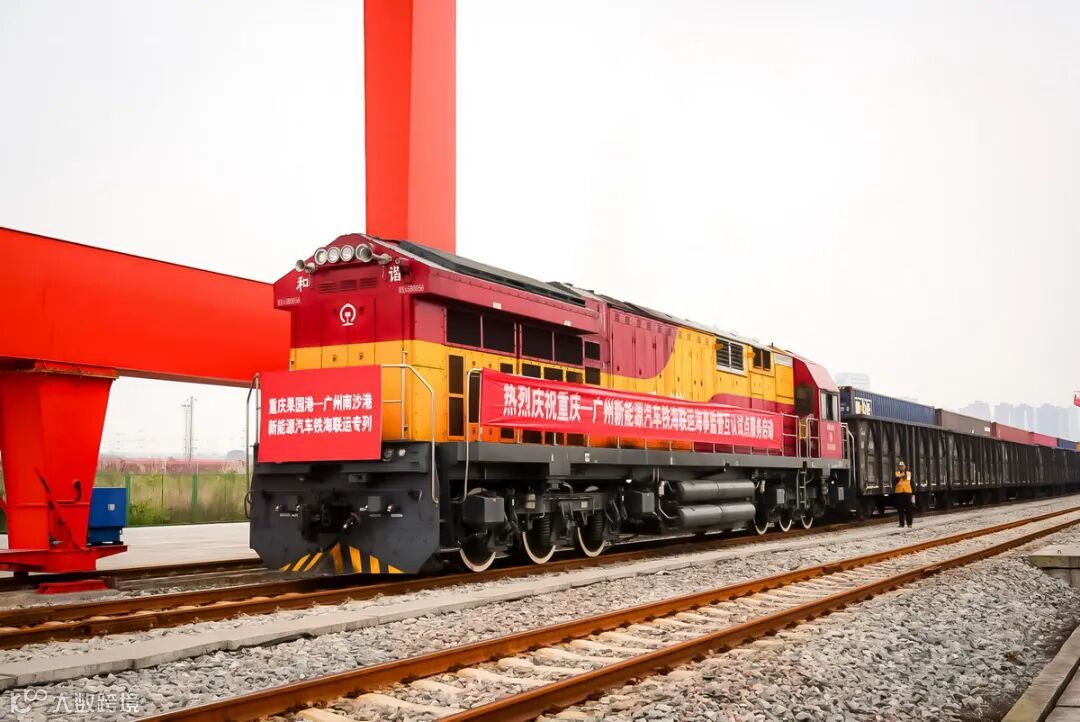
一列运载中国西南城市重庆制造的新能源车的货运列车于2026年1月7日从重庆国元港鱼嘴站出发。该列货运列车计划在48小时内到达中国南方广州的南沙港,然后再运往中东市场。
(照片由重庆国际物流枢纽园区提供)
2026年1月1日,粤港澳大湾区(GBA)首列中欧班列从广州东部公路-铁路多式联运枢纽的增城西站在海关监管下开行。这列列车计划从霍尔果斯口岸出境,约14天后抵达波兰马拉舍维切,根据海关总署(GAC)的数据,这标志着2026年中国至欧洲陆上贸易通道的正式启动。
该列列车运载了110 个20英尺标箱 (TEUs),货值总计约2000万元人民币(相当于280万美元),主要为大湾区生产的电子产品、日用消费品及纺织品。
作为连接大湾区与“一带一路”沿线国家的重要枢纽,增城西站已开通14条去程线路和8条返程线路,覆盖欧洲、中亚及东盟的17个国家的34个城市,增城西站的运营量在广东省位居首位。
在大湾区之外,2026年元旦当天,全国多地也有中欧班列开行,显示出网络化、协同化的广泛启动。
2026年1月1日,从中国中部的湖北省省会武汉的武家山站出发的一列中欧班列,运输了通风系统等货物前往丹麦的哥本哈根。据中国铁路武汉局集团公司介绍,这标志着既开启了武汉今年的首列中欧班列,又首次开通了湖北省直达北欧国家首都的铁路运输服务线路。
据中国国家铁路集团报道,在西安国际港务区站也开行了年度首列中欧班列,运送50标箱前往阿塞拜疆,凸显铁路网络向中亚的持续延伸。
2026年初的强劲开局建立在去年的良好势头之上。2025年,中欧(亚洲方向)货运列车完成了约34,000趟运输,运送货物317万标箱,同比增长分别为9.8%和7.6%,其中仅中欧运输服务就占了2万多趟。同时,中国国家铁路集团在向《环球时报》发布的一份报告中表示,2025年,西部陆海新通道货运量激增47.5%,达到142万标箱。
从货物结构来看,新年首趟中欧班列并不局限于单一类别,而是运输了包括家居用品、电机设备、暖气通风及空调产品以及日常消费品在内的多种商品。这些高附加值货物更贴近中亚及欧洲终端市场需求,表明铁路服务正从早期的补充线路角色,向更加稳定、常规的贸易通道发展。
义乌和深圳的多家出口企业表示,在全球运输费率波动和部分海运线路不确定性增加的背景下,以运输时间稳定和可预期性而受到重视的铁路运输正日益成为首选方案,尤其是对于交货期限紧迫的订单。
阿尔卡迪乌什·费利波夫斯基,波兰物流公司(Fulfilio有限责任公司)的首席执行官,在此前接受《环球时报》采访时表示,公司有相当大部分货物通过中欧班列运输,因为与海运相比,铁路运输更可靠、更便捷。
他补充说,Fulfilio公司看好与中国深化合作的潜力,“了解中国公司的经营方式以及他们在国际合作中看重的因素,对我们来说很重要。”他表示公司将致力于与中国建立长期的合作关系。
北京社会科学院副研究员王鹏1月11日对《环球时报》表示,中欧班列的新年“开门红”反映了该通道长期竞争力的持续释放。他指出,一个关键的变化是货物结构的转型——从早期以基础商品为主,转向包括汽车零部件、机械设备和电子产品在内的高附加值产品——这意味着该服务已经从单纯的物流通道发展为全球产业链的重要环节。
与此同时,返程列车的增长已成为衡量该通道价值的另一个关键指标。近年来,出境与入境服务的平衡稳步改善,一些枢纽已实现近乎双向均衡。中国国家铁路集团对《环球时报》表示,许多返程列车如今携带化妆品、农产品和机械等欧洲货物进入中国,有助于形成更加平衡的双向贸易流,并优化欧亚大陆的贸易结构。
上海同济大学轨道交通专家孙章教授对《环球时报》表示,返程服务比例上升显示中欧班列正从单向出口转向更健康的双向贸易,有助于使欧亚贸易更加平衡和可持续。孙章教授表示,在中美国际格局快速演变的背景下,中欧班列网络的扩展有望进一步促进中国、中亚、欧洲及东南亚之间高科技产品的流通。
分析人士表示,在日益复杂的全球贸易环境下,中欧班列已经从单纯的物流服务发展成为欧亚贸易的稳定器,为出口商提供了更可靠的选项,同时支撑了跨区域的产业增城西站合作,提高了供应链的韧性。
王鹏研究员指出,多走廊、相互支撑的网络是中欧班列应对外部不确定性的一大优势。随着南线、西线和北线的持续扩展,这个系统不再依赖单一通道,有效分散了地缘政治带来的运营风险。
在日常运营中,中欧班列日益发挥着稳定器的作用。中国国家铁路集团表示,其相对固定的时刻表和可预见的运输时间,为出口商提供了更清晰的生产计划、库存管理和现金流预测。
孙章教授表示,在部分国际航运路线受阻和成本波动加剧的情况下,铁路服务已成为跨境供应链持续运作的重要保障。
分析人士指出,中欧班列还在重塑内陆地区的开放水平。诸如武汉-哥本哈根、西安-阿塞拜疆等新线路的开通,使内陆省份能够更直接地与欧洲及中亚市场连接,缩短物流链长度、降低整体成本,并促进高端制造业和出口导向产业在关键枢纽区的集聚。
孙章教授表示,这种物流更加顺畅、贸易不断扩大、产业集群发展的良性循环意味着中欧班列沿线不仅是条运输通道,而且是推动区域经济发展、促进欧亚跨区域产业协作的“超级连接器”。
据新华社报道,中国国家发展和改革委员会在2025年11月表示,将从4个重点领域推动中欧班列的高质量发展:拓展多元高效的通道、推动创新驱动发展、加强安全运营基础建设以及提升其带动和溢出的效应。
分析人士指出,中欧班列正在与“一带一路”形成良性互动。通过持续扩展跨境物流网络,中国与“一带一路”沿线国家的贸易联系不断加强,为欧亚贸易注入了持续的动力。2026年第一天密集的中欧班列开行生动反映了这一趋势。

【关注我们,解锁学术与行业新视野】