


关键词:定量成像 高场成像 神经科学


ISMRM 2025 Abstract #0271
In-vivo quantitative histology using 0.36-mm MR Fingerprinting: technical development
Authors
Xiaozhi Cao1,2, Alexander Beckett3,4, Congyu Liao1,2, Mengze Gao1, Erica Walker3, Zheren Zhu5, Adam Kerr2, Yang Yang5, David Feinberg3,4, and Kawin Setsompop1,2
1Department of Radiology, Stanford University, Stanford, CA, United States,
2Department of Electrical Engineering, Stanford University, Stanford, CA, United States,
3Helen Wills Neuroscience Institute, University of California, Berkeley, CA, United States,
4Advanced MRI Technologies, Sebastopol, CA, United States,
5Department of Radiology, University of California, San Francisco, CA, United States
This work provides a high-quality, motion-robust, and field-inhomogeneity-robust quantitative tool, enabling whole-brain T1 and T2 maps at 0.36-mm resolution, unprecedented for in-vivo quantitative imaging. It makes in-vivo quantitative histology research feasible, providing possibility to quantitative analysis on fine brain structures.
1. T2 Contrast Improves SN/STN and Cortical Segmentation
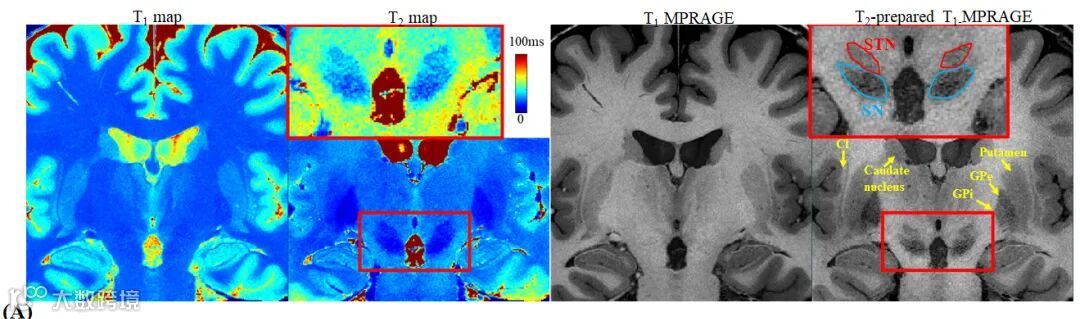
(1A) Quantitative maps and contrast images of SN and STN with similar T1 values, making it difficult to differentiate them in MPRAGE.
However, the STN shows higher T2 values than the SN.
Thus, introducing T2 weighting could improve distinction between these structures.
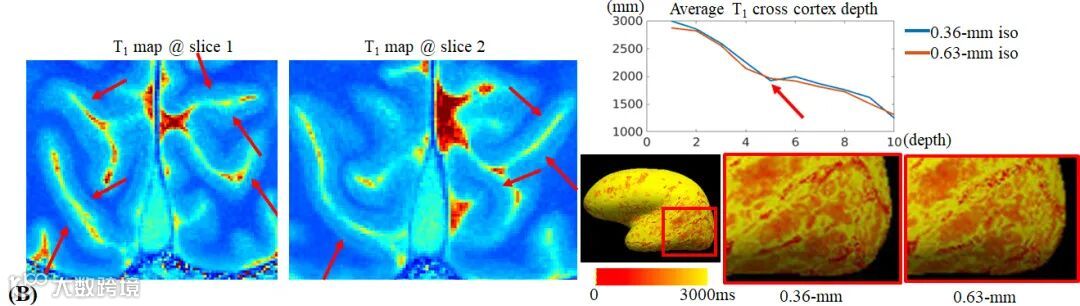
(1B) Zoom-in T1 maps and T1 values along cortex depth.
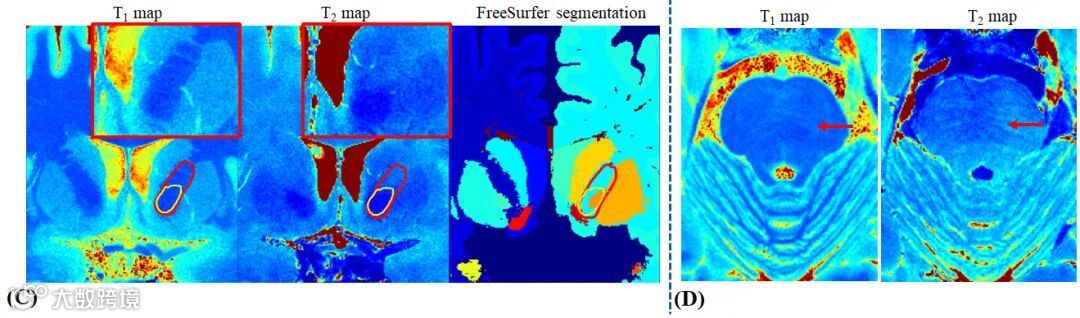
(1C) The red-labeled region has similar T1 values, leading T1-weighted segmentation to classify this region as gray matter. However, in the T2 map, the yellow-labeled area shows lower T2 values.
(1D) The transverse fibers in the basilar part of the pons.
2. Deep-Learning Denoising and Motion Correction Improve SNR in Single-Repetition T1/T2 Maps
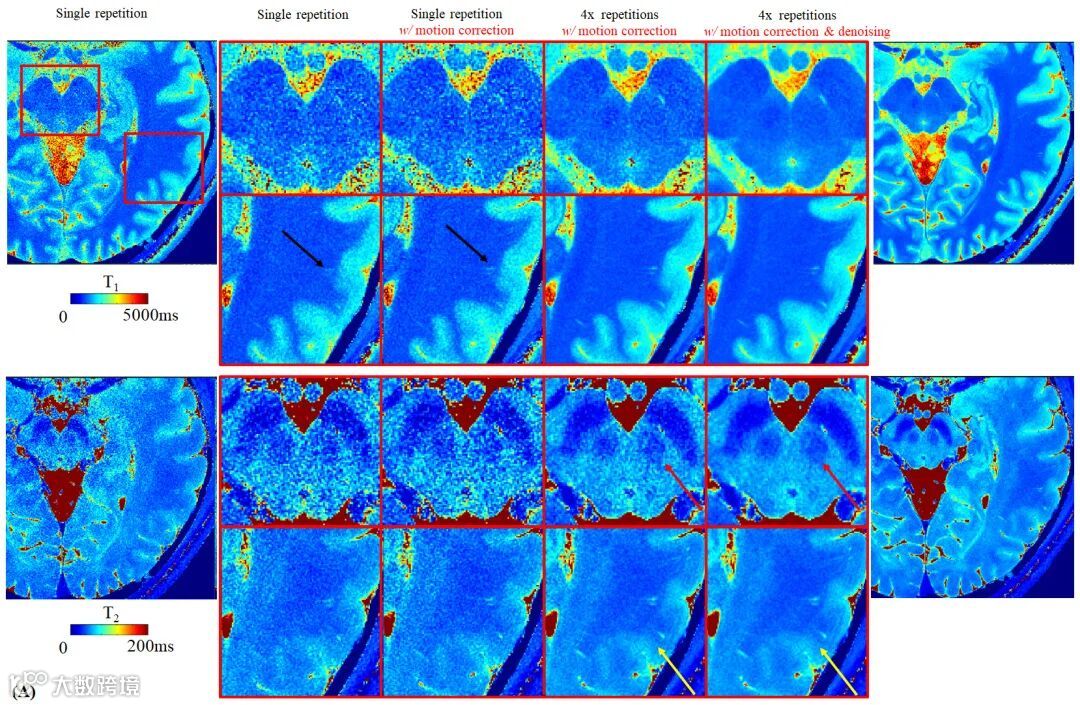
(2A) T1 and T2 maps of using a single repetition, then incorporating with motion correction, multi-repetition averaging, and deep-learning denoising.
Black arrows indicate improvements using motion correction.
The denoising shows a clear SNR enhancement in low-SNR deep brain (red arrows), while preserving the sharpness of high-SNR cortex regions (yellow arrows).
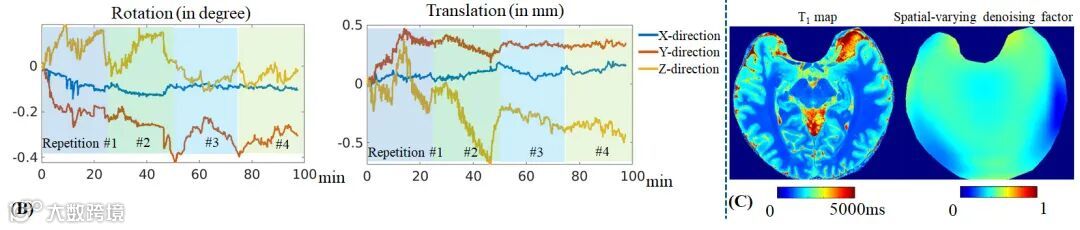
(2B) Motion estimation.
(2C) Zoom-out T1 map and spatial-varying denoising factor
The high-SNR regions received minimal denoising, while lower-SNR regions underwent more extensive denoising.
Skope期待与您在磁共振成像前沿领域的更多可能中相遇,欢迎联系我们了解详细方案。
了解更多Skope产品

长按扫码关注我们
微信公众号|Skope医疗科技


Skope磁共振技术成立于2011年,为磁共振成像(MRI)市场开发传感器技术和信号处理的解决方案。Skope的客户使用这些解决方案可达到MR成像前所未有的精确性和速度。Skope向全世界的患者提供先进的诊断成像。