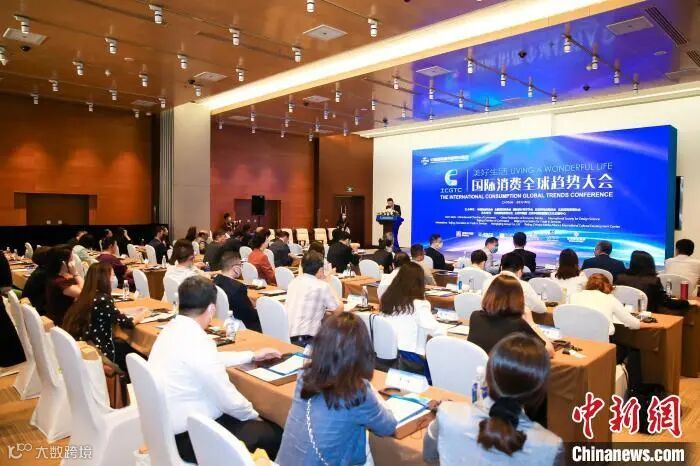
During the 2022 CIFTIS, the "Living a Wonderful Life • International Consumption Global Trends Conference" was organized, which, centering on the key points of building an international consumption center, was designed to strengthen the role of such a global hub in the aggregation of consumption resources and the optimized allocation of these resources, pool creative ideas from around the world, and share the latest information and insightful views.
Jiang Zengwei, former Vice Minister of Commerce and President of the Global Alliance for Trade in Services, said in his speech that apart from further unleashing the potential of investment and export, all countries need to put more emphasis on the role of consumption in driving economic growth. According to the latest data from the United Nations Statistics Division, the proportion of global final consumption expenditure in GDP in 2020 was only 7.8%, meaning that expanding consumption can play a pivotal role in stimulating global economic growth.
Jiang Ming, President of the China General Chamber of Commerce, said in his speech during the Conference that the COVID-19 pandemic has accelerated the reform and innovation of the retail industry, which will continue to put quality, services, digital technology and green operations at its core and will shift toward faster and high-quality development with the rapid advances in new technology, new products, new quality, and new business forms and new models.
Guo Wenjie, Deputy Director-General of Beijing Municipal Commerce Bureau, said consumption is a stabilizer and cornerstone for economic growth, an important foundation for smooth industrial circulation and market circulation, and a direct reflection of the people's growing needs for a better life. Over the past year, the CPC Beijing Municipal Committee and the People's Government of Beijing Municipality, from a strategic perspective, have formulated a five-year plan for building Beijing into an international consumption center between 2021 and 2025. Composed of 10 major actions such as the development of new consumption landmarks and the creation of consumer brand matrices, the plan covers 182 tasks, 140 projects, 99 policies, over 3,000 activities by 200-plus leading enterprises in peak shopping seasons, and five lists. Now the plan is being implemented effectively, with desired results.