
Recently, Li Keqiang, a member of the Standing Committee of the Political Bureau of the CPC Central Committee, Premier of the State Council and Director of the National Energy Commission, presided over a meeting of the National Energy Commission to implement the energy reform and development work, at which he reviewed a plan for the country's modern energy system in the 14th Five-Year Plan period, implementation programs to achieve the 2030 carbon peak target, and opinions on perfecting the institutional mechanism, policies and measures for green and low-carbon energy transformation.
(Photo Source: CFP.CN)
Energy security bears on development security and national security, Li noted. China remains a developing country, and pursues development as its foundation and key to solving all problems. China's energy demand will keep rising with the development of industrialization and urbanization, Li said, and China must ensure it has a secure energy supply. Efforts should be made to foster a modern energy system and raise capacity for a self-reliant energy supply, he added.
A carbon peak and neutrality is required by the country's economic transformation and upgrading as well as international efforts to deal with climate change, Li said. Realizing the carbon targets calls for long-term and unremitting efforts, he said. Li said the timeline and road map to achieve the carbon peak target should be undertaken in a scientific way in combination with the recent response to the imbalance between supply and demand of power and coal. We should take a holistic approach throughout the country. A "one-size-fits-all" approach in shutting down energy-intensive projects or "campaign-style" carbon reduction, which has been found in some areas, must be rejected, Li said. Measures should be taken to ensure people in northern parts of China have a secure power supply to ensure they keep warm over winter, he said. Li called for efforts to ensure the stability of industrial and supply chains and sustained and steady economic development. These efforts should come amid moves to promote the clean use of coal, increase clean energy proportions in total energy consumption, further deepen energy conservation and emissions reduction in key areas, advocate energy conservation throughout the society and enhance green development capacity.
Li pointed out that innovation is an important driving force for the high-quality development of energy. Therefore, efforts should be made to make breakthrough in key technologies and equipment in the energy sector, strengthen research and development in cutting-edge green and low-carbon technologies. Meanwhile, we should improve the intelligence level of the power grid to enhance the capacity of consumption and safe operation of new energy. In addition, we should perfect progressive pricing for electricity consumption, deepen reform in key areas such as power transmission and distribution, and rely on market mechanisms to promote energy conservation, emission reduction, and carbon reduction to improve energy service levels.
2021 China International Fair for Trade in Services (hereinafter referred to as "CIFTIS") was held in China National Convention Center and Shougang Park from September 2 to September 7, with the theme of "Towards Digital Future and Service Driven Development". Telecommunications, Computer and Information Services, one of the 8 thematic exhibitions of this CIFTIS, specially sets up a "carbon neutrality" green technology service section, to show the audience mainstream cutting-edge technology services in energy conservation and carbon reduction, low-carbon technology, clean energy application, energy storage technology, carbon capture, utilization and storage (CCUS), carbon sequestration and ecological construction, and carbon market.
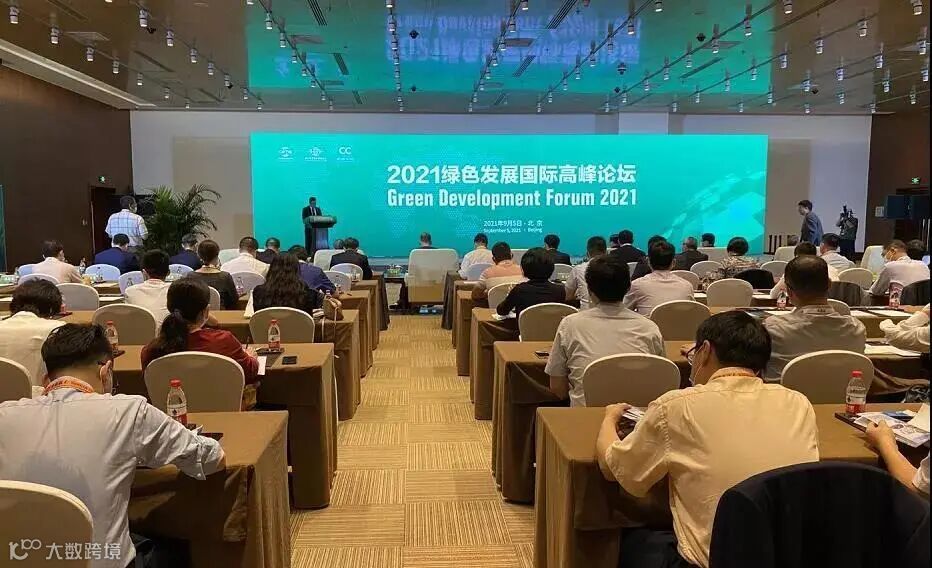
At the "Green Development Forum 2021 - Low-Carbon Life, Zero-Waste City Construction" held during the 2021 CIFTIS, Wang Bingnan, Vice Minister of Commerce, said that green development is not only the theme of high-quality economic development in the future, but also the intrinsic characteristic and development trend of high-quality development of service trade.
(Photo Source: www.zgcsjs.org.cn)
Service trade itself is environmentally-friendly, of which education, finance, information technology, culture, entertainment and other knowledge-intensive services are all green trade, and traditional service trade such as travel and transportation is also accelerating its transformation.
Energy conservation and environmental protection, environmental services, new energy services and green and low-carbon technology services have provided a strong foundation for the green transformation of manufacturing industry, greatly promoting the green transformation process of related industries.
Green and low-carbon transformation is not only an industrial change, but also a systematic social change. It will not only affect trade in services from the supply side, but also stimulate people's new consumer demand for eco-friendly way of life from the demand side.
Lu Xinming, Deputy Director of the Department of Climate Change of the Ministry of Ecology and Environment, said at the Forum that China is working on policies, measures, road map and timeline to achieve its carbon peak and neutrality targets, and accelerating green changes in the ways of life and work under the guidance of green transformation of all sectors and industries in social and economic development.
China aims to have CO2 emissions peak before 2030 and achieve carbon neutrality before 2060, much shorter than that of main developed countries, which means that China not only needs to control the total CO2 emissions when peaking carbon emissions, but also needs to achieve a rapid and sustained reduction in carbon emissions after peaking carbon emissions, thus making China's energy and industry transformation task more arduous, and the challenges unprecedented.
Therefore, concerted efforts of all regions, departments, sectors and industries should be made in a bid to achieve green and low-carbon transformation and carbon peak and neutrality. To this end, we will grasp the critical opportunity of the 14th Five-Year Plan to facilitate the comprehensive green transformation of economic and social development, and realize qualitative changes in improving the ecology.