
In this article, Herbert Smith Freehills shared a general overview of the Energy from Waste (“EfW”) market in the UK. The article addressed the position of EfW in the UK and associated UK policy on EfW.
UK EfW Statistics1
In 2019, 12.63 Million tonnes (“Mt”) of residual (i.e. non-recyclable) waste was processed at EfW plants in the UK – an increase of 9.9% on 2018. This equates to around 89.7% of the total headline capacity. The percentage of headline capacity used since 2015 has remained between 89% and 91%.
At the end of 2019, there were 53 EfW plants of which 48 were operational and 5 were in late commissioning. This is an increase from a total of 47 in 2018 and a total of 33 five years ago, in 2014.
In 2019, the total headline capacity of EfW plants which were operational or in construction increased by 1.6Mt compared to 2018.
Over the course of 2019, EfW plants in the UK exported 6,703GWh of electricity (an amount equal to 2% of UK total power generation) and 1,384GWh of heat. Both were increases from 2018 when 6,230GWh of electricity and 1,112GWh of heat were exported.
Due to major turbine/generator failures, total power export from UK EfW fell in 2019 when measured by kWh generated per tonne of waste processed. This was the second year in a row.
Residual waste inputs to EfW in the UK amounted to 45.5% of the overall UK residual waste market in 2019, according to provisional data. This was an increase from 41.8% in 2018.
In 2019, the total amount of residual waste sent to EfW in the UK exceeded the amount sent to landfill for the first time.
It is estimated that in 2019, 81.5% of EfW inputs came from Residual Local Authority Collected Waste and remainder coming from commercial and industrial waste. The input from commercial and industrial waste is expected to rise sharply in the next few years.
Compliance and Regulation
Under EU and UK law, EfW plants must monitor their emissions. Air emissions must be monitored onsite (on a continuous basis) and by way of a sample sent to an accredited laboratory (on a periodic basis). Water emissions and composition of ash residues are also monitored regularly.
Contracts for Difference
The Contracts for Difference (“CfD”) scheme is the mechanism by which the UK government supports low-carbon electricity generation. Renewable generators located in the UK that meet the eligibility requirements can apply for a CfD by submitting a ‘sealed bid’. So far, there have been three allocation rounds (i.e. auctions)2. EfW is eligible for CfD.
The next CfD allocation round (“AR4”) is planned by the UK government to take place in 2021. This is subject to any required state aid approval for planned changes. Earlier this year there was a consultation on proposed changes to the CfD scheme which would apply to AR4 and which is now closed with the outcome to be published on the government website.
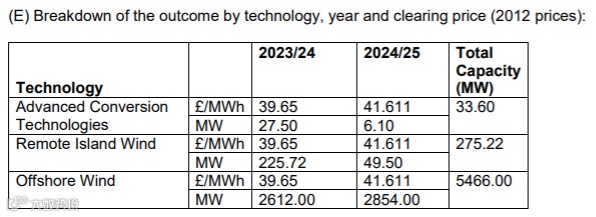
In the most recent CfD allocation round (“AR3”) which ran from May to September 2019, two EfW (Advanced Conversion Technologies) projects were awarded CfDs out of a total 12. This is a breakdown of the outcome by technology, year and clearing price (2012 prices):3
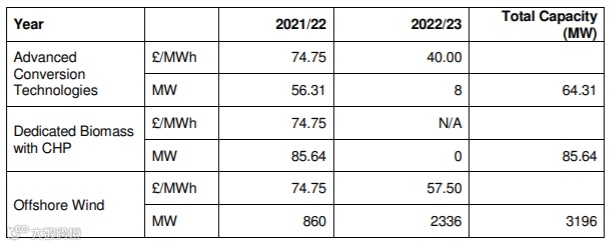
In the second CfD allocation round, in 2017, six EfW projects were awarded CfDs out of a total of 11. This is a breakdown of the outcome by technology, year and clearing price (2012 prices):4
UK Policy
On 16 July 2020, the UK think-tank Policy Connect published a report on the future of EfW in the UK (the “Report”)5. The Report, entitled “No Time to Waste: Resources, recover and the road to net-zero”, was supported by 13 cross-party MPs and states that using the 27.5Mt of residual waste produced by the UK annually to produce heat is a good economic and environmental solution. This is compared to the alternatives of landfill and export. The result could generate EFW heat equivalent to half a million homes and “avoid 4 millions of tonnes of CO2 in 2030 by displacing landfill”, according to the Report.
The Report calls for a “Scandinavian style approach to residual waste, viewing it as a valuable resource to generate heat, to ensure that landfill reliance is driven down to as low as is feasible” through EfW plants being located across the UK. In summary, the Report makes the following recommendations:
The Government should release a policy statement outlining the future role of EfW as the best available residual waste treatment, as well as its role in helping to decarbonise other sectors.
The UK should stop sending its waste abroad. Rather than paying other countries to recover energy from our waste and buying energy back, the UK should deal with our own waste and recover more of our energy and heat needs.
Defra should produce a waste and resources roadmap, outlining the targeted and managed transition to a circular economy and net-zero ambitions.
The Government should support the development and integration of Carbon Capture and Storage technology into EfW facilities, in anticipation of a future carbon tax.
Defra should continue to drive up recycling rates, including supporting innovation and technology development; and eliminating plastics from the residual waste stream should be prioritised.
The Government should drive a national public education campaign around personal responsibility and waste management, and its links to climate change. This should engage authorities and encourage communication of the end-process of residents’ waste.
BEIS’ upcoming Heat and Buildings Strategy should recognise a clear role for EfW heat to provide accessible low carbon heat, as a key early element on the road towards heat sector decarbonisation.
The Government should implement a package of aligned and complementary measures drawn from the menu in this report, to address identified barriers to the EfW heat challenge.
The Government should establish or actively participate in a cross-sectoral forum to consider the appropriate location of EfW infrastructure, prioritising finding potential heat customers.
The Government should revise the National Planning Policy Framework’s presumption in favour of sustainable development to include proposed developments using EfW heat.
Notes
1. Tolvik UK EfW Statistics 2019 Report, June 2020: https://www.tolvik.com/wp-content/uploads/2020/05/Tolvik-UK-EfW-Statistics-2019-Report-June-2020.pdf
2. UK government, Department for Business, Energy & Industrial Strategy: Contracts for Difference https://www.gov.uk/government/publications/contracts-for-difference/contract-for-difference#the-fourth-cfd-allocation-round-ar4
3. Contracts for Difference Allocation Round 3 Results, published by BEIS on 20 September 2019, revised on 11 October 2019: https://assets.publishing.service.gov.uk/government/uploads/system/uploads/attachment_data/file/915678/cfd-ar3-results-corrected-111019.pdf
4. Contracts for Difference Second Allocation Round Results: https://assets.publishing.service.gov.uk/government/uploads/system/uploads/attachment_data/file/643560/CFD_allocation_round_2_outcome_FINAL.pdf
5. No Time to Waste: Resources, recovery and the road to net-zero, Policy Connect: https://www.policyconnect.org.uk/research/no-time-waste-resources-recovery-road-net-zero

KEY CONTACTS

Silke Goldberg
Partner, London
Silke.Goldberg@hsf.com

Monica Sun 孙晔
Head of China Energy Practice, Beijing
Monica.Sun@hsf.com

Calvin Ho 胡贵英
Partner, Beijing
Calvin.Ho@hsf.com

Jie Li 李洁
Senior Associate, Beijing
Jie.Li@hsf.com
史密夫斐尔律师事务所是领先的全球一体化综合性律所,在全球各主要司法辖区设有26家办公室,拥有约3000位律师。本所根植大中华区市场30余年,北京、上海、香港三个办公室拥有强有力的律师团队,对中国的商业文化有着细致深入的体会和理解,为客户提供高效、优质的全方位法律服务。
史密夫斐尔与上海市自贸区的科伟律师事务所正式联营,通过科伟史密夫斐尔联营办公室 (Herbert Smith Freehills Kewei (FTZ) Joint Operation) 提供中国法及外国法服务。