



Follow Us on WeChat

The world is undergoing dramatic demographic change: 9.1% of the world’s population was aged 65 years and above in 2019 and that share is expected to rise to 15.9% by 2050, according to the United Nations. This rapid demographic change is forcing governments to redesign their pension systems, shifting from models solely supported by the government (single-pillar models), to models supported by government, businesses and individuals (three-pillar models).
China’s demographic challenges are significant. With this in mind, the Chinese government has established a three-pillar pension system and made a series of reforms to pension management. In 2020, it allowed Mainland annuity funds to invest in the Hong Kong market via Southbound Stock Connect, and in Nov 2022, issued major implementation document and relevant rules for newly authorized personal pension system to go into effect.
To explore the impacts and opportunities emerging from this reform, as well as reviewing recent trends in global pension system management, HKEX’s Chief China Economist’s Office has released a brand-new paper looking in detail at global pension fund systems, China’s pension system and recent trends in Hong Kong’s markets which we have summarised below.
China’s pension system: three key issues
#1 The ageing issue demands bigger fiscal subsidies
Since the rollout of the basic pension system in the 1990s, China has built a three-pillar pension system supported by the government, businesses and individuals.
Since 2013, the first pillar (basic pension funds) has seen a widening gap between inflows and outflows. Fiscal subsidies from the government therefore have become one of the important sources of income of social insurance funds.
The State Council’s Government Work Report in 2019 proposed to “promote the setup of a multi-level pension system” to ensure the sustainable development of pension insurance, and reform the management of pensions assets to increase their funding capabilities.
#2 The actual proportion of basic pension funds for entrusted investment remains limited
As of 2020, basic pension funds, as the first pillar, had an outstanding balance of RMB5.8 trillion. In 2020, all provinces have started to implement the entrustment of the investment of basic pension funds. At the end of 2020, the size of entrusted investment contracts amounted to RMB1.24 trillion, with the amount received being RMB1.05 trillion, constituting about 17% of the basic pension insurance fund balance of that year.
#3 There is much room for the development of enterprise annuities and related kinds of pension insurance fund
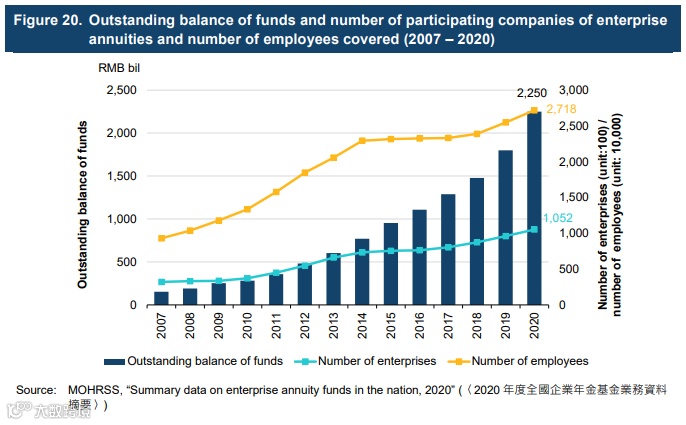
At the end of 2020, a total of about 105,200 enterprises have established enterprise annuities, with 27.17 million participating employees and achieving an outstanding fund balance of RMB2.25 trillion.
Occupational annuities cover more than 41 million people, with an outstanding balance of over RMB1.6 trillion, making it a key component of a sound multi-level pension fund system.
Starting from 30 December 2020, annuity funds have been allowed to invest in eligible stocks under Southbound Stock Connect.
The new policies provide annuity funds with a larger variety of investment channels and investable market scope, allowing more flexible and diversified asset allocation, supporting the development of the enterprise annuity fund management market.
As long-term funds with long holding periods of core assets and relatively less frequent trading, pension funds can reduce the likelihood of large fluctuations in the market.
The market-oriented investment management approach of pension funds can also diversify investment patterns in the market and improve the investment management mechanism of pension funds by increasing its flexibility, so as to prepare for future changes in the market environment.
Hong Kong as an overseas asset allocation centre for Mainland funds
At present, the available set of eligible sectors for investment through Southbound Stock Connect covers various sectors including technology, education, finance, real estate and biomedicine. Many Hong Kong-listed companies within these sectors are unique to Mainland investors.
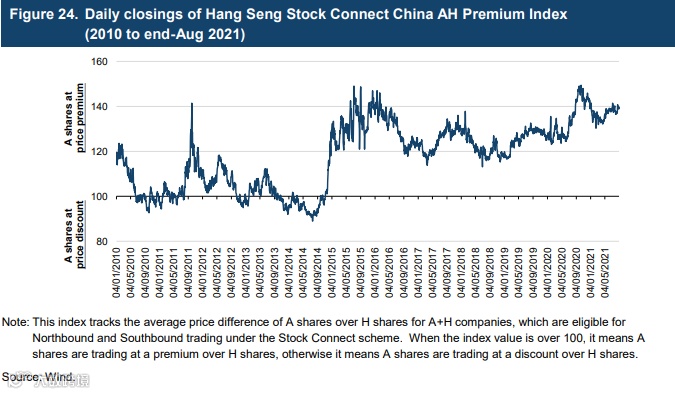
From the perspective of valuation, companies with both H-share and A-share listings trade at a discount in the H-share market compared with their A-share valuation. As such, Hong Kong stocks may provide a better margin of safety for pension funds and provide access to assets with the same quality at a lower cost.
At the end of 2021, the total value of Hong Kong stocks held by Mainland residents through Southbound Stock Connect was about HK$2.25 trillion, accounting for 5.21% of the total market capitalisation of Hong Kong stocks. Mainland insurance funds obtained permission from the China Insurance Regulatory Commission in 2016 to invest in eligible stocks under Southbound Stock Connect.
At the end of January 2021, the first batch of five Southbound Stock Connect pension products introduced by five managers of Mainland annuities were approved for issuance. In April 2021, several other similar pension products were approved.
As more experience is gained through the participation of enterprise/occupational annuity funds (the second pillar) in Southbound Stock Connect, the Mainland pension system may learn from the investment experience of overseas pension funds and consider including Southbound Stock Connect in the investment scope of basic pension funds (the first pillar) as well. Not only will this help achieve the multiple goals of marketisation, diversification, mitigation of systemic risks and ensuring asset security, but it can also make Mainland pension funds an influential institutional investor in the international capital markets.
Tap Read More to read the full report.

HKEX Pulse
Follow HKEX's official WeChat for more information

Connecting China
Connecting the world
Press the QR code to follow