
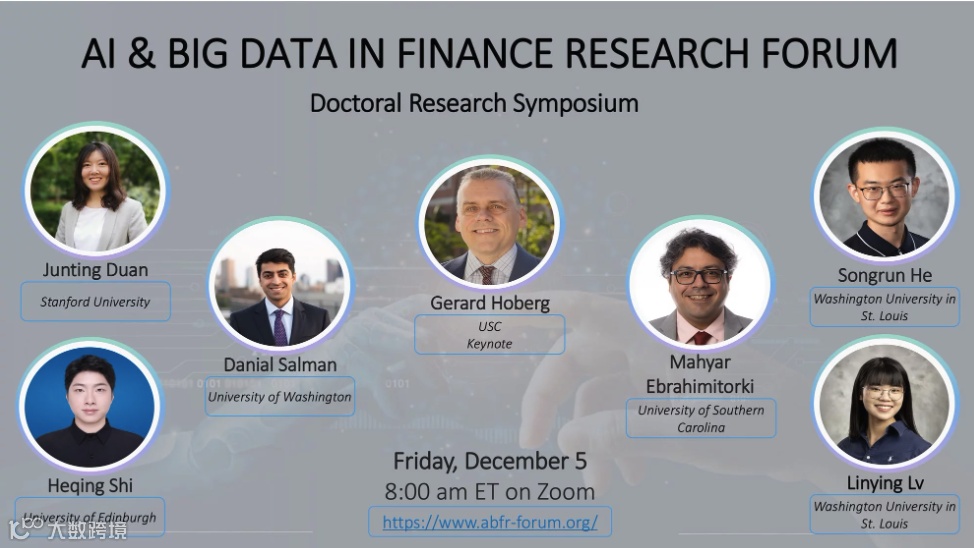
由AI & Big Data in Finance Research Forum(ABFR)主办的2025年博士研究研讨会将于2025年12月5日(美国东部时间8:00 AM – 2:00 PM)在线举行。
本次研讨会汇聚来自斯坦福大学、南加州大学、华盛顿大学、圣路易斯华盛顿大学等高校的博士求职候选人与青年学者,涵盖机器学习方法论、期权隐含风险度量、人工智能与劳动力市场影响,以及文本驱动的股票收益分析等前沿研究。本次研讨会也非常荣幸地邀请到南加州大学Gerard Hoberg教授发表主旨演讲。
https://groups.google.com/u/0/g/abfr-forum
论坛Zoom 会议链接:
https://cornell.zoom.us/j/99004280742?pwd=mLt10vU8QzQbs7xiMZs7J2lli0DxEN.1&jst=2会议号:990 0428 0742
密码:712238
主旨演讲嘉宾简介:Gerard Hoberg 教授
Hoberg教授为南加州大学马歇尔商学院Charles E. Cook讲席教授,并担任Institute for Outlier Research in Business主任,其研究涵盖企业金融、资产定价、创新、并购、IPO、信息环境与产业组织等主题。他以推动计算语言学在金融研究中的应用而闻名,论文发表于JPE、JF、RFS、JFE、JAR等顶级期刊,并担任JFQA与JFSR副主编。
研讨会议程(美国东部时间)
8:00 – 9:00 AM|金融机器学习方法论进展
主持人:Will Cong(康奈尔大学)
论文1
题目:基于插补的缺失协变量推断方法
报告人:Junting Duan(斯坦福大学)
摘要:本研究提出了一套适用于缺失协变量的估计与推断框架。方法包括:(1)在一般缺失机制下利用任意插补方法补全缺失值;(2)自动纠正插补偏误并根据质量自适应加权;(3)在使用全部观测与插补数据的基础上获得更精确的估计与有效区间推断。我们证明了估计量的渐近正态性,并在模拟中展示了偏差与方差均显著优于基准方法。将本方法应用于企业碳排放与股票收益关系的实证中,结果显示:直接排放与收益之间不存在显著关系,但价值链排放与收益呈负相关。
论文2
题目:面向期权隐含风险度量的经济学感知型机器学习方法
报告人:Heqing Shi(爱丁堡大学)
摘要:针对机器学习方法缺乏经济结构约束的问题,本研究提出了consGP(约束高斯过程)模型,使预测结果在最小化插值误差的同时满足经济理论中的线性约束。模型通过先从数据中学习,再利用动态规划将预测调整至符合理论结构。实际应用于期权隐含风险度量后发现,consGP能有效从稀疏、含噪期权数据中恢复风险中性密度,并显著优于传统结构模型。对S&P 500股票的实证表明本方法具有更高预测精度和经济意义。
9:00 – 10:00 AM|主旨演讲
主讲人:Gerard Hoberg(南加州大学),Léa H. Stern(华盛顿大学)
10:30 – 11:30 AM|人工智能与劳动力市场
主持人:Pietro Bini(波士顿大学)
论文3
题目:道路的尽头?自动驾驶与岗位替代风险
报告人:Danial Salman(华盛顿大学)
摘要:本文将劳动者的岗位替代预期与其对自动驾驶技术(AV)的直接和社会接触关联起来。结果显示:在AV暴露度高的地区,商业驾驶资格与卡车驾驶就业下降更为显著。仍留任的司机工作时间增加且减少按揭市场参与。家庭在酒精与烟草方面的消费变化显示焦虑上升。研究提示:感知到的自动化风险会影响劳动供给、信贷行为与健康状况。
论文4
题目:人工智能与人类判断在金融信贷中的互补性还是替代性?
报告人:Mahyar Ebrahimitorki(南加州大学)
摘要:本研究考察 AI 在信贷决策中是否替代或补充人类判断。通过工具变量(IV)与双重差分(DiD)方法比较“人类 + AI”与“算法 + AI”策略,研究发现“人类 + AI”可显著降低坏账率,尤其在经济低迷或信息不对称较高的情境中。更高的贷款筛查强度是改善结果的关键机制。然而,固定节奏的贷款上架制度可能削弱人类判断因竞争压力加大的效力。
1:00 – 2:00 PM|基于文本的股票收益分析
主持人:Maryam Farboodi(麻省理工学院)
论文5
题目:可解释化的全天候系统性风险
报告人:Songrun He(圣路易斯华盛顿大学)
摘要:本文利用高频市场数据与由开源推理大模型(LLM)识别的新闻叙事,构建全天候系统性跳跃风险的首个可解释化分析框架。不同叙事类别的风险溢价高度异质,其中宏观经济类最为显著。基于该发现构建的实时对冲策略可获得高Sharpe值与显著α,是全天候风险管理的重要工具。
论文6
题目:卖方分析师信息的价值
报告人:Linying Lv(圣路易斯华盛顿大学)
摘要:本文基于大模型词向量分析卖方分析师报告,发现其中定性信息可解释超10%的同期股票收益变动,显著高于传统财务预测。Shapley分解结果显示:利润表分析贡献超过一半。研究进一步表明:越早获得分析师报告,潜在交易价值越高,尤其在财报发布后一周内。
The AI & Big Data in Finance Research Forum (ABFR) is pleased to invite you to the 2025 Annual Doctoral Research Symposium, which will be held online on December 5, from 8:00 AM to 2:00 PM ET (5:00 – 11:00 AM PT).
This year’s symposium features emerging scholars presenting frontier research in machine learning methodology, option-implied risk metrics, AI-driven labor market dynamics, and text-based financial analysis. The event will also host a keynote address by Professor Gerard Hoberg of the University of Southern California.
Mailing list:
https://groups.google.com/u/0/g/abfr-forumZoom link:
https://cornell.zoom.us/j/99004280742?pwd=mLt10vU8QzQbs7xiMZs7J2lli0DxEN.1&jst=2Meeting ID: 990 0428 0742|Passcode: 712238
Biography of Keynote Speaker: Gerard Hoberg
Professor Hoberg is the Charles E. Cook Community Bank Professor of Finance and Director of the Institute for Outlier Research in Business at USC Marshall. His work spans empirical corporate finance, asset pricing, innovation, IPOs, disclosure, and industrial organization, with influential contributions introducing computational linguistics into finance. His research appears in JPE, JF, RFS, JFE, JAR, among others.
Schedule (ET)
8:00 – 9:00 AM — Methodological Advancements in ML for Finance
Chair: Will Cong (Cornell University)
Paper 1
Title: Imputation-Powered Inference for Missing Covariates
Presenter: Junting Duan (Stanford University)
Abstract: Missing covariate data is a prevalent problem in empirical research. We propose a flexible and theoretically grounded framework for handling missing covariates in both estimation and inference across downstream tasks. The approach consists of three steps: (1) missing values are imputed using virtually any imputation method under general observation patterns; (2) imputation bias is automatically corrected and imputed values are adaptively weighted based on their quality; (3) all observed and imputed data are jointly incorporated to produce more precise point estimates with valid confidence intervals. We establish the asymptotic normality of the estimator for a broad class of missing-data patterns and imputation schemes. Simulations show substantial reductions in both bias and variance relative to natural benchmarks. Applying the method to equity-market dependence on carbon emissions, we find no relationship between stock returns and direct emissions, but a negative correlation with value-chain emissions.
Paper 2
Title: Economics-Aware Machine Learning for Option-Implied Risk Metrics
Presenter: Heqing Shi (University of Edinburgh)
Abstract: Machine learning models in finance are often highly data-driven and lack embedded economic structure, limiting their applicability where theoretical constraints are essential. We introduce the constrained Gaussian Process model (consGP), which minimizes interpolation error while satisfying linear inequalities encoding key economic constraints. The model first learns from observed financial data and then adjusts predictions through dynamic programming to ensure alignment with theory. Applied to recover option-implied risk-neutral densities (RNDs), consGP demonstrates superior performance—particularly with sparse or noisy option datasets, such as illiquid stock options. Empirical results across S&P 500 equities show that consGP outperforms traditional structural models in both prediction accuracy and economic interpretability, underscoring the value of integrating machine learning with domain-specific constraints.
9:00 – 10:00 AM — Keynote Address
Speaker: Gerard Hoberg (University of Southern California)
Chair: Léa H. Stern (University of Washington)
10:30 – 11:30 AM — AI and the Labor Market
Chair: Pietro Bini (Boston University)
Paper 3
Title: End of the Road? Autonomous Vehicles and Displacement Risk
Presenter: Danial Salman (University of Washington)
Abstract: New technologies such as autonomous vehicles (AVs) have raised concerns about job displacement. This paper links workers’ perceived displacement expectations to their direct and social exposure to AV technologies. Commercial driving licenses and trucking employment fall disproportionately in AV-exposed areas. Remaining drivers expand work hours and exhibit lower mortgage-market participation relative to neighboring less-exposed counties. Spending patterns on alcohol and tobacco indicate heightened anxiety induced by automation risk. The findings show that perceived displacement risk meaningfully affects labor supply, credit behavior, and health, with implications for welfare and policy.
Paper 4
Title: Human-AI Synergy in Marketplace Lending: Complementary Strength or Redundancy?
Presenter: Mahyar Ebrahimitorki (University of Southern California)
Abstract: As AI becomes increasingly central to financial decision-making, an important question arises: does AI complement or substitute human judgment? Using instrumental variables and difference-in-differences strategies, this study compares two FinTech lending paradigms: Human+AI and Algorithm+AI. Results show that pairing human judgment with AI significantly reduces loan charge-offs, especially during economic downturns or in high-information-asymmetry contexts. Enhanced loan-screening intensity emerges as a key mechanism. However, platform-imposed fixed-interval loan listing reduces human performance due to heightened competition and time constraints. The findings reveal when and why human judgment remains uniquely valuable in hybrid AI decision-making systems.
1:00 – 2:00 PM — Text Processing for Stock Return Analysis
Chair: Maryam Farboodi (MIT)
Paper 5
Title: Interpretable Systematic Risk around the Clock
Presenter: Songrun He (Washington University in St. Louis)
Abstract: This study provides the first comprehensive around-the-clock decomposition of systematic jump risk by integrating high-frequency market data with contemporaneous news narratives identified by an advanced open-source reasoning LLM. Categorizing market jumps into interpretable narrative classes reveals substantial heterogeneity in risk premia, with macroeconomic-news-induced jumps carrying the highest and most persistent premium. A real-time annually rebalanced strategy hedging the most priced jump category delivers a high out-of-sample Sharpe ratio and significant alphas relative to standard factor models. Results highlight the value of combining 24/7 market analysis with LLM-based narrative understanding for real-time risk management.
Paper 6
Title: The Value of Information from Sell-side Analysts
Presenter: Linying Lv (Washington University in St. Louis)
Abstract: Using state-of-the-art large language model embeddings, this paper demonstrates that qualitative information in analysts’ written reports explains over 10% of contemporaneous stock returns out-of-sample—an economically significant effect exceeding that of traditional numerical forecasts. A Shapley value decomposition shows that analysts’ income statement discussions account for more than half of this explanatory power. Expressed in economic terms, obtaining analyst reports earlier yields substantial potential trading value. Information value peaks in the week following earnings announcements, underscoring analysts’ vital role in interpreting new financial data.