

On January 26, Wang Wentao, Chinese Minister of Commerce, and Damien O'Connor, Minister of Trade and Export Growth of New Zealand, signed the Protocol for Upgrading the New Zealand-China FTA between the Government of PRC and the New Zealand Government on behalf of their governments via video respectively.
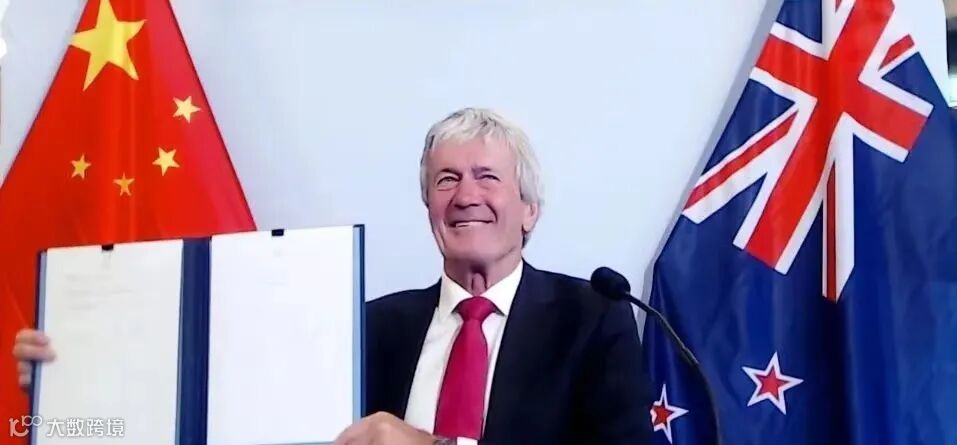
(Photo Source: the official Weibo account of Chinese Ministry of Commerce)
The Upgraded FTP Protocol will further deepen practical cooperation in various areas to boost the interests and welfare of enterprises and the people in both countries, and continuously enrich the contents of comprehensive strategic partnership between China and New Zealand. The Upgraded FTA Protocol signed at the critical time of the global combat against the pandemic is also a positive signal to the international society as it shows the willingness of the two countries to make joint efforts in the face of COVID-19 and their support for multilateralism and free trade.
The Upgraded FTA Protocol further refines and improves the quality and effects of the free trade partnership between China and New Zealand established based on the Regional Comprehensive Economic Partnership (RCEP). In the field of trade in services, China will, on the basis of the RCEP, further expand its opening-up in sectors including aviation, education, finance, elderly care, and passenger transport to New Zealand. In terms of the work permit for special occupations, New Zealand doubles its employment quota for two popular occupations for Chinese citizen applicants - Chinese teacher and Chinese tour guide to 300 and 200, respectively.
As for the investment, New Zealand will lower its threshold for reviewing Chinese investment, allowing it to receive the same review treatment as members of the Comprehensive and Progressive Agreement for Trans-Pacific Partnership (CPTPP). With regard to the rules, both sides promise to strengthen their cooperation in fields including e-commerce, competition policies, government procurement, environment and trade, among which the environment and trade related cooperation, with the terms to improve environment protection, reinforce environment-related enforcement, and implement multilateral environment treaties, outperforms RCEP in the cooperation level.
Facing the adverse unilateralism and protectionism, China is determined to expand its opening-up and speed up the construction of a new development landscape to propel high-quality development, furnish all the countries with more opportunities and contribute to the revival of the global economy. As one of the three major opening-up platforms for conventions and exhibitions, 2020 China International Fair for Trade in Services ("CIFTIS") was held during September 4-9 in Beijing with the theme "Global Services, Shared Prosperity".

As Gao Yan, Chairman and Secretary of Party Committee of the China Council for the Promotion of International Trade, pointed out at the Summit Forum on Trade Facilitation in Services: Perspective of the Multinationals held during the event period, in the long run, international economic connectivity and exchanges are still an objective requirement for the world's economy development as the intrinsic logic of international division of labor and market rules remain the same and the long-term prospect of trade in services is still promising. Therefore, the promotion of the convenience, revival and development of trade in services is of great importance.
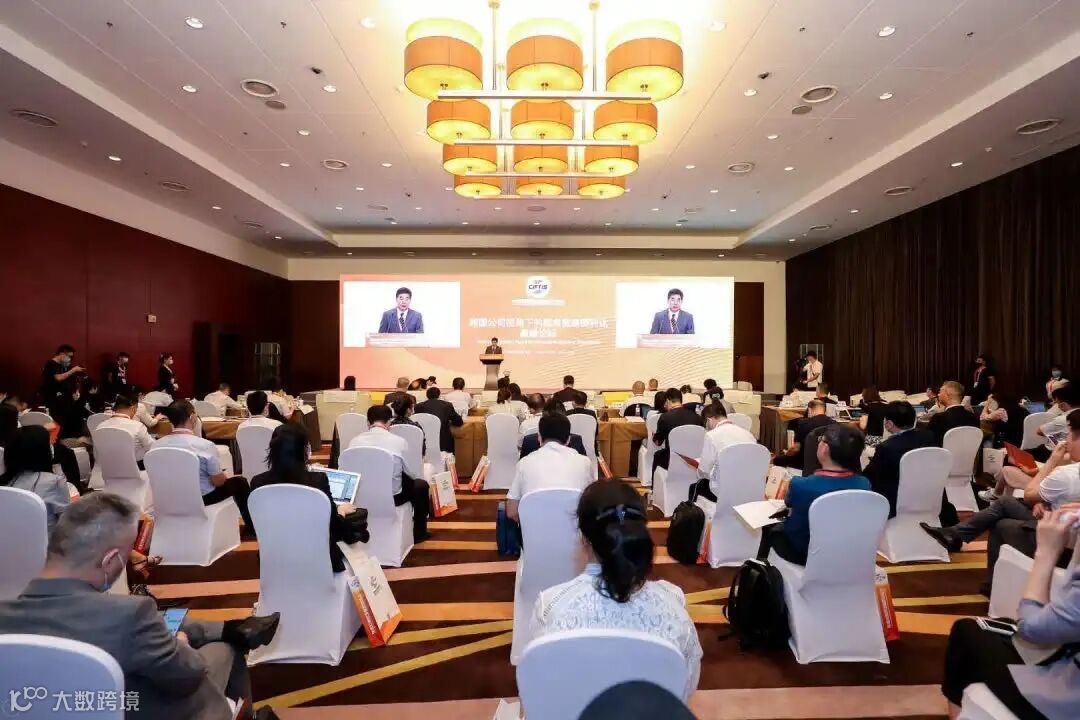
(Photo Source: Development Research Center of the State Council)
Gao Yan said, we should promote the trade facilitation in services through opening-up and cooperation. Upholding multilateralism, we encourage all the countries to work more in information exchange and policy coordination, and cancel or relax the restrictions on trade in services to support the cross-border flow of key elements such as capital, technology, personnel and goods, in order to create an environment that encourages the development of trade in services towards a free and convenient direction.
We should find a new engine to fuel the trade in services through innovative development. We should take targeted measures in the construction of information infrastructure and other aspects to keep in line with the trend of digital economy development in the new context. We should support the building of cross-border financial infrastructure and innovation in products and services through making full use of new technologies such as big data, blockchain and artificial intelligence. Besides, we encourage the development of new business modes such as digital service, copyright service, medicine R&D and smart tourism.
We should deepen the international cooperation in trade in services based on reciprocity, fully combine the comparative advantages of the countries and effectively arrange the global resources of trade in services to urge industrial cooperation between multinationals for keeping the industry and supply chain stable and smooth. We should also deepen the cooperation in trade in services among the members of the Belt and Road Initiative to bolster their joint efforts in technology R&D, tourism and sports, etc.