


The Ministry of Ecology and Environment (MEE) recently unveiled The Implementation Plan for Fully Adopting the Pollutant Discharge Permit System (the Implementation Plan), aiming to promote the full implementation of this system. The Implementation Plan prioritizes ecological and environmental quality improvement, with a strong emphasis on controlling pollutant emissions. It seeks to further improve the alignment between stationary pollution sources and the environmental management system in both depth and scope. Moreover, it proposes pathways for integrating environmental impact assessments, total pollutant control, self-monitoring, ecological and environmental law enforcement, ecological and environmental statistics, and environmental protection tax with the pollutant discharge permit system, thereby ensuring the effective implementation of the stationary pollution source monitoring system.

Photo Credit: Fangchenggang Municipal Bureau of Justice
The Implementation Plan clearly outlines a path for deepening the reform of the pollutant discharge permit system. On the premise of comprehensive permit management, it specifically suggests the inclusion of industrial noise, industrial solid waste, and marine engineering into the scope of pollutant discharge permit management by improving the system of laws and regulations and the pollutant discharge permit management system. Furthermore, it seeks to explore ways to legally incorporate groundwater pollution prevention requirements, electromagnetic radiation, and ammonia emissions from livestock and poultry farming into the pollutant discharge permit management system, ultimately achieving coordinated control of multiple pollutants from stationary pollution sources and ensuring full coverage of pollutant discharging entities, environmental management factors, and emission control.
The 2024 China International Fair for Trade in Services (CIFTIS) took place at both the China National Convention Center and the Shougang Park from September 12 to 16. This year's CIFTIS featured a Thematic Exhibition on Environmental Services with the theme "Carbon Peaking and Carbon Neutrality, Motivation from Vibrant Innovation". Focusing on carbon peaking and carbon neutrality, the thematic exhibition fully showcased the remarkable achievements of environmental services in energy conservation and carbon reduction, as well as the positive outcomes in the innovation-driven green and low-carbon transformation of economic and industrial structures and energy mix.
At the Third Academician Forum on Ecological and Environmental Protection Industry Serving the "Carbon Peak and Carbon Neutrality" Strategy held during the fair, a number of academicians shared the latest research findings and insights related to carbon peaking and carbon neutrality, including new pollutant control, self-purifying city development, green and low-carbon transformation of petrochemical industry, and environmentally-friendly negative emissions.
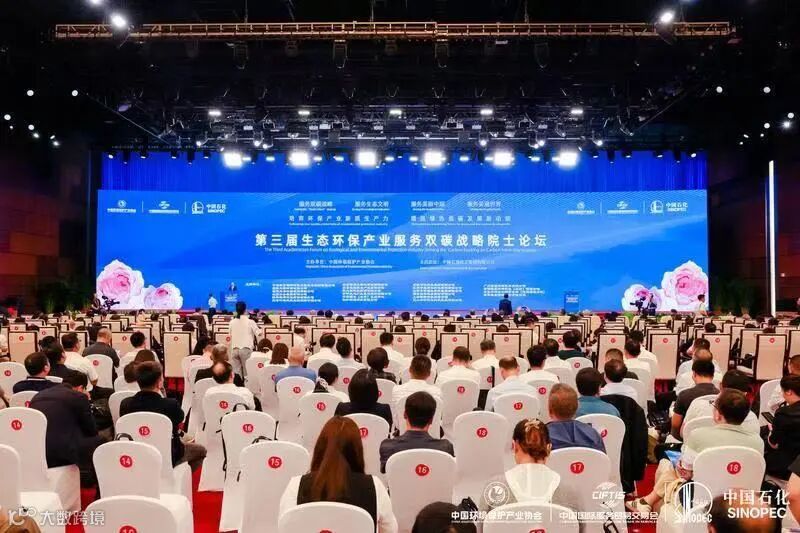
Photo Credit: cfgw.net.cn
At the forum, Wu Fengchang, academician of the Chinese Academy of Engineering, delivered a report titled Major Technological Demands for Controlling New Pollutants in China. He gave detailed accounts of the current demand and situation, research status and technological challenges, overall objectives and technical approaches, key research tasks, and notable achievements in the control of new pollutants in China. He also made an in-depth analysis of the economic and social benefits associated with the control of new pollutants.
He Hong, academician of the Chinese Academy of Engineering, presented a report titled New Quality Productive Forces Boosting the Development of Self-purifying Cities. He underscored the necessity for cities to employ new quality productive forces in supporting the development of self-purifying urban areas while concurrently reducing carbon emissions. This approach involves leveraging the self-purification mechanism of nature in conjunction with advanced artificial technologies to establish cities capable of self-purification across various environmental mediums - be it air, water, or soil - ultimately resulting in low-carbon and even zero-carbon urban environments.
Jiao Nianzhi, academician of the Chinese Academy of Sciences, delivered a report titled Introducing New Pathways for Environmentally-friendly Negative Emissions to Create a Model of New Quality Productive Forces. The report provided a comprehensive overview of the Ocean Negative Carbon Emissions (ONCE) program, supporting the carbon neutrality goals of nations, and presented practical cases in line with the global consensus on climate change.
● China International Fair for Trade in Services (CIFTIS) is co-hosted by the Ministry of Commerce of the People’s Republic of China and the People’s Government of Beijing Municipality.
● CIFTIS is the largest comprehensive fair in the field of global trade in services, serving as an exhibition window, communication platform and cooperation bridge for the service industry and trade in services.

Scan the QR code to follow the subscription account of CIFTIS.

Scan the QR code to follow the service account of CIFTIS.