



(Photo Source: World Intellectual Property Organization)
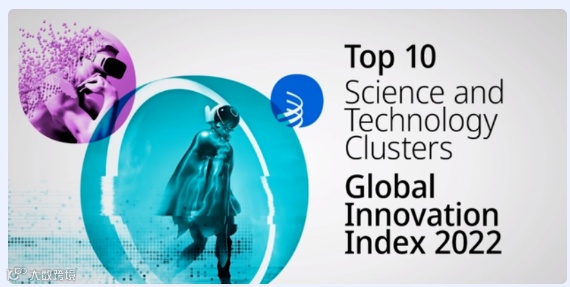
According to the Global Innovation Index 2022 (the Report for short below) recently released by the World Intellectual Property Organization (WIPO), China moved up one place to 11th, having climbed the ranks for the 10th straight year and topping 36 middle-income economies.
From the perspective of innovation input and output, the Report measures and ranks the innovation ecosystems of 132 countries, based on 81 indicators within seven categories, namely, policy environment, HR capital and research, infrastructure, market maturity, knowledge and technology output, and creative output. China ranked first worldwide in nine indicators this year.

Moreover, China has two seats to itself of the world's five biggest science and technology clusters, according to the Report. Tokyo-Yokohama remains the top-performing cluster, while Shenzhen-Hong Kong-Guangzhou and Beijing took the second and third places, followed by Seoul at No. 4 and San Jose-San Francisco at No. 5.
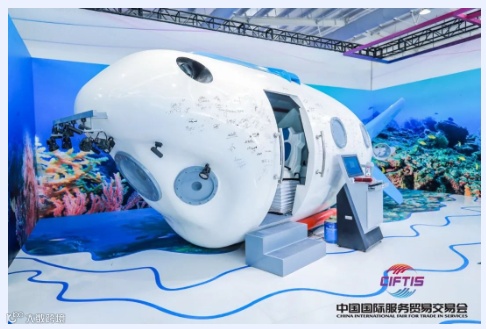
At the 2022 China International Fair for Trade in Services (CIFTIS), major achievements in relevant sectors were exhibited, including the homegrown giant aircraft C919, the self-developed nuclear power technology "CAP1400", and the sand table model of a fully automated terminal at Nansha Port; over 100 new products, technologies and achievements from more than 60 enterprises and institutions in the sectors of AI and fintech made their debut, outnumbering those in the last session.

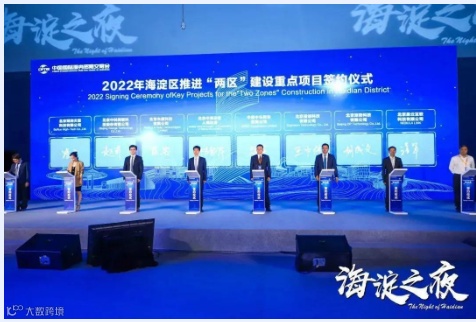
During this year's CIFTIS, a promotional event called "Night of Haidian" was held to show how digital economy and cutting-edge industries develop in Beijing's Haidian District.
One year into the building of the "Two Zones", 66 (or 78.5%) of 84 key tasks have been underway in Haidian District, 67 major project agreements have been signed in seven batches in the district, and Chinese high-tech enterprises and international companies have entered Haidian, including Graphcore, Hongmian XiaoIce, Apolo Intelligent Technology, and United Imaging. Moreover, as Haidian advances the building of offshore innovation and entrepreneurship centers, an ANSO Collaborative Innovation Center for International Cities has been established, and a flagship lab of Nest.Bio Labs has gone into operation; meanwhile, a lot of innovation and entrepreneurship platforms such as MiraclePlus, the International Hydrogen Energy Center and the Medical Robotics Industry Innovation Center have formed a scientific and technological innovation matrix. It is worth noting that the core industries of digital economy contribute more than 50% of Haidian's economic growth. The number of AI enterprises in the district reaches nearly 800, accounting for 20% of the total in China. The district also sees the completion of 3,160 5G base stations and the steady advancement of 18 digital projects.
Haidian District has ranked top for the third consecutive year in the comprehensive evaluation of the business environment across Beijing. At present, professionals in the district amount to 1.9 million or 25% of the total in the city, the most among all districts. Since the building of the "Two Zones" started, 1,206 enterprises have been registered in Haidian, bringing the total number to over 30,000. This shows that Haidian has become a strong magnet for professionals and foreign investors.
\ | /
● 中国国际服务贸易交易会由中华人民共和国商务部和北京市人民政府共同主办。
●中国国际服务贸易交易会是全球首个国家级、国际性、综合型服务贸易交易会,是服务业、服务贸易的展示窗口、交流平台、合作桥梁。
● China International Fair for Trade in Services (CIFTIS) is co-hosted by the Ministry of Commerce of the People’s Republic of China and the People’s Government of Beijing Municipality.
● CIFTIS is the first state-level global comprehensive fair for trade in services, serving as an exhibition window, communication platform and cooperation bridge for the service industry and trade in services.

Scan the QR code to follow the subscription account of CIFTIS.
Scan the QR code to follow the service account of CIFTIS.